Waltham Wood Flooring has been sanding, repairing and installing wood flooring in Burlington for more than twenty years. We are a hardwood floor company and nothing else, which means refinishing, board replacement, stairs and new installation, and most of what we touch in this town has been underfoot for decades. This page is about what that work costs a household to plan for, and how to plan it when the whole house is not in this year’s budget.
Most of the calls we take from town are not emergencies. They are a finish gone dull in the traffic lanes, a room where the carpet came up and there is wood underneath, or water staining near a door or an appliance. Those are decisions about money as much as about wood, and they get easier once the sequence is laid out in front of you.
So the rest of this page reads the way we would talk it through at your kitchen table. Who is paying, what can be staged, what a floor of a certain age usually needs before anything else, and when sanding the boards you already have is the better spend than replacing them.
Who pays for a wood floor in Burlington
In Burlington the answer is short: the owner does. That is not a complaint about the town, it is a matter of public record, and it changes how we quote and how we sequence the work here.
Roughly three quarters of the occupied homes in town are owner-occupied, 7,402 of 9,974. For most of Burlington, in other words, a floor is a household decision, made once and paid for out of savings or a private loan, and the estimate has to be something a household can actually plan around.
The 2022 vote on a town preservation fund
In 2022, Question 5 asked whether the Town of Burlington should accept sections 3 to 7 of Chapter 44B of the General Laws, which is the Community Preservation Act. Voters turned it down, 4,196 yes to 6,354 no, with 295 blanks out of 10,845 votes cast.
The proposal on the table was a 1.5 percent surcharge that would have exempted the first $100,000 of residential value and the first $100,000 of commercial value, along with low income and low and moderate income senior homeowners. Supporters forecast it would raise about $1.7 million a year for affordable housing, historic preservation and recreation. Because it was defeated, Burlington has no Community Preservation Fund behind any of those three things.
No town repair loan, and we checked the neighbors
Reading the Town of Burlington’s own housing pages, we found no municipal home repair or rehabilitation loan for owner-occupants. We ran the same search on the same day for five nearby cities and found one in each: Woburn, Medford, Malden, Everett and Cambridge each publish a rehabilitation program on their own municipal pages. The comparison is the point, because it tells you the absence is a finding about what Burlington publishes rather than a search that came up short.
What the Town does list is real and worth knowing, even though none of it pays for a floor. The Housing Information page names the Burlington Housing Authority, the Burlington Housing Partnership Committee, Grandview Commons, the Fourth Avenue Affordable Apartments, and the Rebuilding Together Safe at Home program among its aging-in-place resources. The Housing Partnership Committee’s stated job is to consider the housing needs in Burlington with particular attention to housing that is affordable to residents of all income levels and abilities. We would rather you hear where that line falls before the estimate than after it.
Looking for wood-flooring closer to Woburn? See Wood-Flooring in Woburn.
Planning a floor in stages instead of all at once
Not every floor job has to happen in one season. When the budget does not reach the whole house, we would rather write an estimate that names plainly what is being deferred than quietly shave quality off everything at once.
What a staged plan actually looks like
Staging works when each stage is a finished piece of work in its own right, sanded, coated and cured, rather than a half measure you pay to redo later. We write those stages as separate line items with their own scope, so you can commit to one now and hold the rest without reopening the whole job.
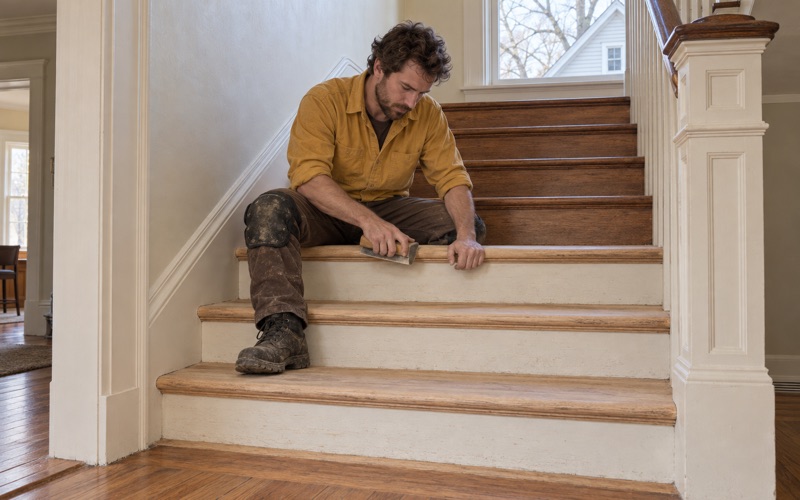
Stairs are the clearest example, and we quote them tread by tread, because a staircase is not measured the way a room is. Treads, risers and nosings each carry their own labor, and holding the staircase for a later stage does not change what the rooms around it cost.
What we would not put off
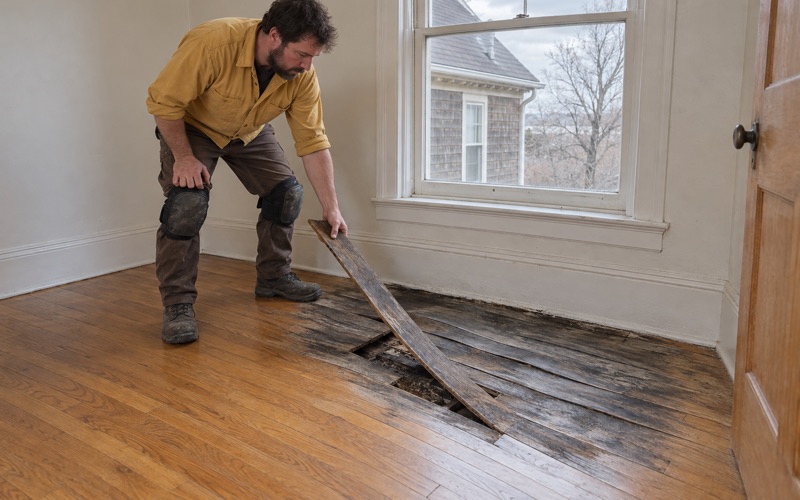
Some things are genuinely cheaper now than later, and we say so out loud. An active moisture source, whether that is a slow supply line, an appliance that has overflowed more than once, or a lower level that reads wet on a moisture meter, keeps working on the boards while you wait. Cupping that would have sanded out this year can become boards that have to come out next year.
The same is true of a finish worn through to bare wood in the traffic lanes. A screen and recoat is a much smaller job than a full sand, and once the wear goes past the finish into the wood itself, that cheaper option is simply gone.
What a floor laid before 1980 usually needs first
Of Burlington’s 10,371 housing units, 62.2 percent were built before 1980. That figure sets our expectations before we walk in the door, because most of the floors we look at here have been sanded at least once already and some have spent decades under carpet.
Reading the floor before we quote it
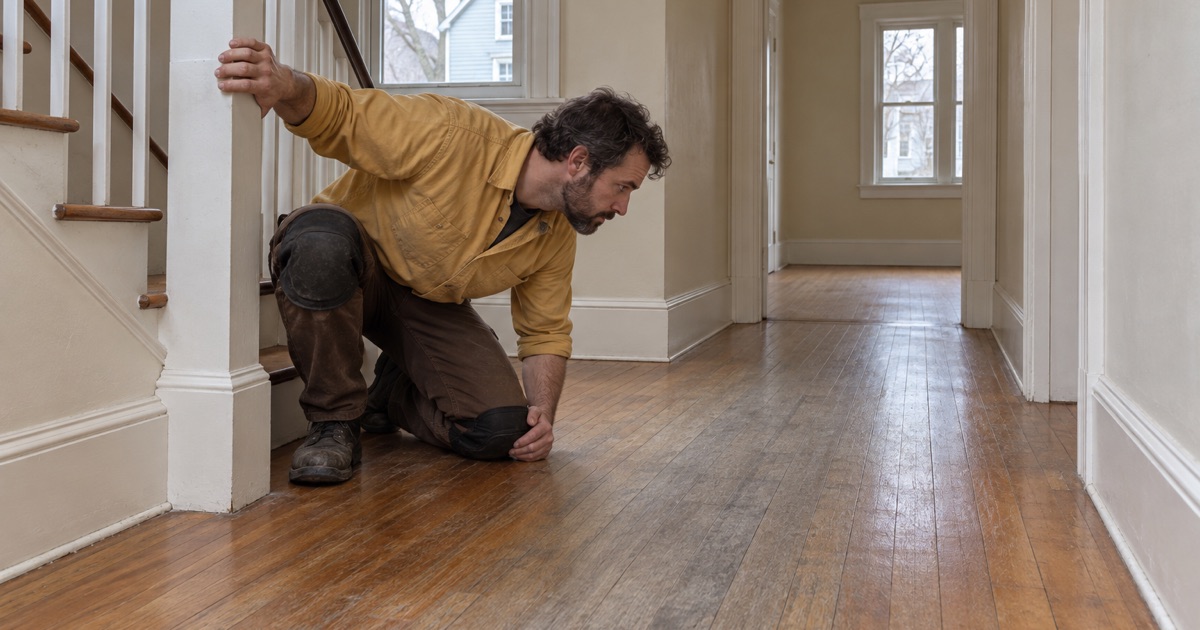
The first thing we measure is how much wood is left above the tongue and groove. A postwar oak strip floor that has already been through two sandings may have one good pass left in it, and that is a measurement we take rather than a guess we make.
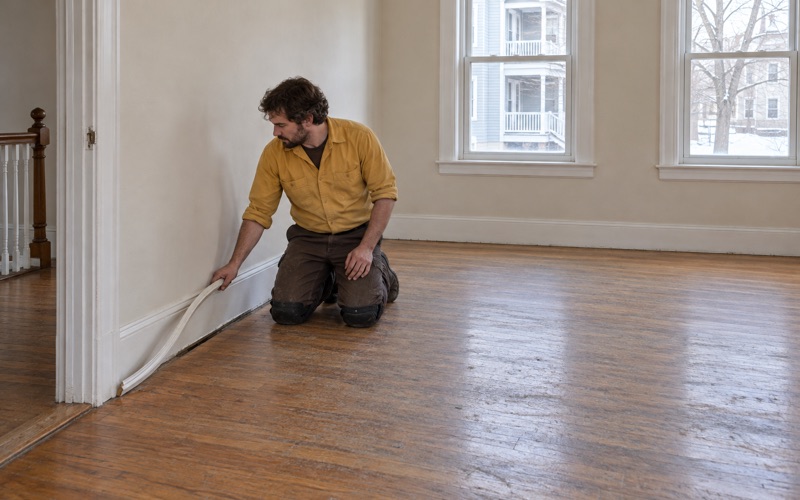
Then we look for the conditions that change the job rather than just the price of it: winter gaps that close up again by June, cupping or crowning across the boards, rug shadow and sun fade, pet urine stains that have gone through the finish into the wood, and the exit holes and frass that point to powderpost beetle or old house borer. Some of that we can read from the doorway. A few of them need the carpet up first, which is why we prefer to look before we put numbers on paper.
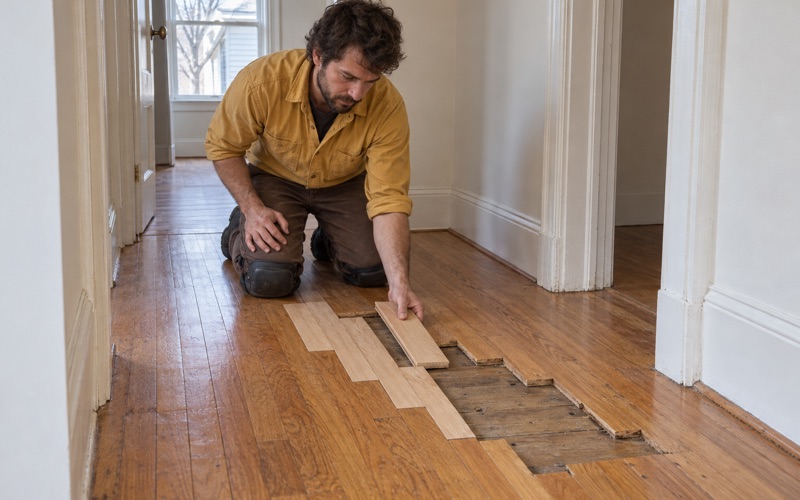
Holes left where steam radiators and their pipes came out are common on floors of this age. We patch them with matching boards woven into the floor rather than filling them, because filler in a radiator hole reads as a repair from across the room for as long as the floor lasts.
Paint, tile and the things we stop for
We check the build year and any painted surfaces before a sander is switched on, because Massachusetts runs its own lead-safe renovation rules for homes built before 1978. In a town where most of the housing stock predates 1980, that check is routine rather than exceptional, and it belongs in the schedule from the start.
Old resilient floor tile and the black mastic under it get identified, not disturbed. When we find it, sanding stops and the work waits for the right trade to handle it. That is a pause we would much rather build into a plan than discover in the middle of one.
Old wax and old finish
A shellac finish, or years of wax and cleaning-product residue, will keep a new coat from bonding to the wood. We test for it and remove it before anything goes down, using a grit sequence that takes the floor back to clean wood rather than skating over the residue.
This is the least visible part of the work and the most expensive to skip. A finish that peels six months after it was laid costs the whole job a second time.
Refinishing versus replacing, priced honestly
This is the comparison most Burlington calls come down to, and it is where an honest answer saves the most money. Refinishing is almost always the lighter spend, but only when the floor underneath actually supports it.
When sanding the floor you have is the right spend
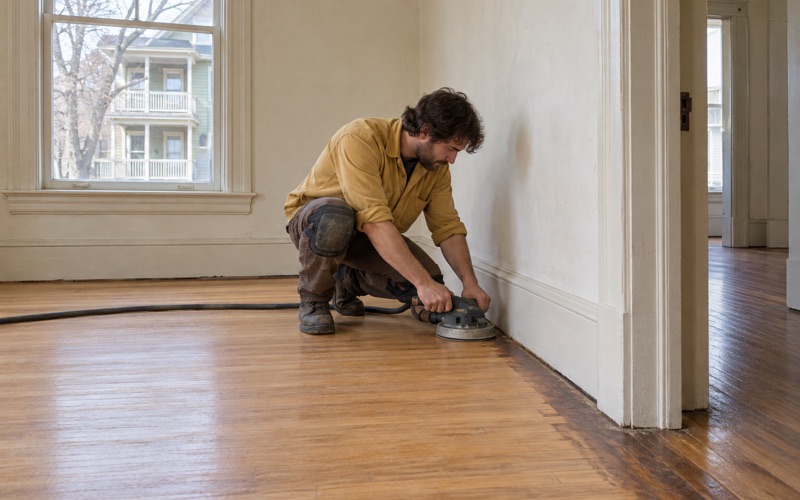
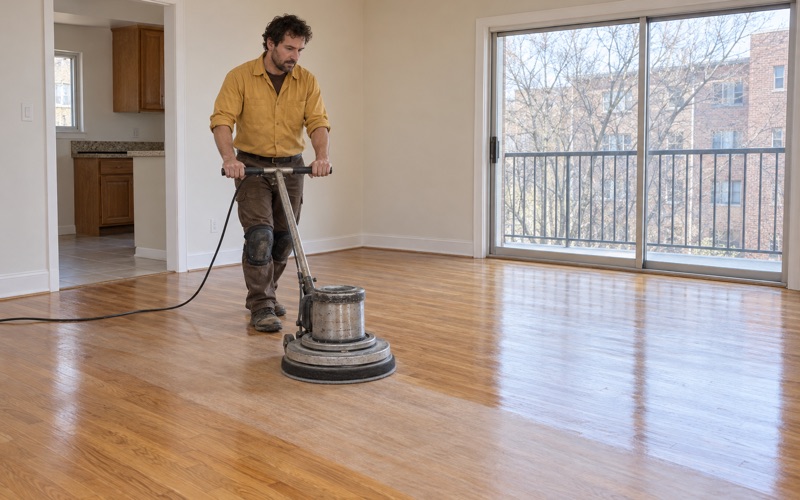
If the boards are sound, thick enough and mostly original, we sand and refinish rather than tear out. That holds for postwar oak strip floors even when they look past saving, because orange oak darkened under an old finish, deep traffic lanes and water stains around a door are mostly finish rather than wood. Dustless sanding with a HEPA vacuum keeps that work liveable in an occupied house.
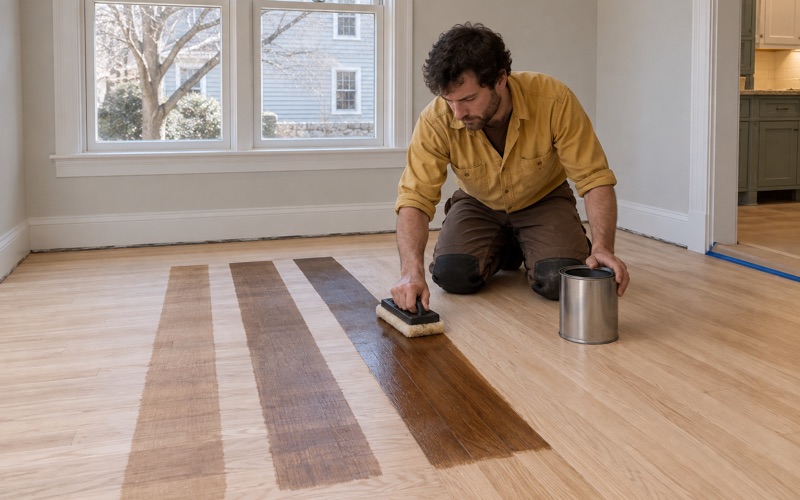
We lay stain samples on your own floor, in your own light, before a color is chosen, since oak takes stain differently from board to board and a sample card will not show you that. Sheen level gets settled the same way. Waterborne polyurethane, oil-modified polyurethane and hardwax oil each wear and look different, and we choose among finishes that fit the Massachusetts limits for wood coatings, which are stricter than the federal ones.
When replacement is the honest answer
Sometimes the wood is simply spent. Boards sanded past their useful thickness, buckling across a room, or a floor that has taken standing water more than once are replacements, and saying so at the estimate is cheaper for you than a sand that fails.
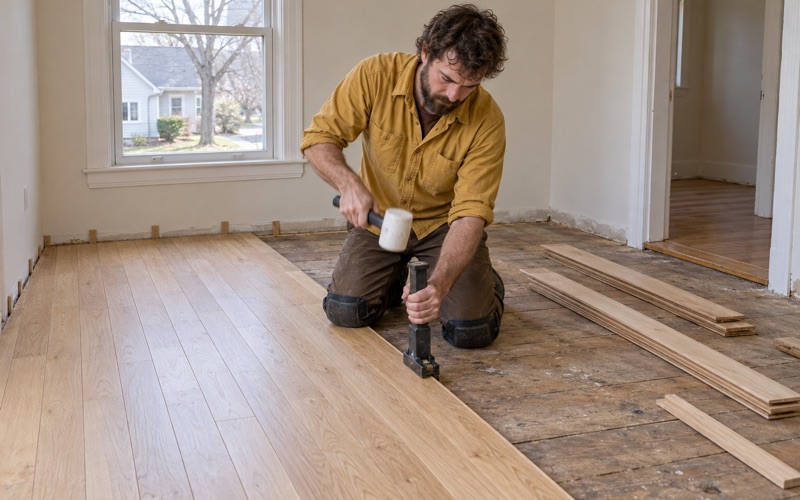
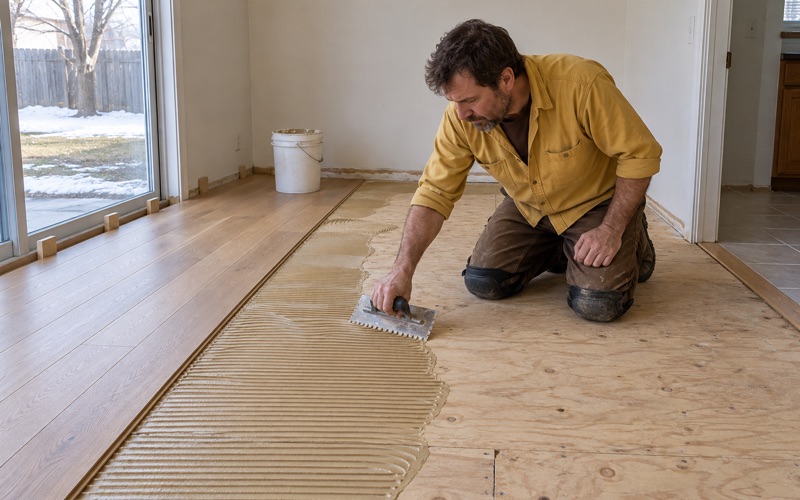
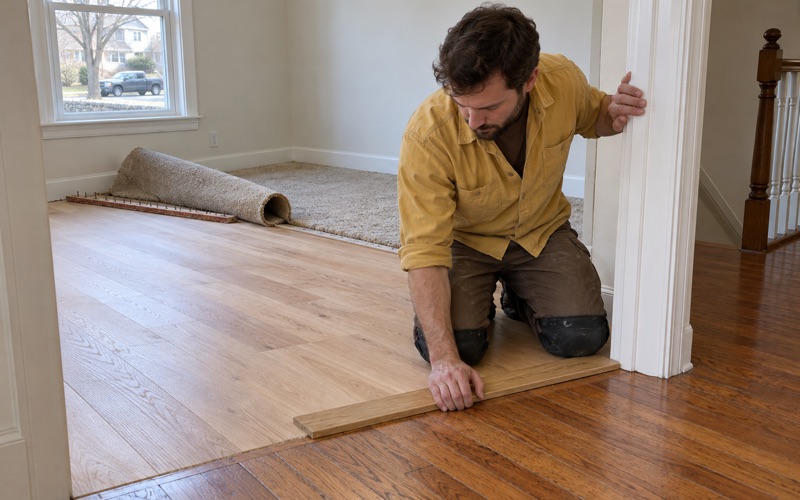
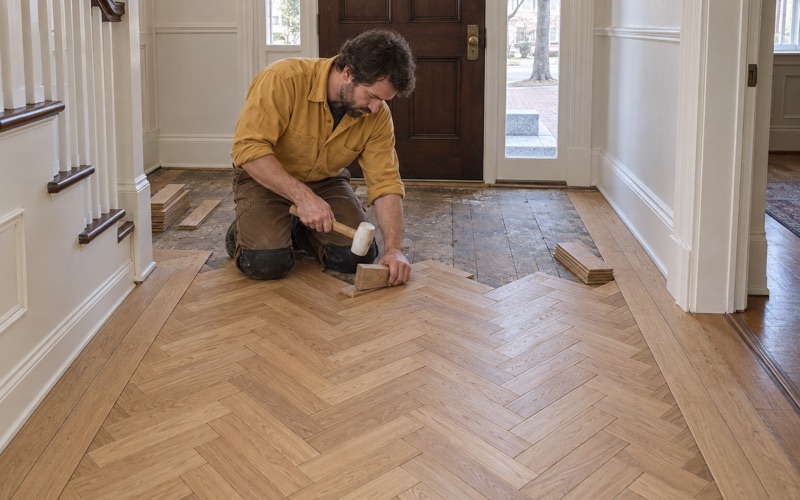
Where only part of a floor is gone, because a wall came down, an outlet was moved or a section went soft under an appliance, we weave in board replacement so the repair reads as floor rather than as a scar. On a lower level we match the material to the moisture we actually measure there, which usually means engineered wood with a real wear layer rather than solid hardwood.
Floors in a Burlington home with a deed restriction
If your home carries a deed restriction, there is one question to settle before you spend anything, and it is how the work is treated at resale. Burlington’s affordable units are monitored through the Regional Housing Services Office, the shared office the town joined in 2011 with Acton, Bedford, Concord, Lexington, Sudbury and Weston, which handles monitoring, lotteries and resales for its member towns.
The state’s definition of a capital improvement turns on necessary maintenance that, left undone, would compromise the structural integrity of the property, with a new roof, exterior painting due to deterioration and repair of structural deficiencies given as the examples. Whether a floor refinish or a floor replacement is treated that way under your particular rider is not something we can tell you, and we will not guess at it.
What we can tell you is that the process runs in advance rather than at the closing table, so the time to ask your monitoring agent in writing is before the work starts, not after. Send them the question, and we will write the estimate in whatever detail they ask for.
- 20+ Years On Wood Floors
- Written Itemized Estimates
- Stain Samples On Your Own Floor