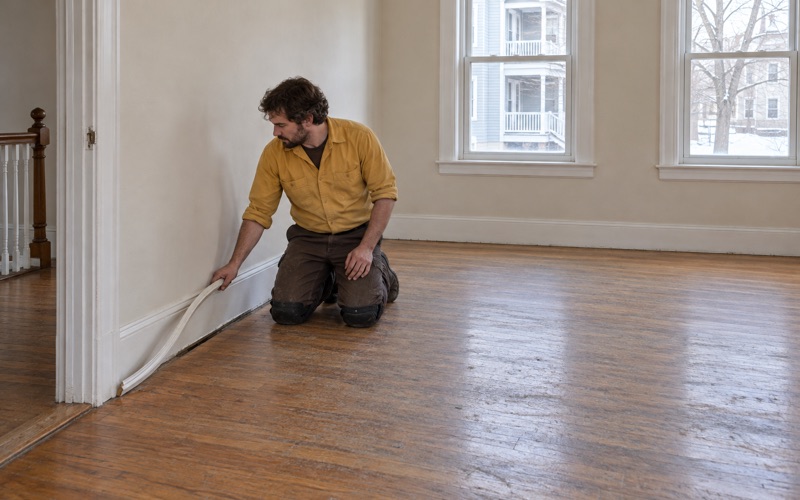
Waltham Wood Flooring has spent more than twenty years sanding, patching and refinishing wood flooring in Charlestown, and a good share of that work lands in the weeks between one tenancy and the next. A floor that has carried five years of ordinary traffic looks nothing like one that has been gouged or soaked, and the two call for different work at different prices. Telling them apart is most of the job before a machine ever comes off the truck.
We get called from both sides of that question. Some of the work comes from owners readying a unit for the next tenant, and some comes from people who have just moved in and want to know what the boards under them actually need. The answer usually turns on the finish first, the board condition second and moisture third.
What follows is how we read a wood floor here: what ordinary use leaves behind, what damage looks like next to it, and which of screening, recoating or a full sand and refinish fits each case. It starts with the paperwork, because in a rental the question is often framed by a document written on the day the tenancy began.
Wood Floors and Wear and Tear in a Charlestown Rental
City of Boston Planning Department 2025 estimates put Charlestown at 9,010 occupied homes, of which 4,322 are renter-occupied, or 48.0 percent. In a neighborhood divided that evenly, the condition of a wood floor is regularly a question between two parties rather than one owner’s private decision. What gets recorded at move-in is what both sides have to work from later.
The Move-In Condition Statement and What It Records About a Floor
Under M.G.L. c.186 s.15B(2)(c), a landlord who takes a security deposit must furnish the tenant “a separate written statement of the present condition of the premises to be leased or rented,” upon receipt of the deposit or within ten days after the tenancy commences, whichever is later. That statement is required to contain “a comprehensive listing of any damage then existing in the premises, including, but not limited to, any violations of the state sanitary or state building codes.”
The statutory notice on that form tells the tenant it “must be returned to the lessor or his agent within fifteen days after you receive this list or within fifteen days after you move in, whichever is later.” Where a tenant submits a separate list, the lessor has fifteen days to return a copy with either a signed agreement or a clear statement of disagreement attached. For a wood floor, that exchange is the only description of its starting condition anyone will have a year from now.
What the Statute Does Not Say About Floors
Subsection (4) allows a deduction of “a reasonable amount necessary to repair any damage caused to the dwelling unit by the tenant,” with “reasonable wear and tear excluded,” and it requires “an itemized list of damages, sworn to by the lessor or his agent under pains and penalties of perjury, itemizing in precise detail the nature of the damage and of the repairs necessary to correct such damage.” That is a demanding standard of description, and description is where a flooring contractor is actually useful.
The statute names no floor, no floor covering and no refinishing item anywhere in it. A wood floor enters only through the general condition statement and through that wear-and-tear line, and the statute draws the line without defining it for floors. Our written estimates are itemized room by room and set down what we observed and what we propose to do, and we leave the characterization of it to the parties.
Looking for wood-flooring closer to South End? See Wood-Flooring in South End.
Ordinary Wear on a Hardwood Floor Versus Damage
Most of what a tenancy leaves on a hardwood floor happens in the finish rather than in the wood. A polyurethane coat is a wear layer, and it thins where people walk long before it fails anywhere else. That one distinction drives the whole question of scope and cost.
Traffic Lanes, Rug Shadow and Sun Fade
Traffic lanes are the first thing we look for: a dulled path from the entry door to the kitchen, from the kitchen to the hall, around the foot of a bed. The sheen level flattens along that path while the rest of the room still reflects, and underneath it the wood is frequently untouched. A rug shadow, the lighter or darker rectangle left where a rug sat, and sun fade in front of a bright window belong to the same family, since both are color change rather than a wound.
Seasonal movement reads as a defect to anyone seeing it for the first time. Winter gaps open between boards during the heating season and close again in summer, and mild cupping across board widths follows humidity in the other direction. We would rather look at a floor in both conditions than judge board gapping from a single February visit.
Gouges, Water Stains and Pet Urine Stains
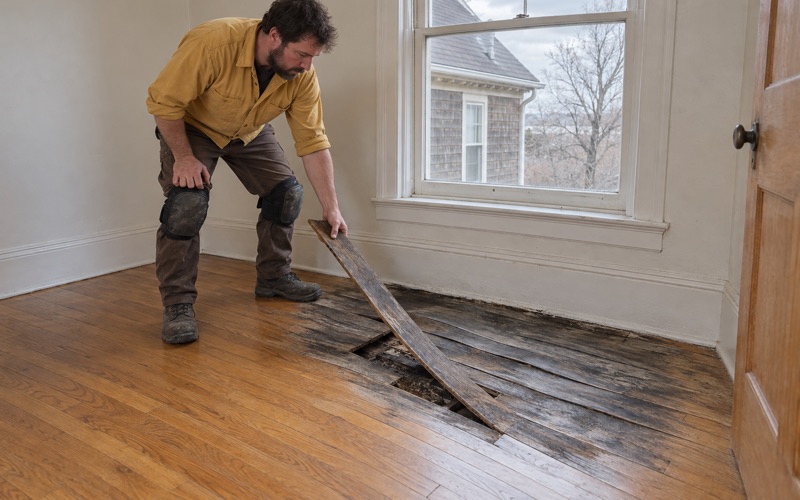
Damage tends to be local and abrupt: a gouge through the finish and into the wood, a scored line where something heavy was dragged, dark water stains ringing the spot a planter or a washer sat. Pet urine stains are their own category, because they travel into the wood and along the seams between boards, and they frequently survive a full sanding. We say so at the estimate rather than after the machines are already running.
Water gets traced before anything is replaced. We read the boards and the subfloor with a moisture meter, look for the source in a supply line, an appliance or a window, and dry the assembly before cutting any board in. The state sanitary code at 105 CMR 410.500 requires an owner to keep buildings and structural elements free from defects that create an injury risk, and to dry all surfaces within 48 hours of a leak or flood, so the drying record matters on its own. Water-damaged floors get documented room by room, in a form an adjuster can use.
Screening, Recoating and Refinishing a Rental Floor
Three different jobs all get called refinishing, and they differ by a wide margin in both cost and downtime. Choosing between them is a condition question rather than a budget question, though the budget is usually what prompts someone to ask it.
Screen and Recoat
A screen and recoat abrades the existing finish with a screen on a buffer, takes the floor no further than that, and lays a fresh coat over the top. Nothing reaches bare wood, the color does not change, and a unit can be back in service quickly. It only works while the old finish is still continuous, so a traffic lane worn through to the wood rules it out.
What kills a recoat is contamination. Old wax and cleaning-product residue have to be tested for and removed first, or the new coat sits on them and peels away in sheets a few months later; a shellac finish on an older floor behaves differently again. We match the sheen level to what is already there and choose products that fit the Massachusetts VOC limits for wood coatings, which are tighter than the federal ones.
Full Sand and Refinish
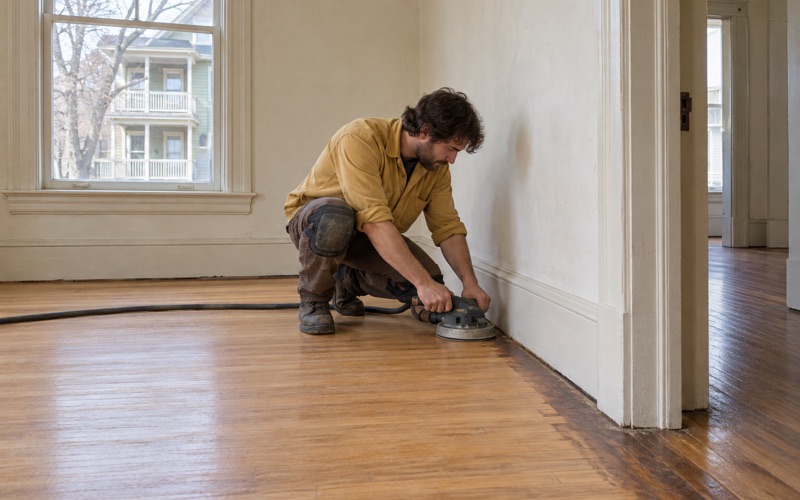
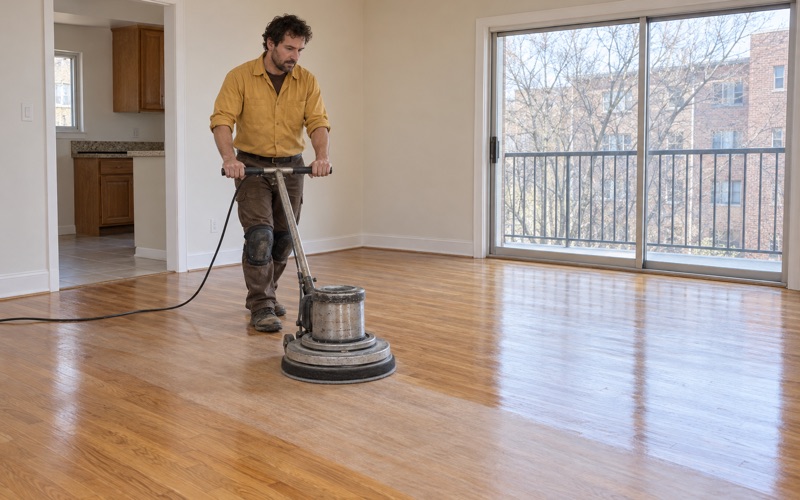
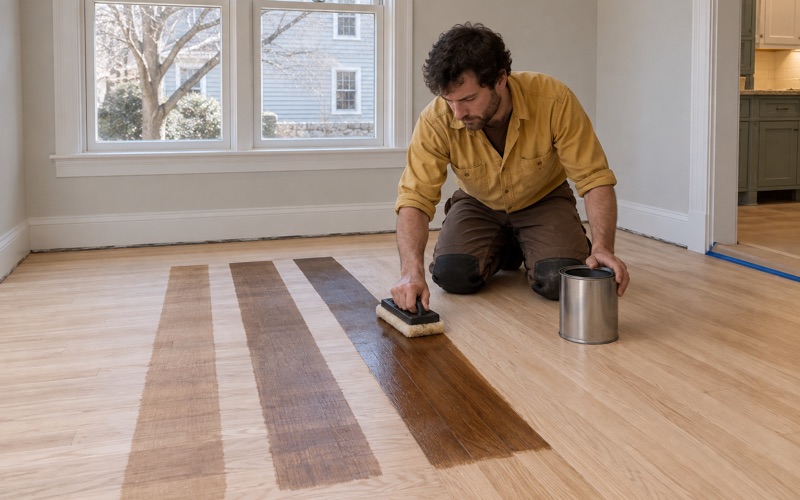
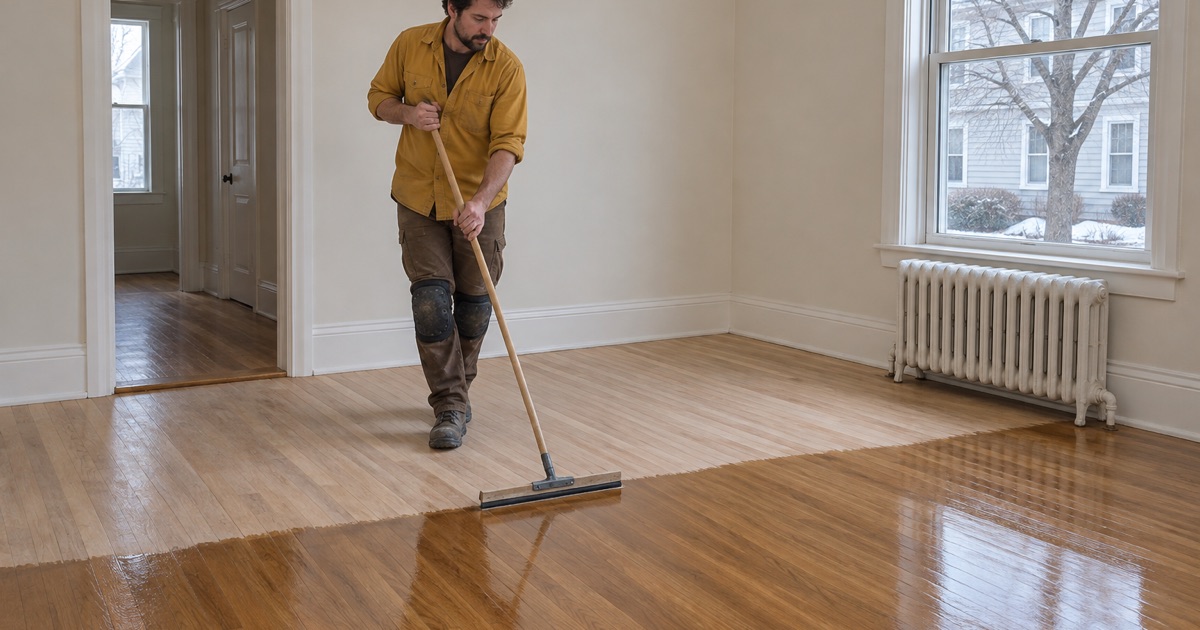
A full refinish takes the floor to bare wood through a grit sequence, usually a drum machine followed by an orbital, with dustless sanding and a HEPA vacuum so the rest of the unit stays usable. When a stain color is involved we lay stain samples on your own floor in your own light, because red oak strip flooring takes a color differently than maple does and neither one looks like the sample card. Waterborne polyurethane, oil-modified polyurethane and hardwax oil each cure on their own schedule, and that schedule is what really sets the handover date.
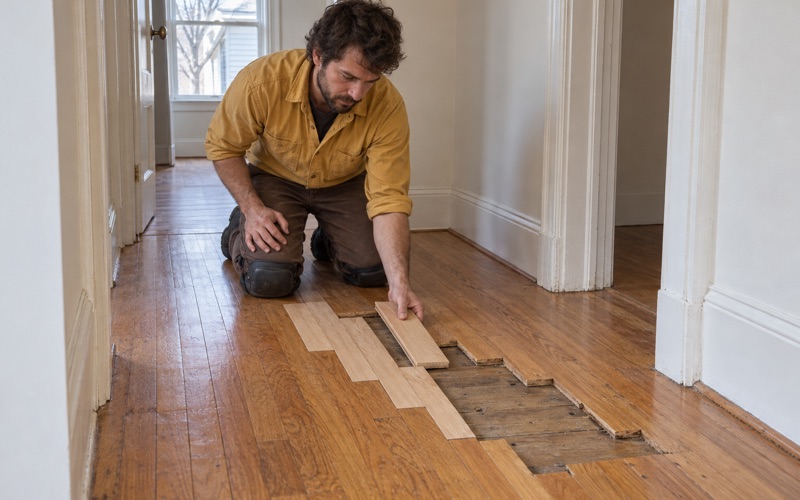
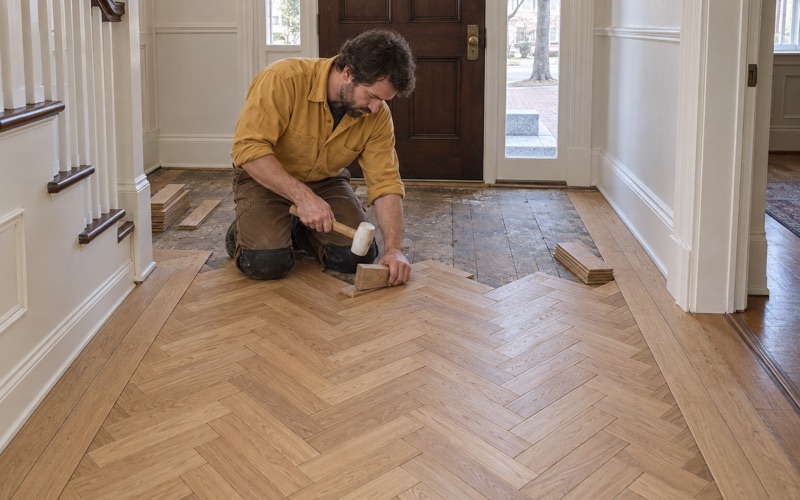
Thickness gets checked before any of that is promised. Postwar oak strip floors in houses built in the 1950s and 1960s are usually worth sanding rather than tearing out, but only once we have measured what is left above the tongue. Holes left where steam radiators and their pipes came out, and the scars where a wall came down or an outlet moved, are patched with matching boards woven into the field so the repair reads as floor; stairs we quote tread by tread, because a staircase is not priced by the square foot.
Planning Floor Work in a Charlestown Rowhouse or Navy Yard Unit
Charlestown is a neighborhood of Boston rather than a town with ordinances of its own, so the building authority here is the City of Boston Inspectional Services Department and the tenancy rules are state law. The practical constraints are local in a different way: 2,561 of the 10,107 housing units in ZIP 02129 sit in buildings of fifty or more units, a ZIP-level proxy for the neighborhood, and buildings that size have their own rules about elevators, work hours and how material comes in.
Older Buildings and What We Check First
In that same ZIP-level proxy, 50.3 percent of the units were built in 1939 or earlier and 72.6 percent before 1980. We check the build year and any painted surfaces before sanding, because Massachusetts runs its own lead-safe renovation rules for homes built before 1978, and that check belongs at the estimate rather than on the first morning of the job.
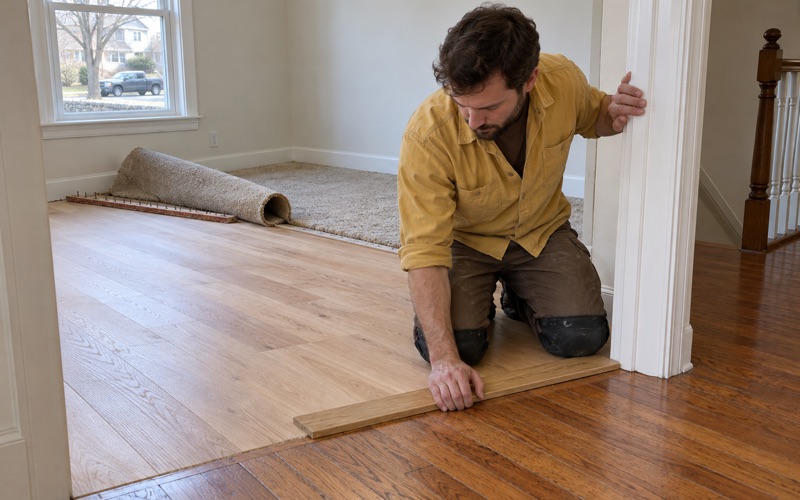
The layers underneath are the other thing we open carefully. Under carpet, tack strip and pad there is often red oak strip flooring worth saving; under a later vinyl layer there is sometimes old resilient floor tile and the black mastic beneath it, which we identify and leave undisturbed, stopping work until the right trade has handled it. Neither is a discovery anyone wants in the middle of a two-week turnover.
Working Around a Turnover
The window between tenancies is usually the entire schedule. A screen and recoat fits inside it comfortably, while a full sand and refinish plus cure time has to be planned backward from the move-in date, and we would rather say that at the estimate than halfway through. In an owner-occupied two- or three-family we work one floor at a time, so the household on the other floor keeps living in the house.
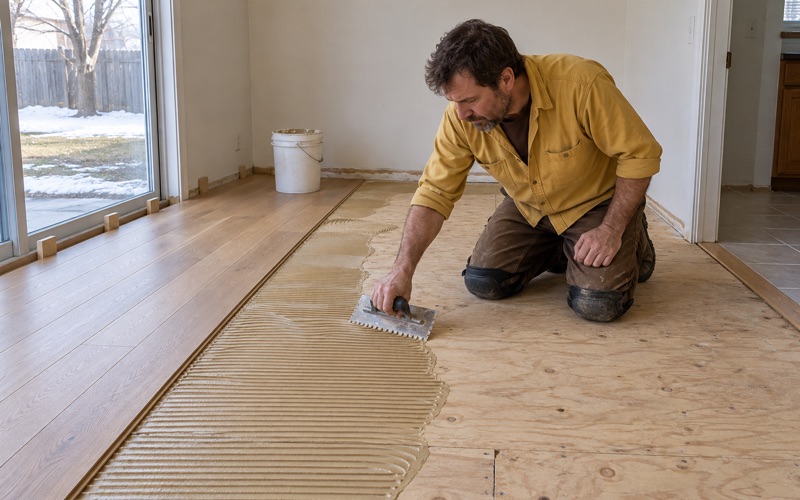
Lower-level rooms get their own answer. We match the material to the moisture we actually measure there, which usually means engineered wood with a real wear layer rather than solid, set with an expansion gap at the walls. Whatever the floor turns out to need, the estimate comes back written and itemized by room, which is the same form the condition statement and the damages list both take.
- 20+ Years On Wood Floors
- Written Itemized Estimates
- Stain Samples On Your Own Floor