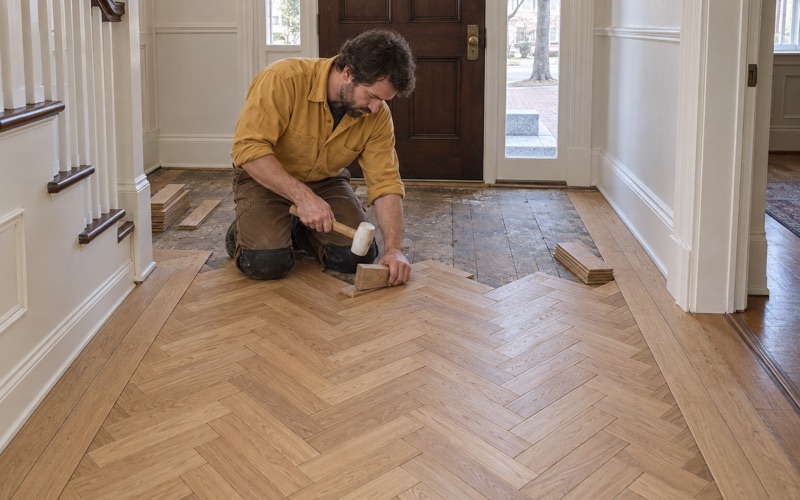
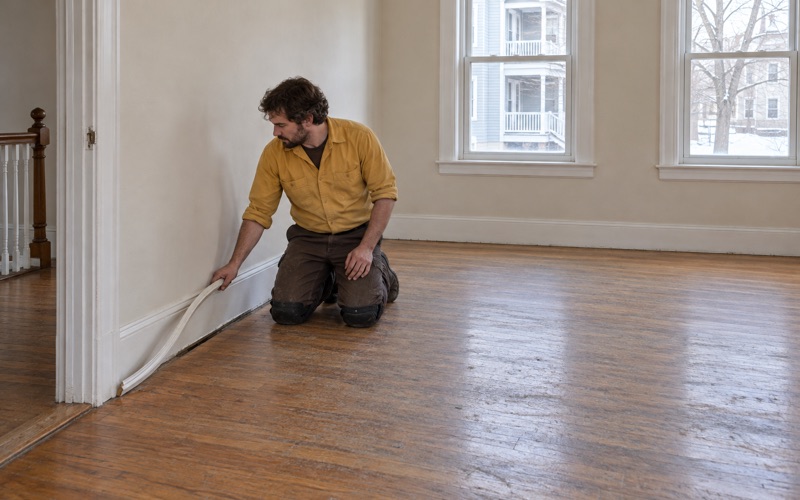
Waltham Wood Flooring has installed, repaired and refinished wood flooring in Cochituate for more than 20 years, and most of that work happens on ground that sits close to water. People call us for a floor in a lower-level room, for a refinish that will bring a dulled oak floor back, or for a repair after water has already reached the boards. The right answer is rarely the same twice, because it depends on what a moisture meter reads in that particular room on that particular day.
We work as a crew rather than a sales operation, so the first visit is spent measuring. We read moisture in the room the floor is going into, check board thickness before anyone assumes an old floor has to come out, and lay stain samples on your own floor in your own light before a color is settled.
That approach matters more than usual here, because in Cochituate a wood floor question is often a water question wearing different clothes. What follows is how we think about the work: what belongs on a lower level, what happens when water has already found a floor, and what we check before a sander touches a board.
Wood Floors Between a Lake and a Pond
Cochituate is a village and census-designated place inside the Town of Wayland, and it has no government of its own. Every permit, bylaw and board that touches a floor here belongs to Wayland, and we name the authority correctly on an estimate because getting it wrong costs a homeowner a wasted phone call.
The village sits with water on two sides of it. Lake Cochituate covers 625 acres across Natick, Wayland and Framingham, and it spent a century as Boston’s reservoir: developed from 1848 to 1863, it supplied the city’s water until 1951 through the 14-mile Cochituate Aqueduct, and its 1890 dam replaced two older dams at the lake’s northwest outlet. Dudley Pond, an 84-acre Great Pond owned by the Town of Wayland on a long-term lease, sits inside the village itself.
What This Ground Changes About a Floor
None of that geography decides anything about your floor by itself, and we do not pretend it does. What it changes is how seriously we take a number: a moisture reading taken in a Cochituate lower level is a measurement we act on, not a box we tick on the way to selling solid hardwood.
Two houses on the same street can read differently, and the same room can read differently in April than it does in September. So we measure the subfloor and the room, we let material acclimate rather than installing it the day it arrives, and we tell you what we found even when the finding is inconvenient.
Solid, Engineered, and Which One Belongs Where
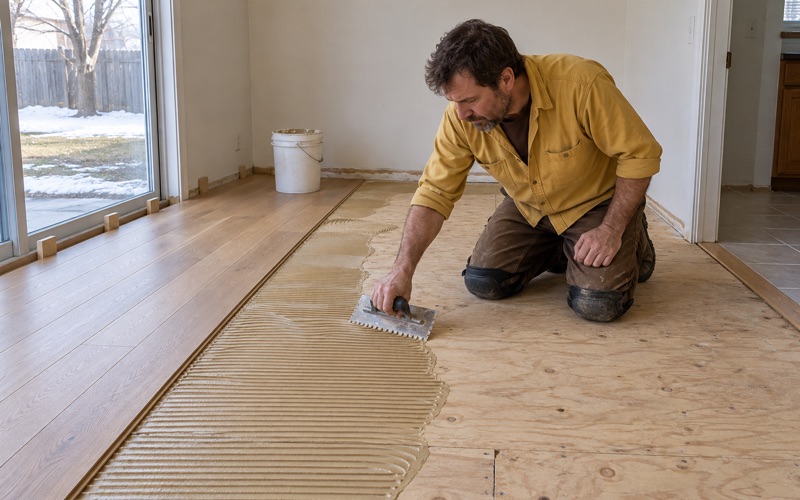
A lower-level floor is matched to the moisture actually measured there, which in practice usually means engineered wood rather than solid. An engineered board with a real wear layer holds its width through a damp stretch far better than a solid board will, and it can still be screened, sanded and refinished later where the wear layer allows it. Solid hardwood upstairs remains the right call in most Cochituate houses; it is the lower level where the assumption gets people into trouble.
The NWFA installation guidelines treat a level as below grade when soil sits three inches or more above its floor, walk-out rooms included, and that definition catches more rooms than homeowners expect. Below grade the details do the work: a vapor retarder where the assembly calls for one, an expansion gap left at every wall and held under the molding, and rosin paper or the right underlayment between the wood and the subfloor. Skip those and the floor tells you about it within a season, usually as cupping along the board edges.
Looking for wood-flooring closer to Medford? See Medford Wood-Flooring.
The Snake Brook Dam and Wayland’s Rehabilitation
Snake Brook is one of the four major tributaries in the Lake Cochituate watershed, alongside Beaver Dam Brook, Course Brook and Pegan Brook. It was dammed in colonial times, built to its current plans in 1878 and upgraded in 1907, and it has been part of the village’s water picture for so long that most people pass it without a thought.
From a Fair Rating to a Poor One
The dam’s Phase 1 inspection rating was fair in 1999. By August 2021, after Hurricane Ida, that rating had fallen to poor, and a structure described as roughly 150 years old was carrying the verdict.
Wayland has since been awarded $1.40 million under FEMA’s Hazard Mitigation Grant Program to rehabilitate it, with the work raising the dam’s core wall and rebuilding the stone retaining wall. We mention it because it is the kind of town project Cochituate homeowners are already talking about, not because it changes anything about any particular house.
What a Public Works Project Does Not Tell You
We will not tell you that Wayland’s dam schedule has some consequence for the floor in your house, and nobody honest can. What we can say is narrower and more useful: on ground like this, a floor is worth specifying for the moisture that is actually present, and the cost of measuring for that is small next to the cost of replacing a floor that never suited the room.
So we keep the two conversations separate. Public water infrastructure is the town’s work and the floor in front of us is ours, and the only real bridge between them is that both reward measuring over assuming.
Drying, Patching and Refinishing a Floor After Water
Water reaches a wood floor in ordinary ways far more often than dramatic ones: a burst supply line, a washing machine that ran over during the night, a water heater at the end of its life. Whatever the source, we trace it, dry the floor, and read it with a moisture meter before a single board is pulled.
Reading a Floor Before Replacing It
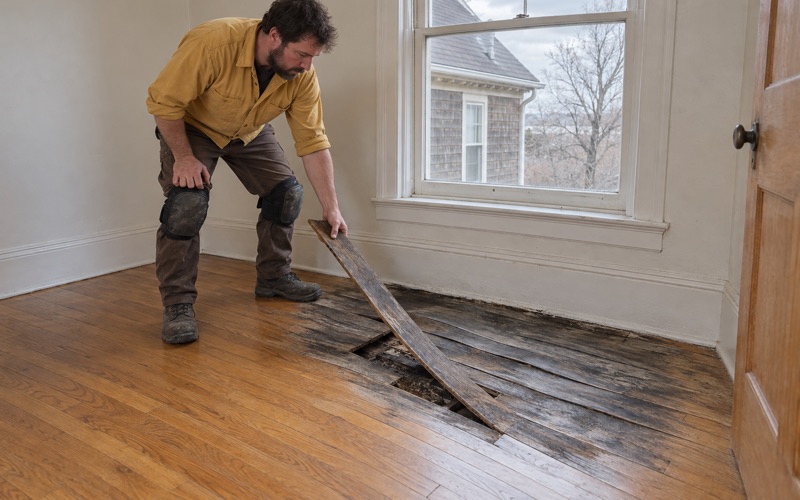
A wet floor usually looks worse than it is. Cupping, where the board edges rise above their centers, is the normal first response to moisture arriving from below, and a great many cupped floors flatten back out once the room and the subfloor are genuinely dry. Sanding one flat while it is still wet is how cupping turns into crowning, and crowning is a real loss of wood that cannot be taken back.
Buckling, where boards lift off the subfloor altogether, is a different matter and usually does mean replacement in that area. Board gapping is different again and often seasonal, since winter gaps in a dry heated house close on their own by summer. Knowing which of the three you are looking at is most of the job, and it is why we start with a meter rather than a pry bar.
Weaving Boards In Rather Than Filling
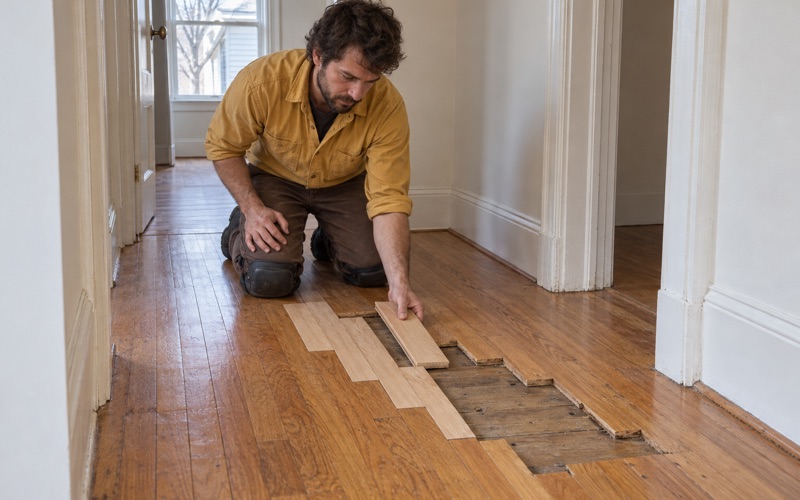
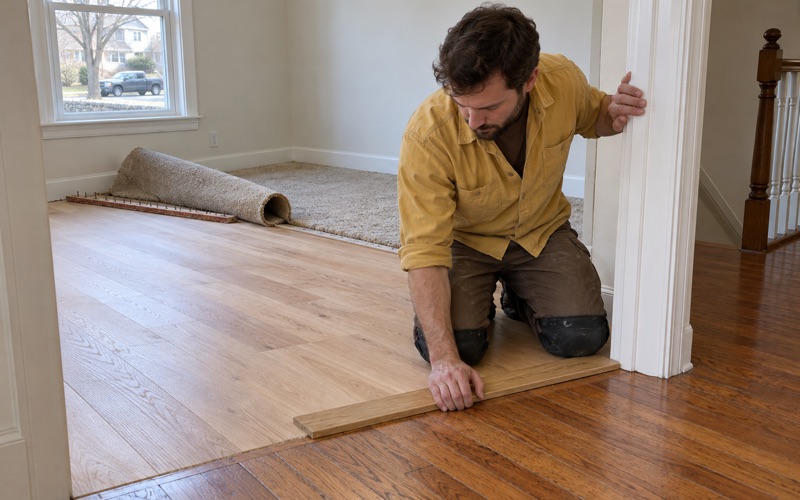
Where boards do have to come out, we weave the new ones into the existing floor with staggered end joints so the patch reads as floor instead of as a scar. It is the same method we use on the holes left where steam radiators and their pipes came out, and on the line a floor shows after a wall came down or an electrical outlet was moved: matching boards woven in, never filled.
Matching matters as much as method does. Red oak strip flooring from a postwar house is not the same board as white oak in a newer room, and a patch in the wrong species or the wrong cut announces itself the moment the finish goes on. We match species, width and cut first, then sand and finish the area so the repair disappears into the floor around it.
Writing Down What the Rooms Actually Show
Water-damaged floors get documented room by room for the adjuster, with readings and photographs taken before drying equipment changes what there is to see. We make no claims about what any policy will or will not do; our part is making sure the record of the damage is complete enough that the conversation stays about facts.
For landlords, the estimate is itemized and written, because that is what Massachusetts requires under M.G.L. c.186 s.15B before a tenant can be charged for damage to a floor. In an owner-occupied two-family or three-family, we work one floor at a time, so the household on the other floor keeps living in the house while the work goes on.
Refinishing Older Cochituate Floors
About 23.8 percent of housing units in the Cochituate CDP were built in 1939 or earlier, on a small sample with wide margins, and a large share of the rest went up in the postwar decades. Those postwar oak strip floors are the ones most often written off when they did not need to be.
What We Check Before Sanding
We check the build year and any painted surfaces before sanding starts, because Massachusetts runs its own lead-safe renovation rules for homes built before 1978, and a drum sander in a painted room is the wrong way to discover that. Where old resilient floor tile and the black mastic under it turn up beneath a carpet or a later floor, we identify it and stop rather than disturb it, and the work waits until the right trade has handled it.
Old wax and cleaning-product residue are tested for and removed before any new finish goes down, since a finish that cannot bond to what is beneath it peels in the traffic lanes within a year. On a 1950s or 1960s oak strip floor we check board thickness first: where there is wood left above the tongue, that floor gets sanded and refinished rather than torn out.
Sanding, Stain and Sheen
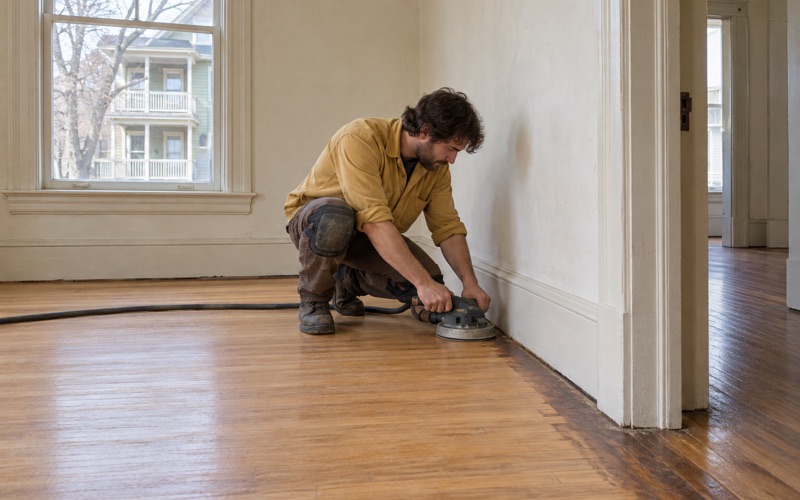
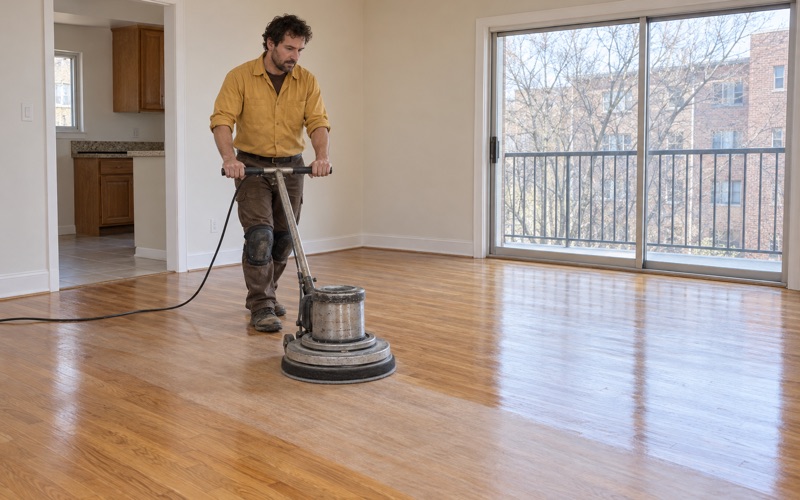
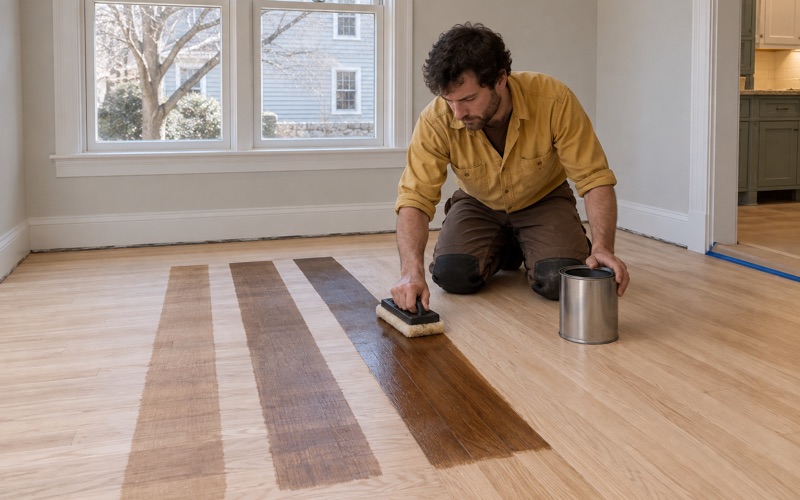
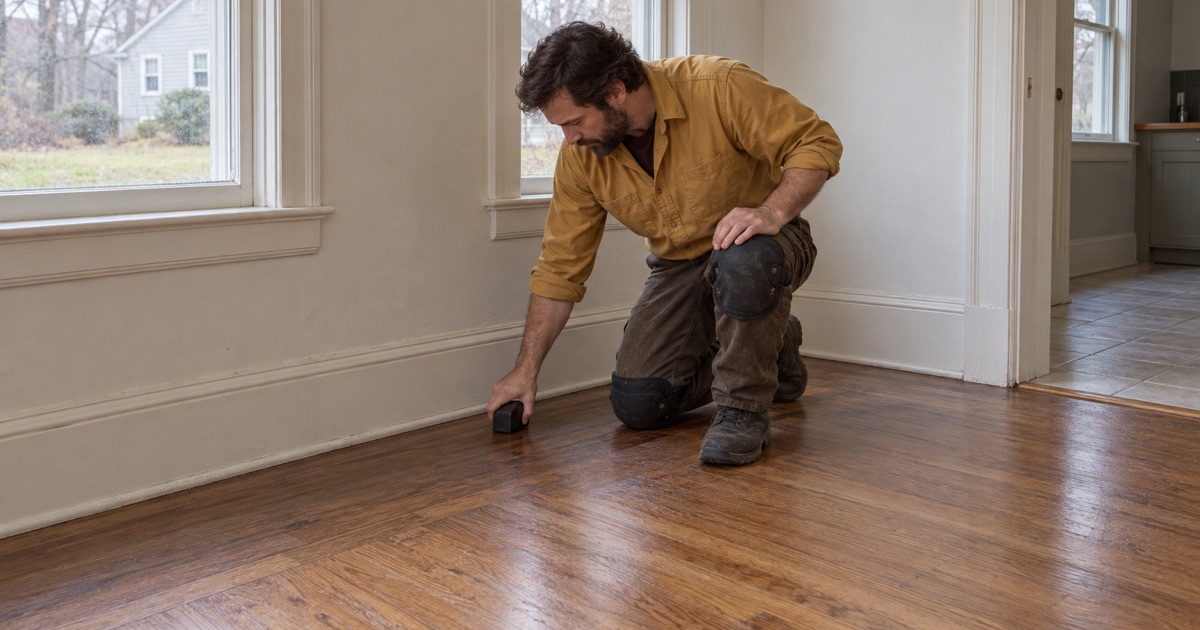
Sanding is a grit sequence rather than a single pass, and we run dustless equipment with a HEPA vacuum so the house stays livable while we work. Where a stain is going down, we lay samples on your own floor and look at them in your own light at different hours, because orange oak under a lamp and the same floor in afternoon sun are not the same color.
Finishes are chosen to fit the Massachusetts VOC limits for wood coatings, which are stricter than the federal ones. Inside those limits there is still real choice: waterborne polyurethane for a fast return to the room, oil-modified polyurethane for warmth over red oak, hardwax oil where a repairable surface matters more than maximum film hardness, and a sheen level low enough that a bright room does not show every footprint.
Stairs, Thresholds and the Rest
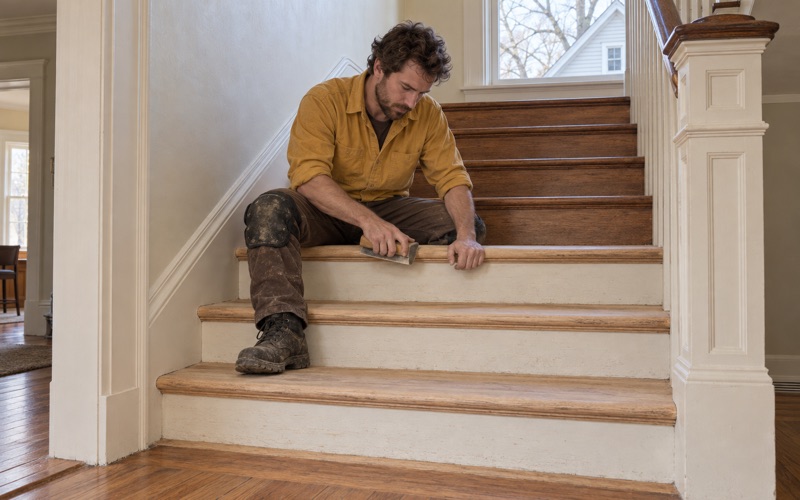
Stairs are quoted tread by tread, because a staircase is not priced by the square foot and pretending otherwise produces an estimate that has to be corrected later. Treads, risers and nosings each carry their own labor, and a staircase being refinished alongside a floor should be priced that way from the start.
The small parts finish the job: reducers and thresholds where wood meets tile or steps down into a lower-level room, and quarter round set to the floor rather than nailed through it. If you want a floor in Cochituate looked at, we will come out, measure what is actually there, and tell you plainly what we would do with it.
- 20+ Years On Wood Floors
- Written Itemized Estimates
- Stain Samples On Your Own Floor