Waltham Wood Flooring has spent more than twenty years on wood flooring in Dedham, and a good share of that work has started with water: a supply line that let go, an appliance that overflowed overnight, or a lower-level room that came up damp after a wet spring. Those jobs are why homeowners here tend to find us.
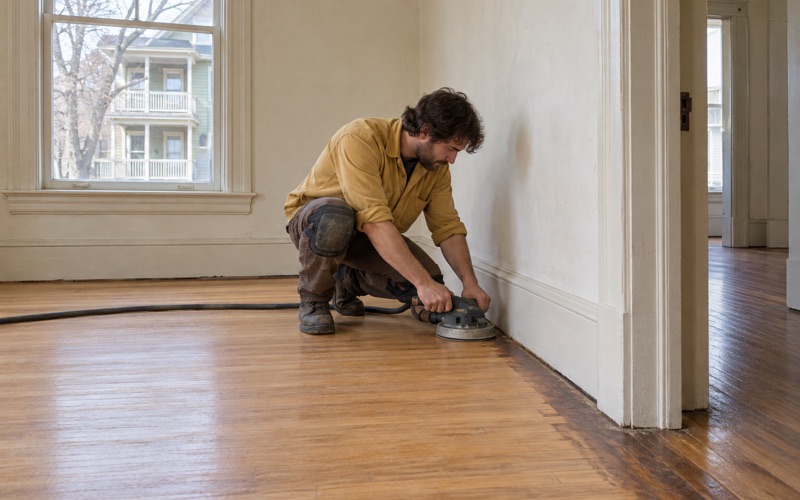
We sand and refinish oak strip floors, replace boards, weave patches into existing floors, and lay new wood on upper floors and lower levels alike. What we do not do is guess. Before a single board comes up we read the floor with a moisture meter, trace where the water actually traveled, and let those numbers decide what gets dried and what gets replaced.
That habit counts for more in Dedham than it does in most towns, because this is a place that has thought about where water goes for a very long time. What follows is how we approach a wood floor here: what moisture does to one, how we dry and repair it, and what we recommend putting down in a room near the water.
Water Is the First Question on a Dedham Wood Floor
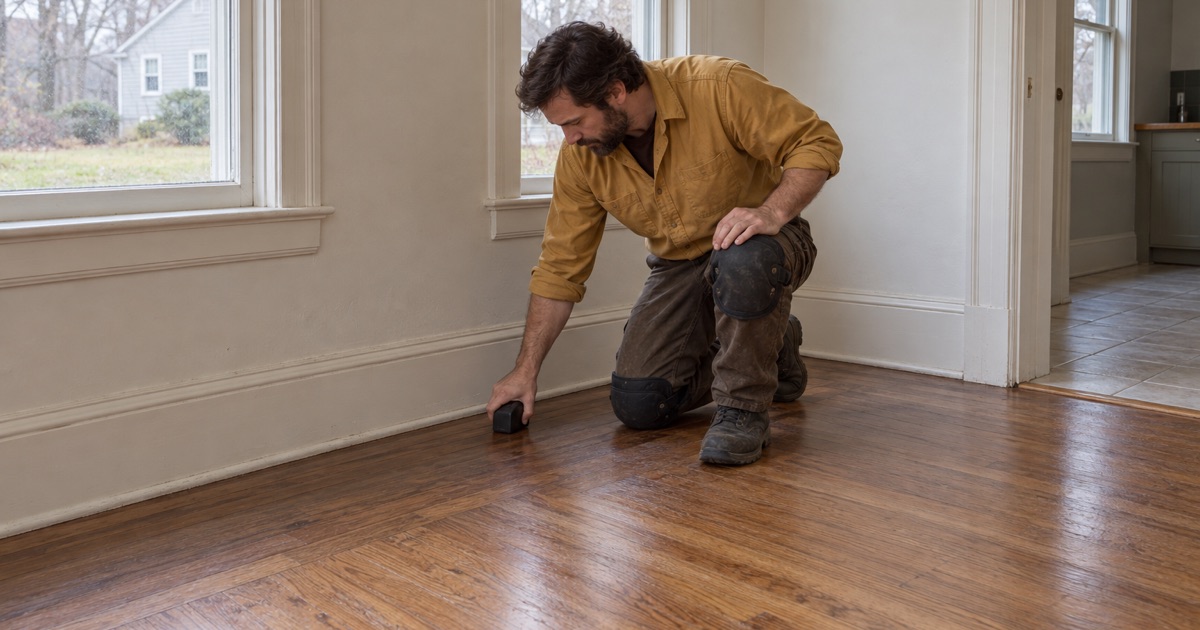
Most of the calls we take from Dedham are about a floor that got wet, or about a floor going into a room where getting wet is a live possibility. Those are two different jobs with one thing in common: the answer comes from a measurement rather than an opinion. A floor that reads dry at the subfloor is a refinishing job, and a floor still reading wet three feet from the wall is something else entirely.
How Moisture Shows Up in Oak
Wood moves with moisture, and a hardwood floor reports what it has taken on. The most common signal is cupping, where board edges rise above their centers because the underside has absorbed more moisture than the top. Left through a dry winter, cupped boards often flatten part of the way back on their own, which is why we almost never sand a floor the week we first see it.
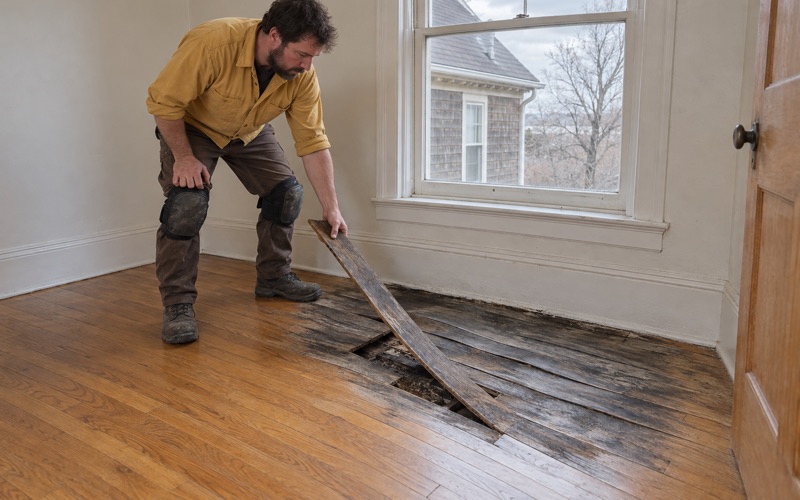
Harder cases show up as crowning, where a floor sanded flat while it was still wet dries into high centers, or as buckling, where boards lift off the subfloor and lose their hold on the flooring cleats. Board gapping runs the other direction: a floor dried hard and fast opens seams that were tight in June. Working out which of these you have, and how long it has been going on, decides whether the fix is a screen and recoat, a full sanding, or a set of replacement boards.
Reading the Floor Before Anything Comes Up
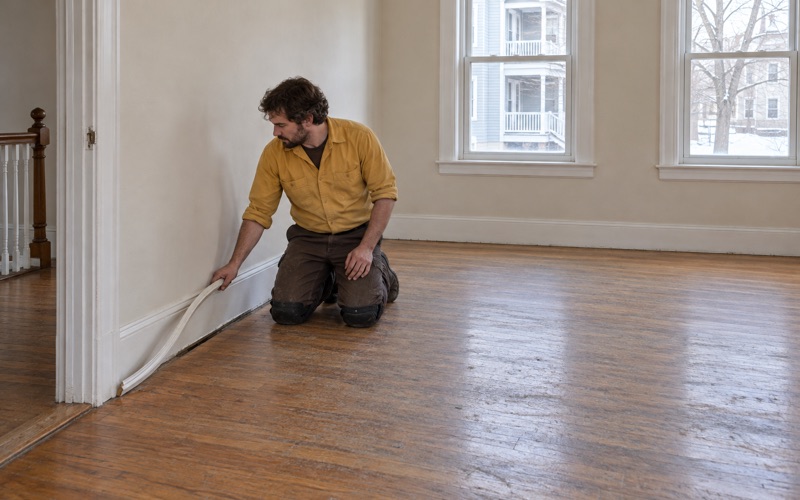
We start with a moisture meter, and we take readings across the room rather than at the wet spot everybody can already see. Water runs along the tongue and groove and down between the joists, so the true edge of the problem is rarely where the puddle was. We check the subfloor from underneath wherever there is access, because a dry-feeling surface over a saturated subfloor will fail a new finish inside a season.
Those readings get written down room by room, with dates, so there is a record of what the floor was doing before anyone touched it. If an adjuster is involved, that documentation is what makes the damage legible to someone who was never in the house. For a landlord it becomes the itemized written estimate Massachusetts requires before a tenant can be charged for damage to a floor.
Looking for wood-flooring closer to Wellesley? See Wood-Flooring in Wellesley.
Mother Brook, the Charles, and a Town That Plans for Water
Dedham has been deciding where Charles River water goes for longer than anywhere else in the country, and that history is the reason we ask careful questions before quoting a floor near the water here. The background is worth knowing, because a homeowner who already asks those questions is asking the right ones.
A Canal Dug in 1639, Still in Service
Mother Brook is an artificial waterway in Dedham and Hyde Park, constructed in 1639 to divert water from the Charles River to the Neponset River. It is described as the first man-made canal in what is now the United States, and it was dug to power water mills. The mills have been gone for generations; the channel has not.
Mother Brook is part of a flood-control system today and remains in use for that purpose, with the Neponset River Watershed Association monitoring it. NOAA’s National Water Prediction Service publishes a gauge named Charles River at Mother Brook at Dedham, which means the level there is a published, watched figure rather than neighborhood folklore. We are flooring contractors and not hydrologists, but a town whose water has its own gauge is a town where we ask about a room’s history before recommending solid wood for it.
What the Charles River Flood Model Says and Does Not Say
The Town of Dedham built a watershed-scale flood model in partnership with the Charles River Watershed Association and fourteen other communities in the upper and middle Charles River watershed. The model visualizes the impacts of increasingly severe storm events and then shows what happens if the watershed invests in nature-based solutions such as land conservation, green stormwater infrastructure, and reducing impervious surfaces. It was developed by Weston and Sampson and funded through the Massachusetts Executive Office of Energy and Environmental Affairs FY21 MVP Action Grant Program.
Four subwatershed areas, also called impact areas, were selected for detailed flood mitigation designs, and Dedham along with Boston is one of those four. None of that tells you anything about a particular house, and we will not pretend otherwise: we do not read flood maps, and drainage, culvert and foundation work is not our trade. What it does tell us is that water is a standing design question in this town, and a floor specified as though it were not is a floor specified badly.
Drying and Repairing a Water-Damaged Floor
When water has already been in, sequence matters more than materials. We trace where it came from, dry the assembly, and only then decide how much wood actually has to go. Skipping straight to replacement is how a repair ends up being done twice.
Drying Comes Before Anything Else
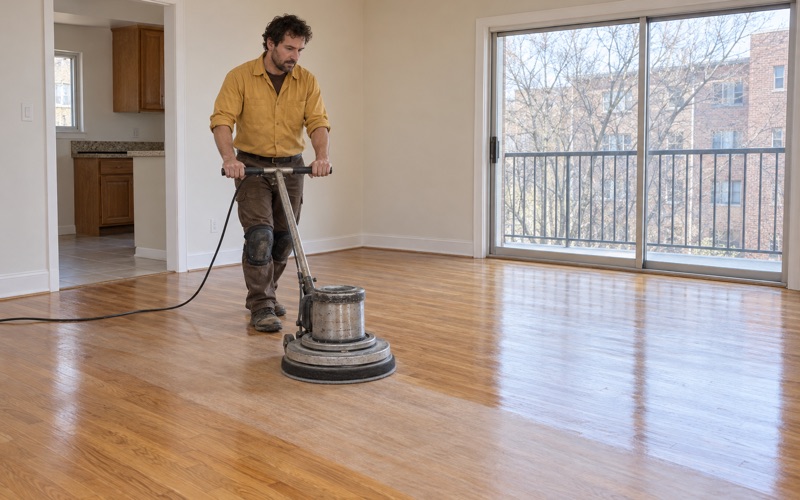
A floor still giving up moisture cannot be sanded, refinished or patched successfully, because every dimension set today shifts as the wood dries. We monitor readings until they stabilize and match the rest of the house, which can take days or weeks depending on how long the water sat and what is underneath. Only then does the plan get written.
While that runs, we look at what is under the boards. Old rosin paper, an underlayment that stayed wet, and in older houses a layer of resilient floor tile set in black mastic all change the approach. We identify that tile and the mastic under it rather than disturbing either one, and we stop and hand the room to the right trade before any sanding begins.
Weave-In Repairs and Board Replacement
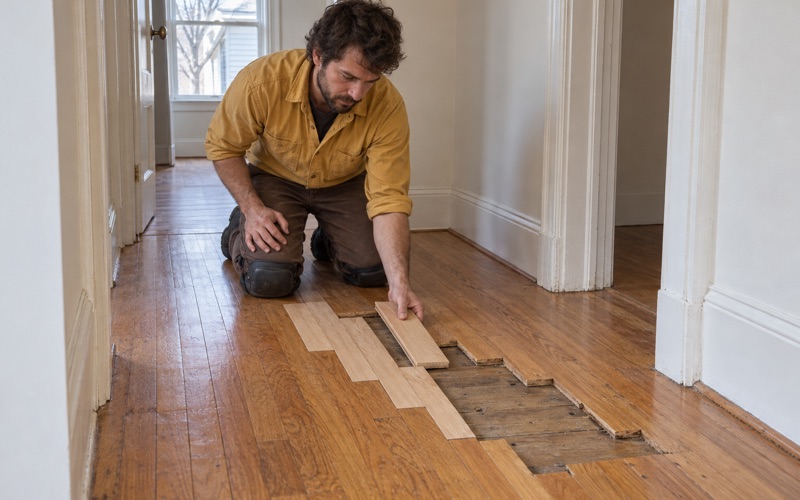
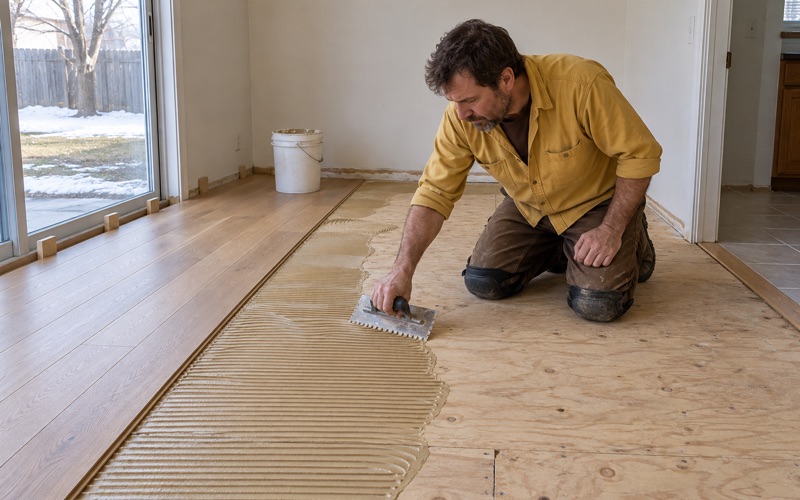
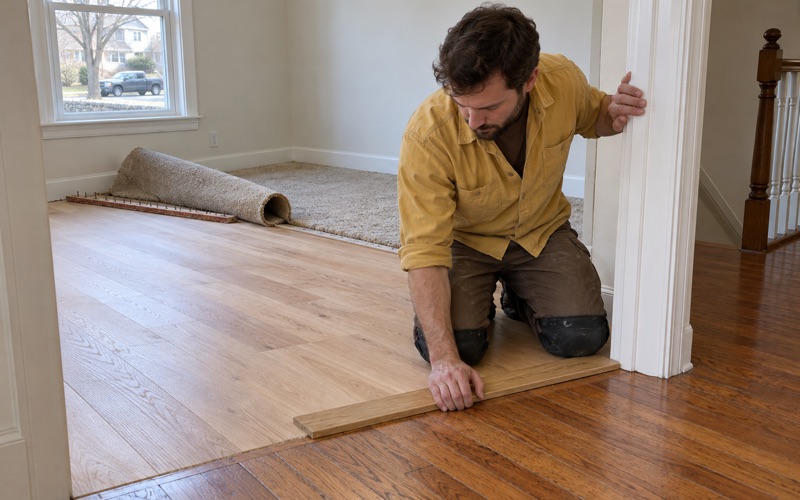
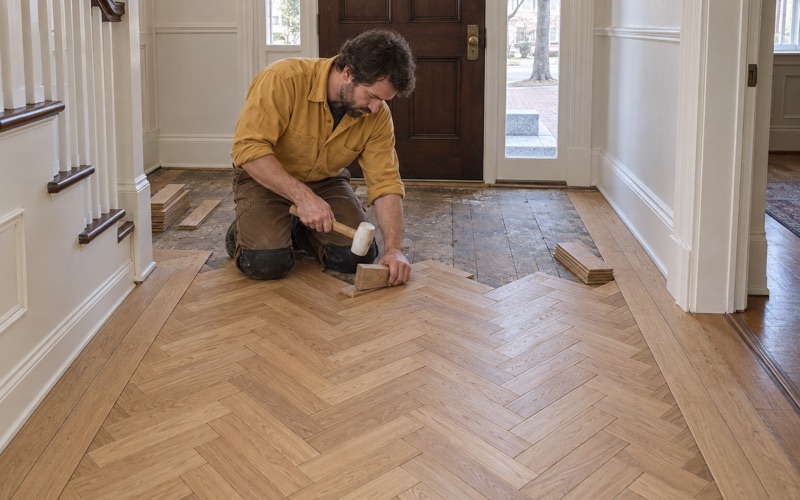
Where boards have to come out, we take out as few as we can and weave the replacements into the surrounding field so the end joints stagger the way the original floor does. The same method handles the holes left where steam radiators and their pipes were removed: matching boards cut in and woven through, rather than a filled rectangle that reads as a patch for the rest of the floor’s life. Where a wall has come down or an outlet has moved, the goal is the same, which is that the repair should read as floor.
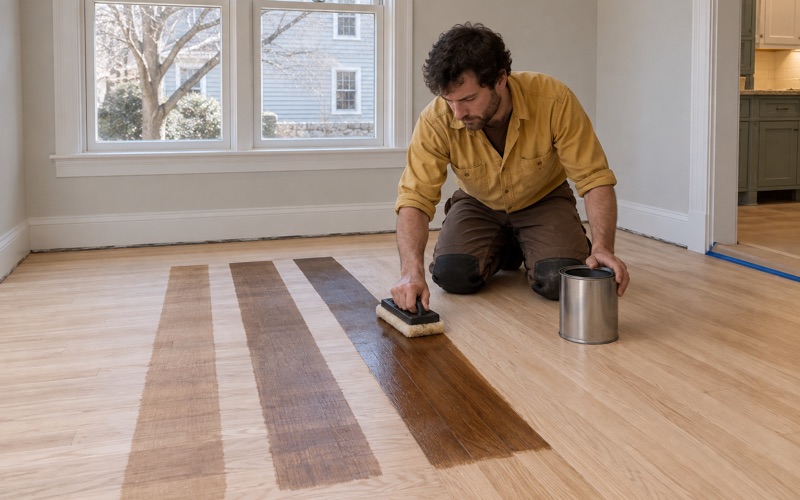
Species and cut carry that result. Most of what we patch around here is red oak strip flooring, with white oak or maple turning up as well, and matching board width and grain direction does more for the finished look than stain ever will. Once the new wood is in and the floor has been sanded through a full grit sequence, we lay stain samples on your own floor, in your own light, before a color is chosen.
Finishes That Bond to a Repaired Floor
A finish only performs if it has clean, bare wood to grip. On older floors we test for old wax and cleaning-product residue and take it off before anything goes down, because a waterborne polyurethane laid over wax peels through the traffic lanes within a year. That check matters even more on a floor that was scrubbed hard during a cleanup.
We choose coatings that fit the Massachusetts VOC limits for wood coatings, which are stricter than the federal ones, and we match sheen level to how the room is used instead of defaulting to gloss. On a floor already sanded thin by earlier refinishes, a screen and recoat is often the better call than another pass with the drum sander, so we check board thickness first and say plainly which one the floor can take.
Planning a Floor for a Lower-Level Room
In a town where one neighborhood, Riverdale, is described as surrounded by the Charles, the question we hear most is what to put down in a lower-level room. The honest answer is that it depends on what the room measures over time, not on how it looks on a dry day in August.
Measure the Room, Then Choose the Material
We match below-grade and lower-level floors to the moisture actually measured in that room, not to a rule of thumb. In practice that usually means engineered wood rather than solid, because an engineered wear layer over a stable core holds its dimensions against seasonal swings that would cup solid stock. It still needs an expansion gap at every wall and a vapor retarder suited to what sits underneath it.
Solid hardwood is not automatically wrong down there, but it has to be earned by readings taken across a full seasonal cycle. Where the numbers do not support wood at all, we say so rather than sell it anyway. A floor we install and then have to replace is not a job either of us wants.
What Is Already Down There
Before anything new goes in, we find out what is under it. Houses built before 1978 get the build year and any painted surfaces checked ahead of sanding, because Massachusetts runs its own lead-safe renovation rules for homes of that age and those rules shape how the work is set up.
We also look over the subfloor for old fasteners, previous repairs and any sign of insect activity. Powderpost beetle exit holes and the fine frass beneath them do turn up in older framing around here, and they change what the subfloor and underlayment have to do before new wood goes over them.
Stairs, Transitions and Living in the House
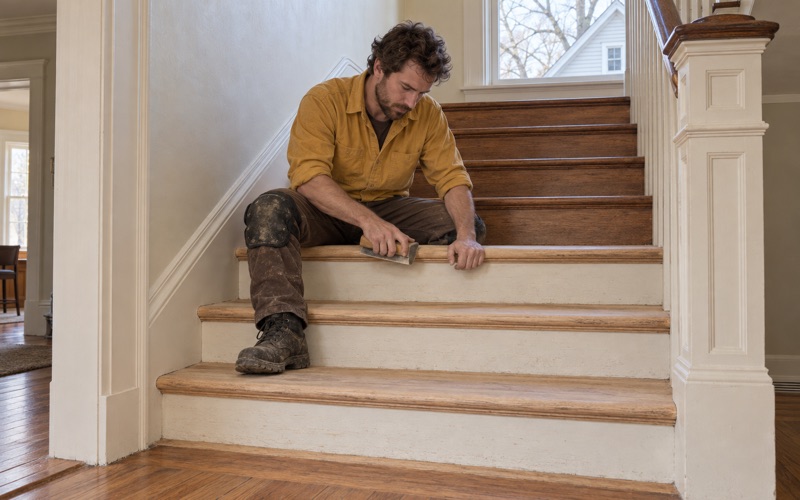
A staircase between a lower level and the floor above is quoted tread by tread, because a stair is not priced by the square foot. Treads, risers and nosings are separate pieces of work, and the estimate should show them separately instead of burying them in a square-foot number.
Transitions get the same attention, since a reducer or threshold at the head of the stairs is what keeps two different floors from fighting each other along the joint. In an owner-occupied two- or three-family we work one floor at a time so the household on the other floor can keep living in the house, and we give new wood time to acclimate in the room it is going into before a single board is fastened.
- 20+ Years On Wood Floors
- Written Itemized Estimates
- Stain Samples On Your Own Floor