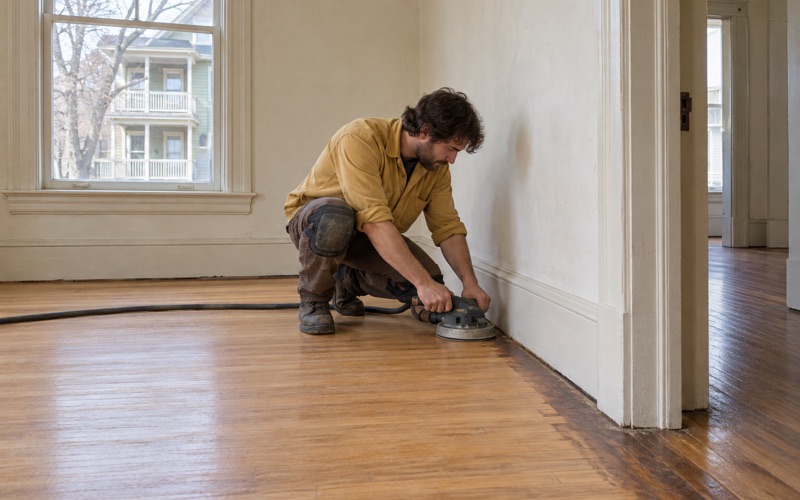
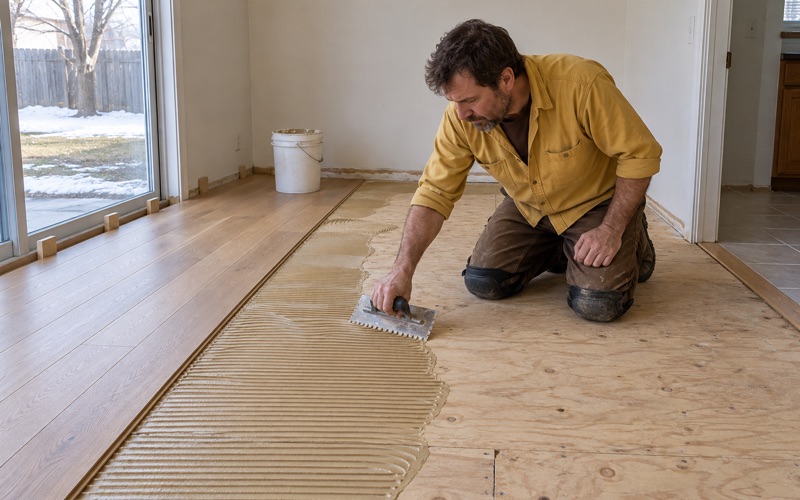
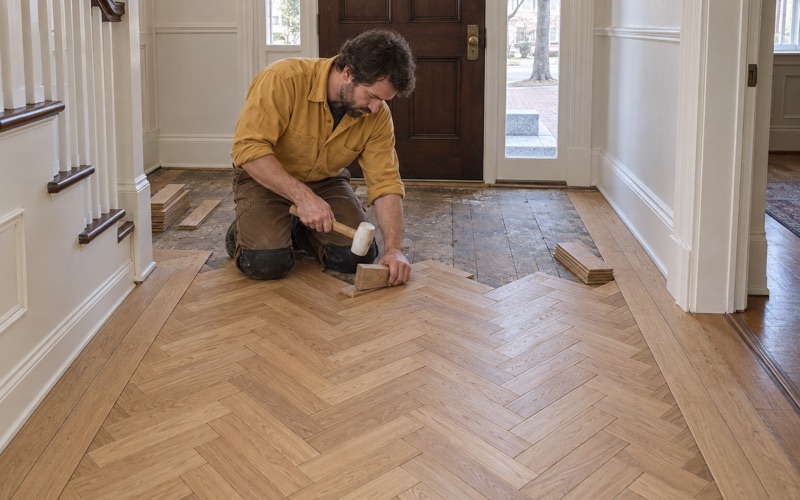
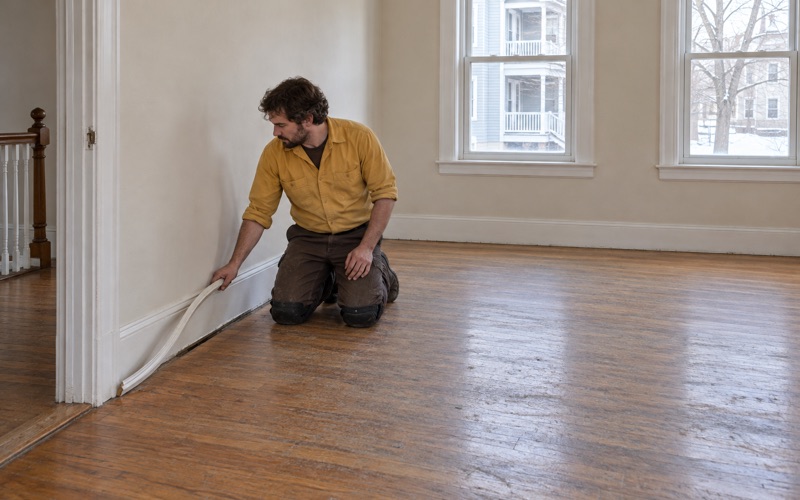
Waltham Wood Flooring has been doing wood-flooring in East Boston for more than twenty years, and most of that work is sanding, refinishing, repairing and installing floors in buildings that are already lived in. We work on red oak strip flooring, white oak, maple, eastern white pine and the occasional herringbone or wide plank floor. A job here usually starts with a floor somebody already owns rather than a bare subfloor.
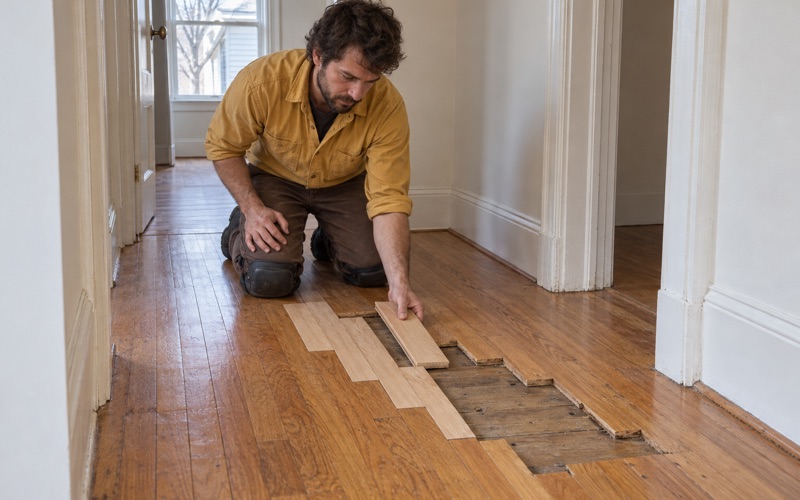
Our repair work is the part people notice least, which is the point. Holes left where steam radiators and their pipes came out are patched with matching boards woven into the floor, not filled. A floor opened up where a wall came down or an electrical outlet moved gets closed the same way, so the repair reads as floor rather than as a scar.
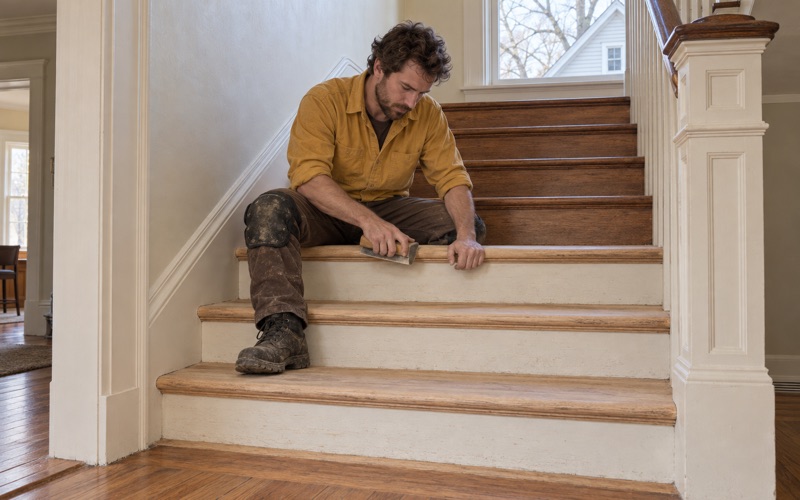
Before we quote anything we look at what is actually on the boards and what is under them. Old wax and cleaning-product residue is tested for and removed so a new finish bonds instead of peeling, and board thickness is checked before a sander touches a floor that has been sanded before. Stairs are quoted tread by tread, because a staircase is not priced by the square foot.
Floors in a Neighborhood That Shares Its Shore With the Port
East Boston’s northern shore is one bank of a working industrial channel, and that shapes the building stock more than it shapes any single floor. Housing, small storefronts and institutional buildings sit close together on the higher ground, with the maritime uses held to the water’s edge. The practical result for us is a neighborhood of older residential floors with a steady amount of light commercial refinishing mixed in among them.
A Working Channel on the Northern Shore
Chelsea Creek, shown on federal maps as the Chelsea River, is a 2.6-mile waterway that runs between Chelsea and East Boston and then into the Mystic River. It is one of ten Designated Port Areas in Massachusetts, a class of waterfront district first created in 1978 by the Massachusetts Office of Coastal Zone Management for sites with deep-water access, land transportation links and utilities infrastructure, and restricted by state regulation to maritime uses.
What is kept along that stretch of water is not incidental to the region. All of the jet fuel used at Logan International Airport is stored along Chelsea Creek, together with 70 to 80 percent of New England’s heating fuel and road salt for approximately 350 communities across the region. The corridor also holds vehicle processing, a shipyard for large-vessel repair, metal scrapyards and boat salvage, which is why the waterfront stays industrial while the blocks above it stay residential.
Ground That Was Made in the 1940s
Logan International Airport sits inside East Boston’s own outline, and that outline was created in the 1940s by connecting five of the inner harbor islands with fill. The part of the neighborhood people live in largely predates that work, and it shows up in the floors: in the ZCTA 02128 area used as a labeled proxy, 53.2 percent of housing units were built in 1939 or earlier, per the ACS 2024 five-year estimates.
That age is the most useful single thing to know before a sanding estimate. Floors from that era are typically narrow solid strip over plank subfloors, fastened with cut nails or flooring cleats, and many have been refinished more than once already. We measure what is left above the tongue before planning a grit sequence, because a floor with little wear layer remaining is a screen and recoat, not a full sand.
Looking for wood-flooring closer to Everett? See Everett Wood-Flooring.
Traffic Lanes and Entry Areas in East Boston Homes
Most of the residential work we are called for here is wear rather than damage. A floor walked the same way for decades develops traffic lanes down the hall and through the kitchen doorway while the rest of the room stays sound. Deciding what to do about that gap is usually the entire conversation.
Reading the Wear Before We Quote
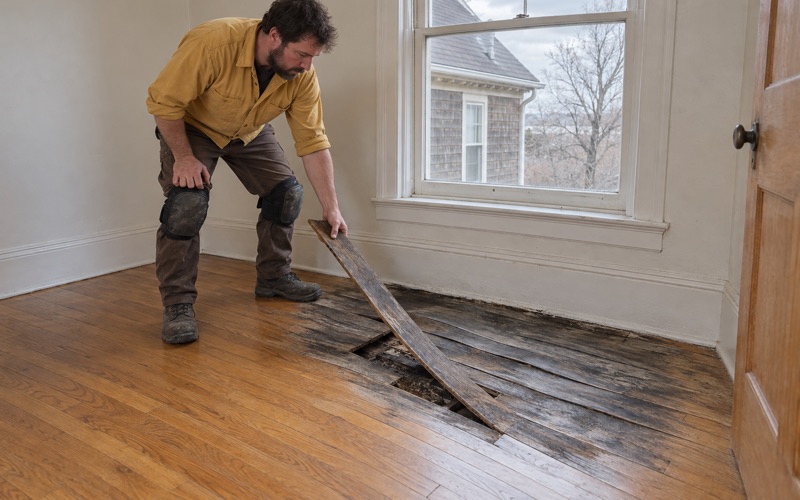
We walk the floor first and name what we see, because the answer is different for each one. Traffic lanes, rug shadow where a carpet sat for years and sun fade along a window line are finish-level wear that generally comes off in a sand. Pet urine stains and water stains reach into the wood itself, and those areas often need board replacement instead.
Cupping and crowning tell us about moisture rather than foot traffic, so we chase the source before planning any sanding. Board gapping that opens every winter and closes every summer is normal seasonal movement in a solid floor, not a defect, and we say so rather than selling a repair for it. Exit holes with frass beneath them point to powderpost beetle or old house borer, which is another trade’s call before ours.
Entry Areas Take the Worst of It
An entry area collects grit, and grit is what actually takes a finish off underfoot. Where people walk to the bus and the train more than they pull into a driveway, the first six or eight feet inside a door commonly wear two or three times faster than the rest of the room.
That is often a screen and recoat every few years rather than a full sand, which keeps the wear in the finish instead of in the wood. Where the finish has already been walked through to bare boards, we sand the room and match the sheen level to the adjoining floors so the work does not announce itself. Thresholds, reducers and quarter round get replaced where they have been chewed up instead of painted over.
Repairs That Disappear Into the Floor
Weave-in repair is what we do in place of a patch panel. Boards are cut back at staggered ends, new stock of the same species and width is laced into the opening, and the area is sanded and finished as one continuous floor.
That is how we handle a radiator removal patch, a run of floor opened for an electrical change, and the strip left behind when a wall comes out. On older red oak strip flooring, matching means matching grain and cut as well as species, so rift and quartersawn boards do not get dropped into a plainsawn floor and left to stand out.
Commercial and Institutional Floors That Stay in Use
The small commercial and institutional buildings mixed into East Boston’s residential blocks have floors that cannot close for a week. Storefronts, offices and meeting rooms keep their schedule whatever we are doing, so we plan the work around the building rather than around the sander.
Sequencing Around an Open Building
We work in sections, close off whatever is being sanded, and hand back usable floor at the end of each stage. Waterborne polyurethane is usually the right call in an occupied building, because it goes down in more coats and returns the space to foot traffic sooner than oil-modified polyurethane does.
Oil-modified still wins where somebody wants its warmer amber color on an older floor and can give us the extra time. Hardwax oil is a third option worth discussing when a floor will be maintained in place and spot-repaired rather than fully recoated every decade. We lay those trade-offs out in the estimate instead of defaulting to one product.
Finishes, Residue and Dust
Every finish we put down is chosen to fit the Massachusetts VOC limits for wood coatings under 310 CMR 7.25, which are stricter than the federal ones. That is a real constraint on product selection in this state rather than a formality.
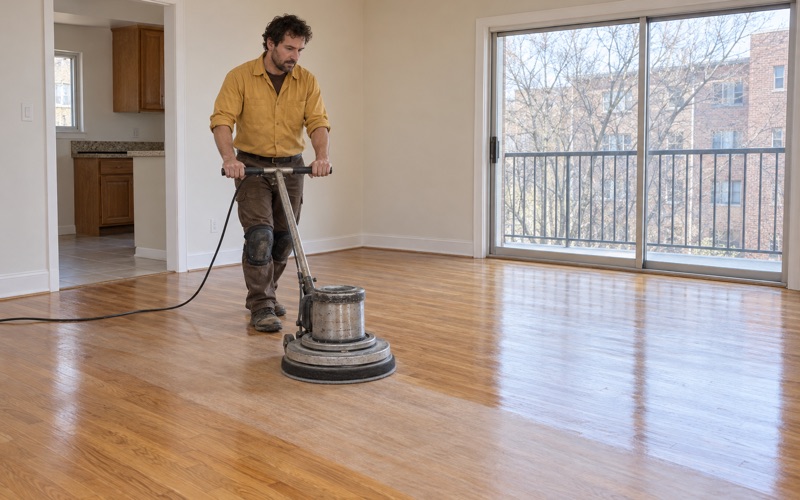
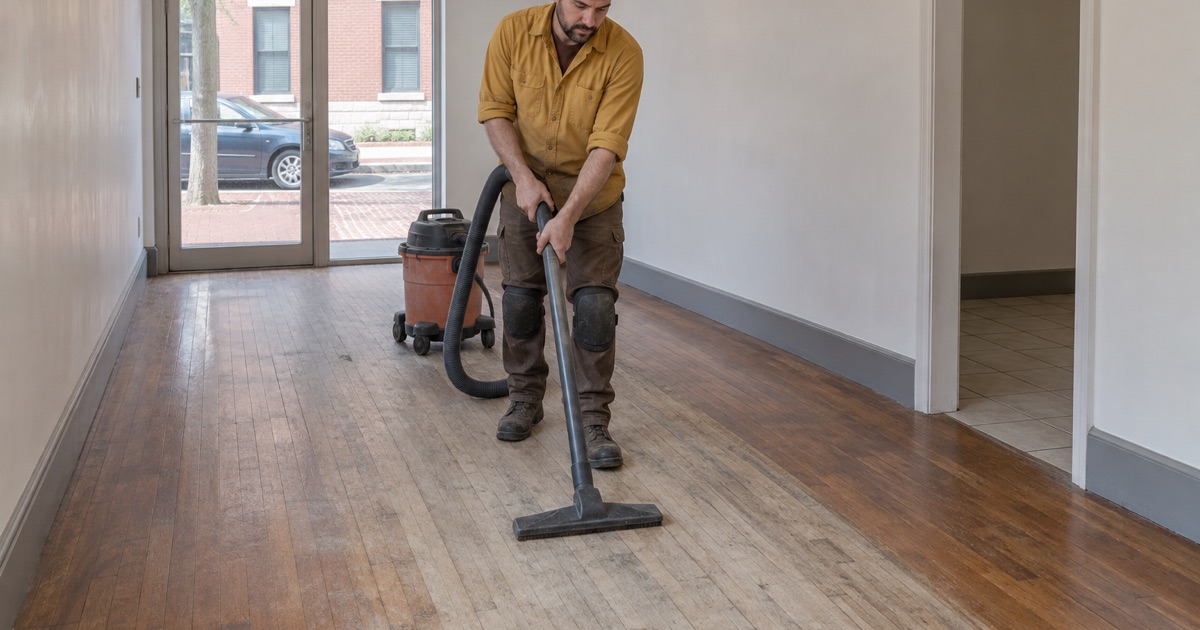
Before anything is applied, we test for old wax and cleaning-product residue and remove it, because a waterborne finish laid over wax peels in sheets months later. Sanding is done dustless, with the drum sander and orbital sander tied into HEPA vacuums, which matters more in an occupied building than anywhere else. Rosin paper protects whatever floor we are not working on that day.
Stairs, Thresholds and Transitions
Stairs are quoted tread by tread. A commercial staircase with worn stair nosing and split stair risers is often more work than the room it leads to, and pricing it by the square foot hides that instead of answering it.
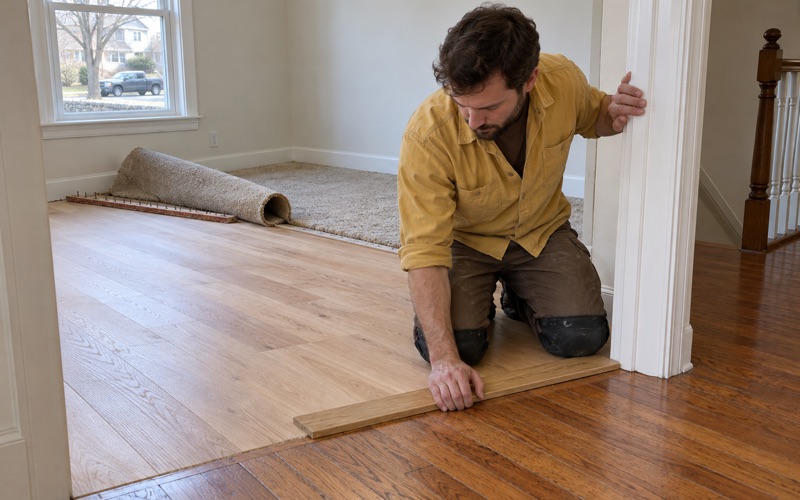
Transitions are where a phased job shows its seams if nobody plans them. We set reducers and thresholds at doorways so each stage ends on a line that looks deliberate, and so the building can go on using the half that is already finished.
Planning a Floor Project in East Boston
What We Check Before Sanding Starts
The build year comes first. Massachusetts runs its own lead-safe renovation rules for homes built before 1978, so the age of the building and any painted surfaces in the work area get checked before a machine is switched on.
What sits underneath is the other question. Old resilient floor tile and the black mastic beneath it are identified rather than disturbed, and we stop and hand that off to the right trade instead of sanding through it. Where a floor is below grade on a lower level, we match the specification to the moisture we actually measure there, which usually means engineered wood over a vapor retarder rather than solid hardwood.
Water gets the same treatment. A burst pipe, an overflowing appliance or a wet lower level is traced, dried and read with a moisture meter before a single board is replaced. The affected rooms are documented one at a time so an adjuster has something concrete to work from.
Who the Local Authorities Are
East Boston is a neighborhood of Boston, annexed by the city in 1836, rather than a separate municipality, so the authority here is the City of Boston and the county is Suffolk. Building matters go to the City of Boston Inspectional Services Department.
For owners renting out a unit, the city runs an annual rental registration and a five-year rental inspection, with owner-occupied buildings of six or fewer units exempt from that inspection. We give landlords itemized written estimates, which is what Massachusetts requires before a tenant can be charged for floor damage. Owner-occupied two- and three-families are worked one floor at a time, so the household on the other floor keeps living in the house while we are there.
Winter Gaps, Humidity and Timing
An East Boston address falls in NWS forecast zone MAZ015, Suffolk, and the seasonal swing there is what opens and closes a solid floor every year. Winter gaps between boards in a heated house in February are normal, and a floor sanded and filled at the widest point of that swing will show ridges in July.
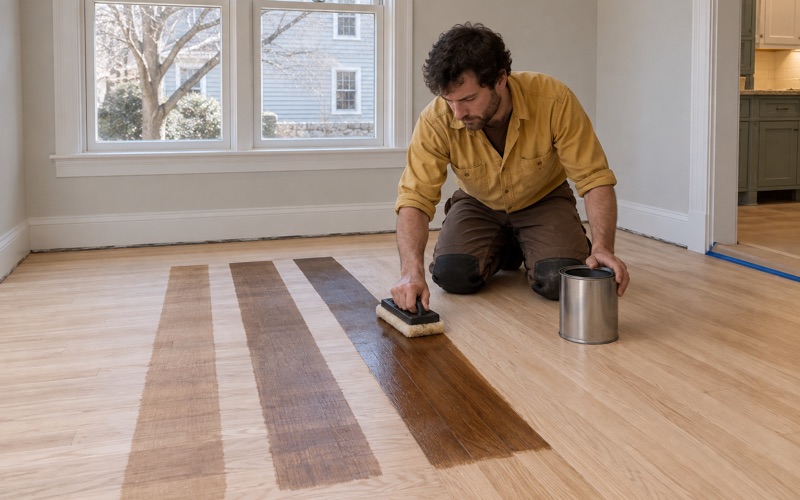
So we acclimate material in the space before installation and leave the expansion gap at the walls where it belongs under the molding. Water popping before stain goes down evens the color across boards that would otherwise take it differently. Then stain samples are laid on your own floor, in your own light, so a color is chosen from what you can actually see rather than from a card.
- 20+ Years On Wood Floors
- Written Itemized Estimates
- Stain Samples On Your Own Floor