Waltham Wood Flooring installs, repairs and refinishes wood flooring in Everett, and after more than twenty years of it we are usually called in the same week somebody gets the keys. A floor that has spent decades under carpet is a question mark until someone kneels down and pulls a corner back. That first look decides the whole job.
We work the way an empty house lets us work: boards read first, moisture measured, the finish chosen only after we know what the wood is. Nothing about a first sanding is reversible, so we would rather spend an hour on the diagnosis than lose a floor to a guess.
What follows is how we approach a floor in a newly bought house here: what tends to be under the covering, and which boards come back. It is also why we push so hard to get the work finished before the furniture arrives.
The first floor job in a newly bought Everett house
Most of the floors we open up in this city belong to somebody who has owned the building for about a week. The purchase closed, the previous owner’s rugs went out the door, and underneath there is either hardwood nobody has seen in decades or a subfloor that was never meant to be looked at. We are there to tell the difference before anything else gets scheduled.
That is a better moment than it sounds. The rooms are empty, nobody is living around the work, and the decisions ahead — sand or replace, stain or clear, solid or engineered — are all still open. Once the furniture is in, every one of them gets more expensive.
What the floor is worth comes up in that first conversation too. A building bought as a first home rarely has a large budget left over at closing, and knowing which rooms need work now and which only need cleaning is most of the value of the visit.
Why the calendar matters here
The city’s First-Time Homebuyer Down Payment Assistance Program provides $20,000 in assistance to eligible applicants, funded by a $400,000 earmark from the FY23 American Rescue Plan Act. Assistance is provided on a first-come, first-served basis based on the date and time of the receipt of a completed application. We are a flooring company and have nothing to do with that paperwork, but we see what it does to a schedule.
A buyer working to a date-and-time queue is often moving faster than they would choose, and the floor is the one item that genuinely cannot be done later without emptying the rooms again. So we quote quickly, and we say plainly when a floor can wait a year.
What we look at on the first walkthrough
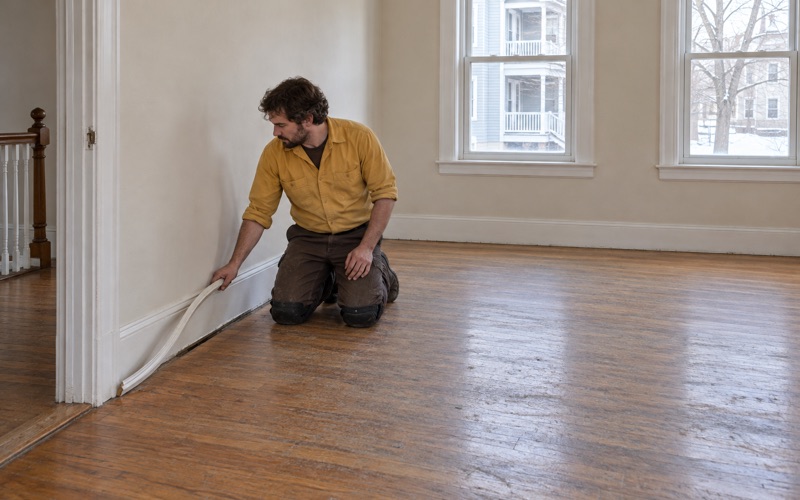
We start at the edges, where a floor tells the truth: under a closet door, along a heat register, at the top of the stairs. A corner of covering lifted at a threshold shows the species, the board width and the layers in between. From there we check thickness at a cut edge, because that number decides whether a sanding is available at all.
Then the moisture meter comes out, room by room and level by level, along with a look at the joist bays from below where that is possible. Cupping, crowning and board gapping all have causes, and reading the cause first is the difference between a repair that holds and one that returns next winter.
Looking for wood-flooring closer to North End? See Wood-Flooring in North End.
What is under the carpet in a pre-1940 Everett two-family
Everett’s housing stock is old in a way that usually works in a floor’s favor. Of the city’s 18,827 housing units, 10,035 — 53.3 percent — were built in 1939 or earlier, back when a strip floor went down as a matter of course. Pull a covering in one of those buildings and there is often narrow tongue and groove hardwood underneath, fastened with cut nails over a plank subfloor.
The other number that shapes this work is the building type. 52.5 percent of the city’s units sit in two-, three- or four-unit structures — 4,839 in two-unit buildings and 5,049 in three- and four-unit ones — so a first purchase here is frequently a whole small building rather than a single house. That means several floors, often of different vintages, under one roof.
Carpet, pad and tack strip
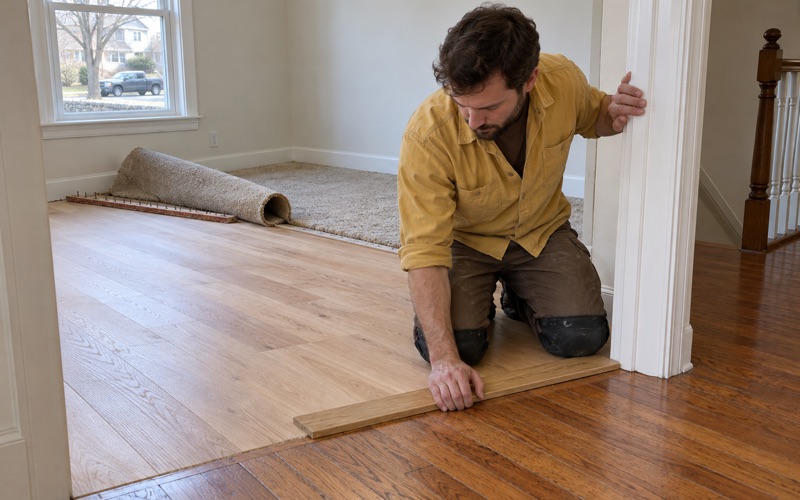
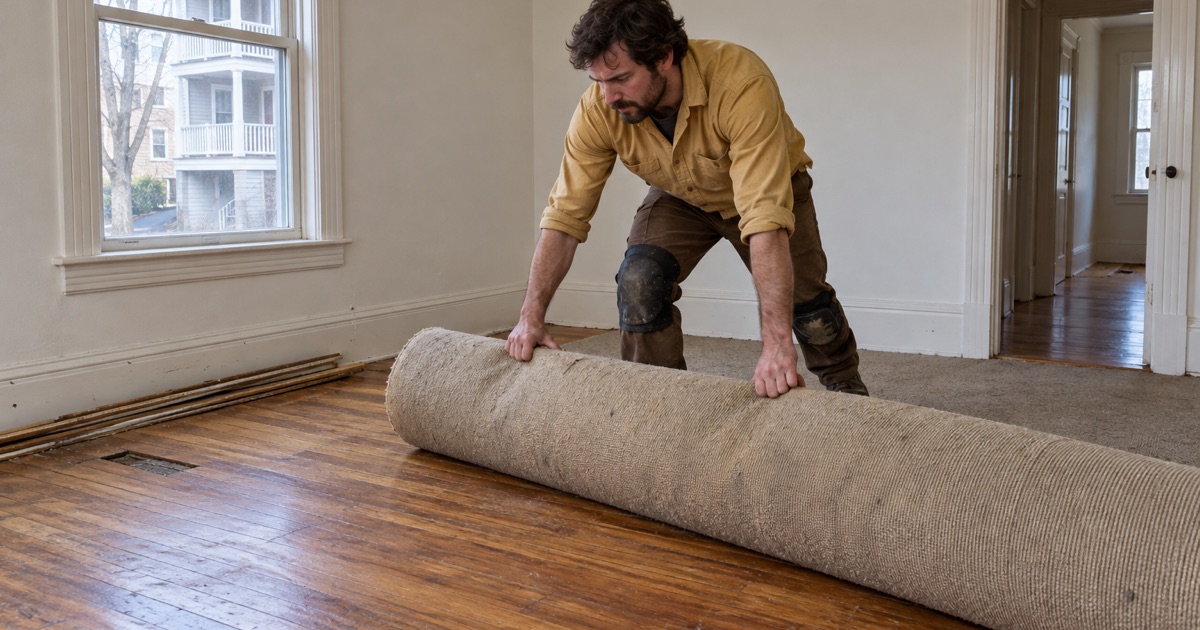
Wall-to-wall carpet is the kindest thing that can happen to an old floor, and taking it out is the easiest part of our day. The pad and the tack strip come up, the strip’s nails come out of the border, and a layer of rosin paper sometimes appears underneath as evidence the floor was finished before it was ever covered. What is left is usually dull rather than damaged.
What does show is the pattern of how the house was lived in: traffic lanes worn through the finish at the doorways, rug shadow where a carpet sat before the wall-to-wall went down, sun fade at the windows and a dark ring where a plant stood. Almost all of that sits in the finish and the top fraction of the board.
Vinyl, adhesive and what we leave alone
Sheet vinyl and resilient floor tile are a different conversation. Older resilient tile and the black mastic under it are materials we identify rather than disturb, and when we find them we stop and say so until the right trade has handled it. Nobody should be running a sander over an unknown adhesive.
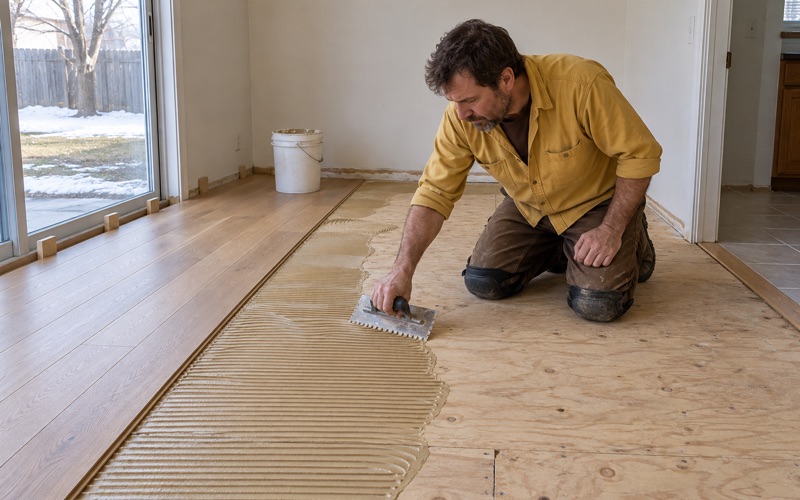
Where the adhesive is a modern one, the residue still has to come off the wood before any finish goes down. The same goes for decades of wax residue and cleaning-product buildup on a floor that was never covered at all — we test for it and remove it, because a finish laid over wax peels instead of bonding.
Under all of it, the subfloor matters as much as the surface. Board gapping that opens every winter and closes by June is seasonal movement and needs nothing done to it, while a floor that moves underfoot is a fastening or joist question that has to be settled before a finish goes anywhere near it.
Which old boards come back and which do not
The honest answer is that most of them come back. A hardwood floor from that era was laid thick, and if the tongue and groove is sound and the boards are tight to the subfloor, a sanding and a new finish give you a floor that will outlast almost anything sold today. Our first job is to confirm the thickness is actually there.
Before a sander starts we check the build year and any painted surfaces in the room, because Massachusetts runs its own lead-safe renovation rules for homes built before 1978, and 77.2 percent of the city’s housing units predate 1980. That changes how we set up for the work, not whether the work can be done.
What sands out and what does not
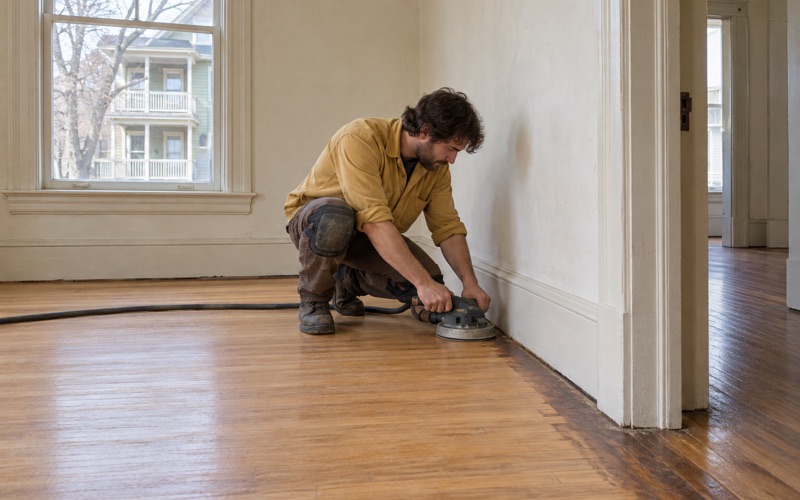
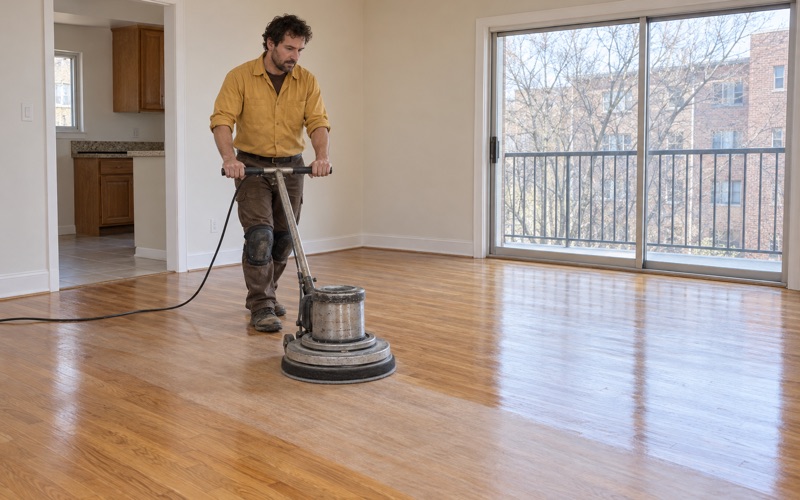
Traffic lanes, water stains, orange oak that has ambered under an old shellac finish and most surface scratching all disappear in the grit sequence. We run a drum sander for the field and an orbital for edges and corners, with dustless sanding through a HEPA vacuum so the rest of an empty building stays usable while we work.
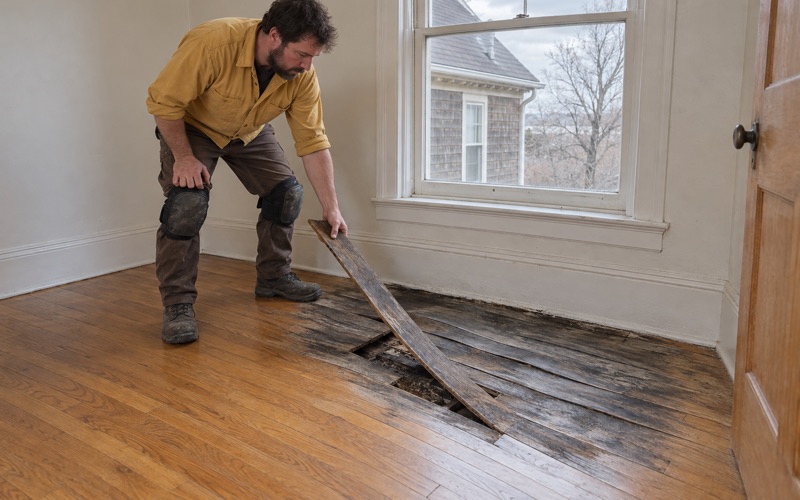
Pet urine stains that soaked through the finish and into the board are the common exception; they discolor the wood itself and often the subfloor beneath, and the fix is replacement rather than sanding. Deep gouges, burn marks and boards eaten by powderpost beetle — exit holes and frass in the joist bays are the tell — fall in the same category.
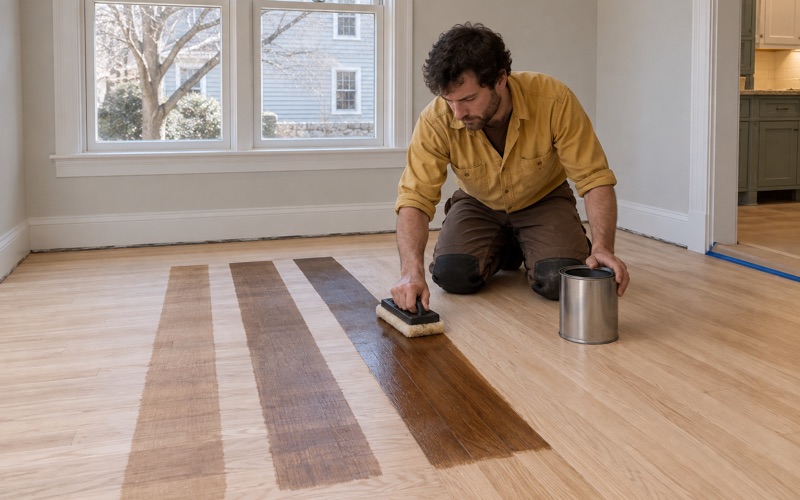
Where a color is going on, we lay stain samples on your own floor in your own light before anything is committed, and water pop the field when a darker tone needs even uptake. Sheen level gets chosen the same way, on the actual boards rather than out of a fan deck.
Patches, radiator holes and missing boards
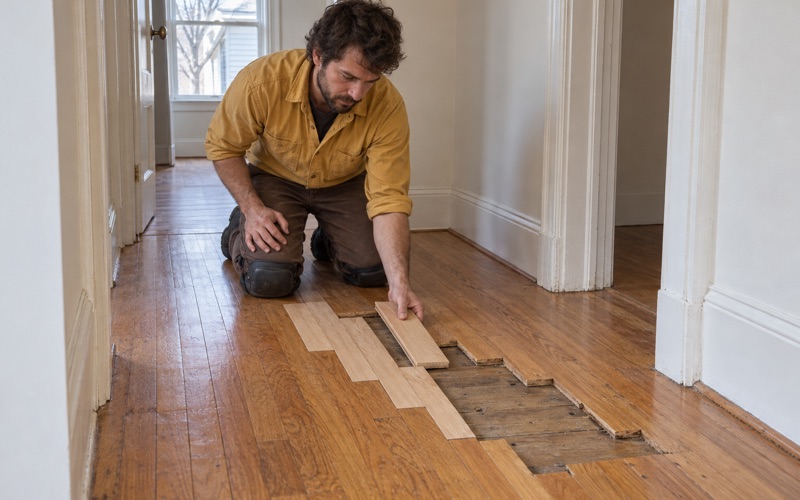
Steam heat left its mark on nearly every old building here. When a radiator and its pipes come out there is a hole in the floor, and we patch it with matching boards woven into the surrounding field rather than filled, so the repair reads as floor instead of as a scar.
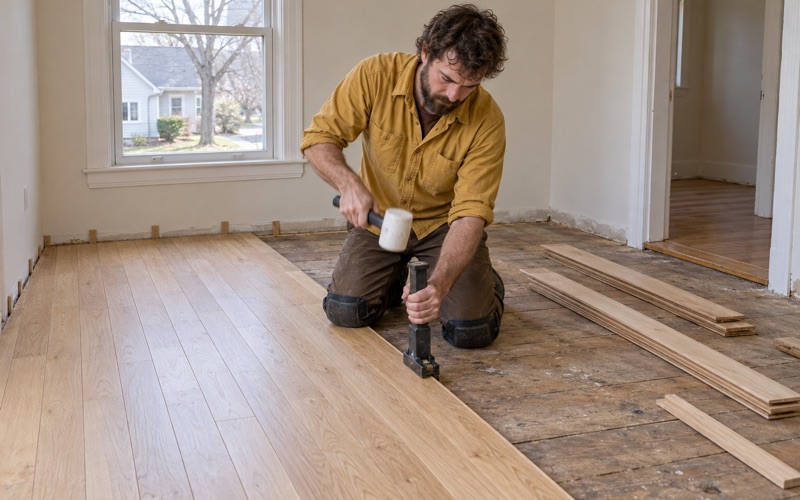
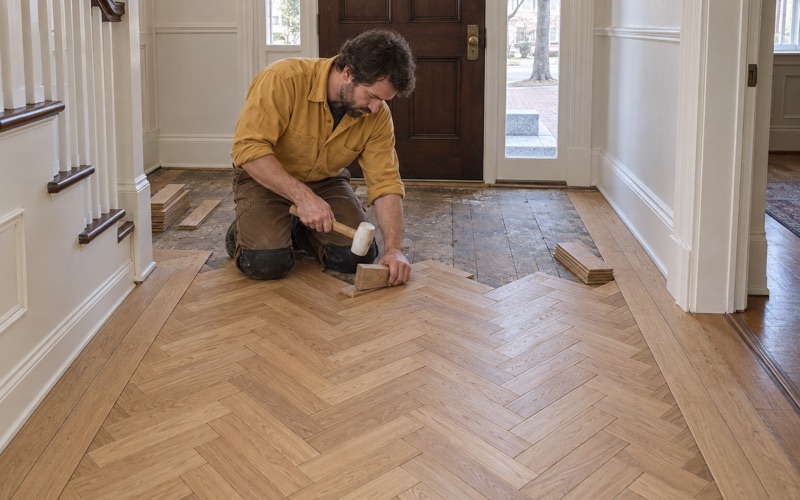
The same weave-in repair handles the line a removed wall leaves behind and the notch where an outlet or a pipe was moved. Board replacement means sourcing the right species and width — red oak strip flooring in most of these houses, eastern white pine in the oldest of them — and letting it acclimate in the room before it goes down.
Doing the floors before the furniture arrives
The weeks between a closing and a move-in are the cheapest time in a floor’s life to do this work. Nothing has to be lifted, wrapped or stored, no household is sleeping down the hall from a running sander, and the finish gets to cure on an empty floor with the windows open.
It is also the only window in which a whole building can be treated as one job. Matching a stair to a hall, or a bedroom patch to the field it sits in, is far simpler when every room is open at once and the same batch of finish covers all of it.
Working a building with more than one unit
Not every unit in a two- or three-family building is empty on the same day, and that is normal. We work those buildings one floor at a time, sequenced so that whoever is living on another level keeps a clear path to their own door and their own stairs while we are in the rest of the house.
Each level also gets read on its own terms. A lower-level floor is matched to the moisture we actually measure there, which usually means engineered wood with a real wear layer instead of solid hardwood, and expansion gaps are set for what the boards will do in a Massachusetts winter rather than for what they measure in August.
Stairs, finishes and the edges
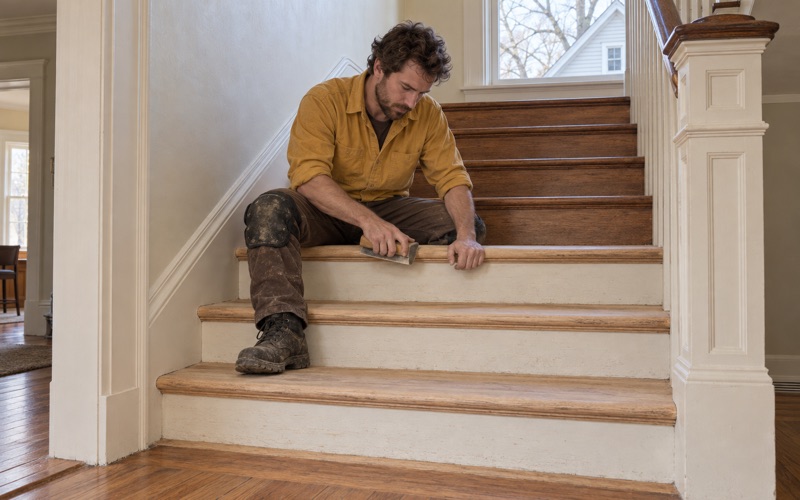
Stairs are quoted tread by tread, because a staircase is not priced by the square foot. Treads, risers and nosings each take different work, and in an old building the stair is often a different species and a different age than the floor it lands on.
Finishes are chosen to fit the Massachusetts limits on volatile organic compounds in wood coatings, which are stricter than the federal ones. Waterborne polyurethane, oil-modified polyurethane and hardwax oil each behave differently on an old floor, and the choice follows the room. Reducers, thresholds and quarter round are cut last, once the field is down and flat.
A floor that gets this treatment before the furniture arrives will not need it again for a long time. A screen and recoat every several years keeps the finish ahead of the traffic, and the boards underneath stay exactly where they are.
- 20+ Years On Wood Floors
- Written Itemized Estimates
- Stain Samples On Your Own Floor