Waltham Wood Flooring has been sanding, repairing and refinishing wood flooring in Forest Hills for more than twenty years, and the work here starts at the door. Houses in this pocket of Jamaica Plain sit against a great deal of unpaved ground, and what comes in on shoes ends up in the finish. We plan a Forest Hills floor around that first, then around everything else.
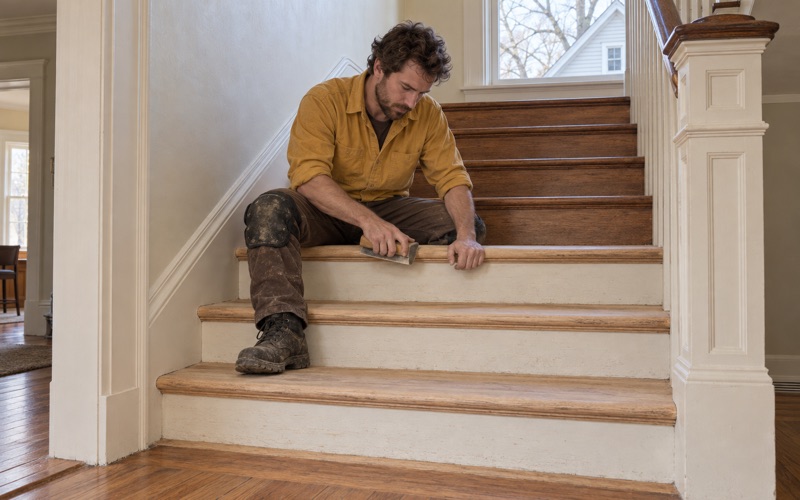
Our crews handle solid hardwood and engineered floors, board replacement and weave-in repair, stair treads and risers, and full sand-and-finish jobs on floors that have been walked on for decades. We work in single-family houses, owner-occupied two- and three-families, and the small commercial spaces near the station. Each of those has a different tolerance for dust, noise and time off the floor, and we quote accordingly.
Every estimate we write for Forest Hills is itemized, and stairs are counted tread by tread rather than folded into a square-foot number. Before we sand anything we check the build year and any painted surfaces, because Massachusetts runs its own lead-safe renovation rules for homes built before 1978. That check happens on the first visit, not the morning the machines arrive.
Floors Beside the Arboretum, the Cemetery and Bussey Brook Meadow
Forest Hills is a small residential pocket wrapped in institutional land, and the acreage around it is the single biggest factor in how its floors wear. Forest Hills Cemetery is a 275-acre rural cemetery, created when the Roxbury City Council gave an order on March 28, 1848 to buy the farms of the Seaverns family, and privatized when Roxbury was annexed to Boston in 1868. The Arnold Arboretum of Harvard University spans 281 acres on another side.
The 24 Acres Between the Station and the South Street Gate
Bussey Brook Meadow fills the ground between the two: 24 acres of spontaneous meadow and wetland assembled from parcels that formerly belonged to the MBTA, the City of Boston and Harvard University, brought under the Arboretum’s indenture in 1996. The Blackwell Footpath crosses it, connecting the Forest Hills T station to the Arboretum’s original South Street Gate. It is a pleasant walk and a hard one on a floor.
Grit tracked off a footpath is sharper and wetter than grit off a sidewalk, and it behaves like sandpaper under a shoe. On floors within a few blocks of the meadow we usually find the finish worn through in the entry long before the rest of the room has aged at all. That pattern is repairable, but only if it is read correctly.
We would rather add protection at the entry than refinish a whole room twice as often. A deep mat run inside the door, a landing zone where boots come off, and a screen and recoat laid before the finish is breached will hold a red oak strip floor for years. Once the wear reaches bare wood the fix is a full sand, and the price changes with it.
What We Do Not Quote for Forest Hills
Forest Hills has no Census geography of its own and is counted inside Jamaica Plain, so we quote no population figure, no housing share and no ownership percentage for it. When a contractor hands you a number attached to this name, it came from somewhere larger. We would rather tell you what we measured in your own rooms.
The same discipline applies to the institutions next door. We describe the ground because it changes how floors wear, not because it implies anything about who we work for. Henry A. S. Dearborn, botanist, mayor of Roxbury and first president of the Massachusetts Horticultural Society, founded the cemetery as a rural garden burial ground, and that is history rather than a reference.
Looking for wood-flooring closer to Stoneham? See Stoneham Wood-Flooring.
Entry Areas, Hallways and Traffic Lanes
The wear we see most often in Forest Hills houses is a lane rather than a spot: a darkened, dulled path from the front door through the hall and into the first room anyone actually uses. Traffic lanes are a finish problem before they are a wood problem, and catching them at that stage is what keeps the cost down.
Screen and Recoat Before the Finish Is Gone
When the wear layer of polyurethane is thin but the wood underneath is still sealed, we abrade the existing finish with an orbital sander and lay a fresh coat over it. A screen and recoat takes a fraction of the time of a full sand, puts far less dust in the house, and removes no thickness from the boards.
The test is simple and we do it in front of you. If water beads, the finish is intact; if it darkens the wood, the seal is broken and a recoat will not hold. We also test for old wax and cleaning-product residue and remove it, because a coat laid over wax peels instead of bonding.
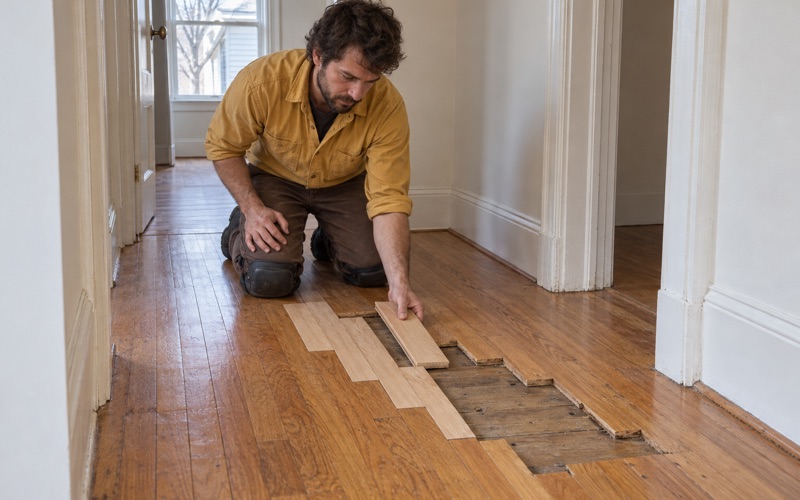
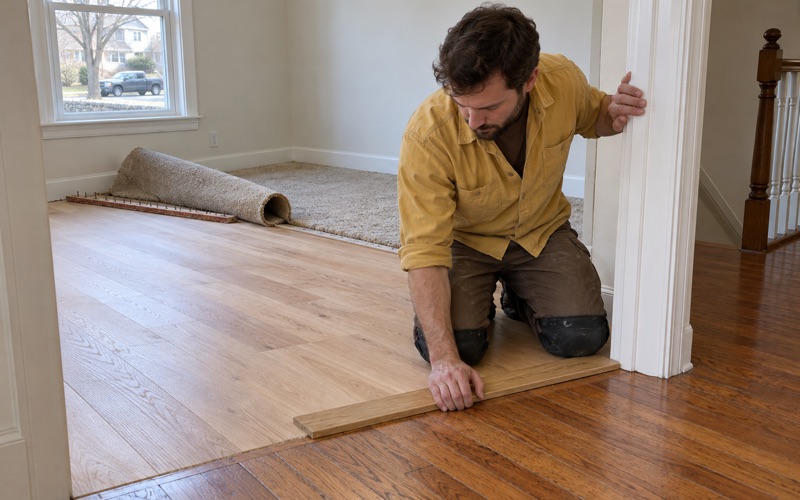
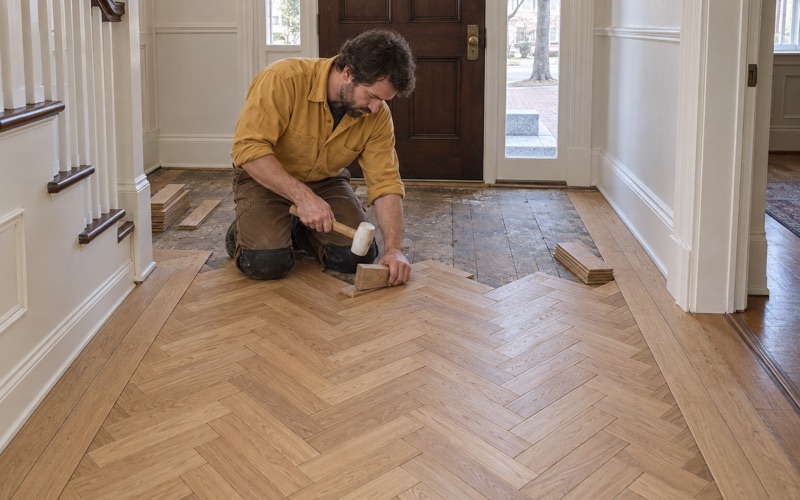
We look at the boards themselves before deciding anything. A weave-in repair around a damaged board, a patch where an electrical outlet was moved, or a hole left where a steam radiator and its pipes came out are all done with matching boards threaded into the existing courses. The repair reads as floor rather than as a scar.
When the Lane Has Gone Through to Bare Wood
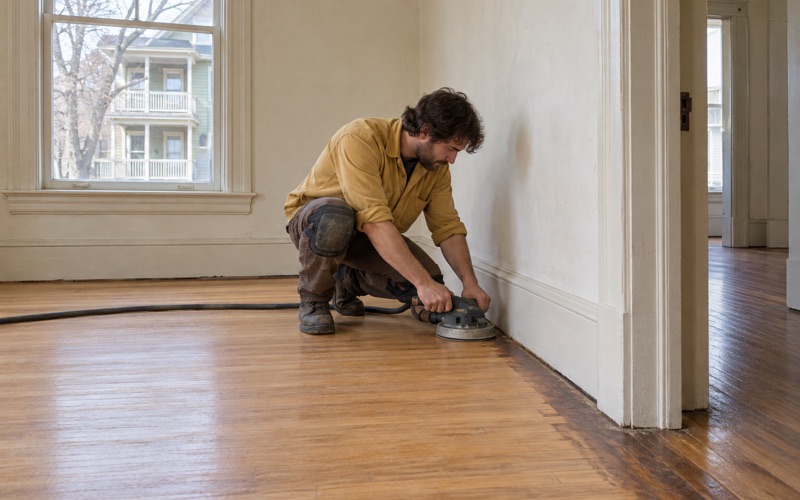
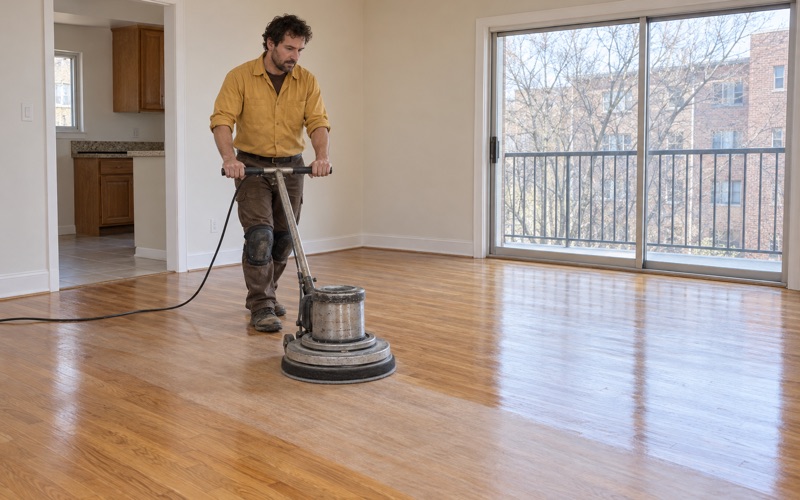
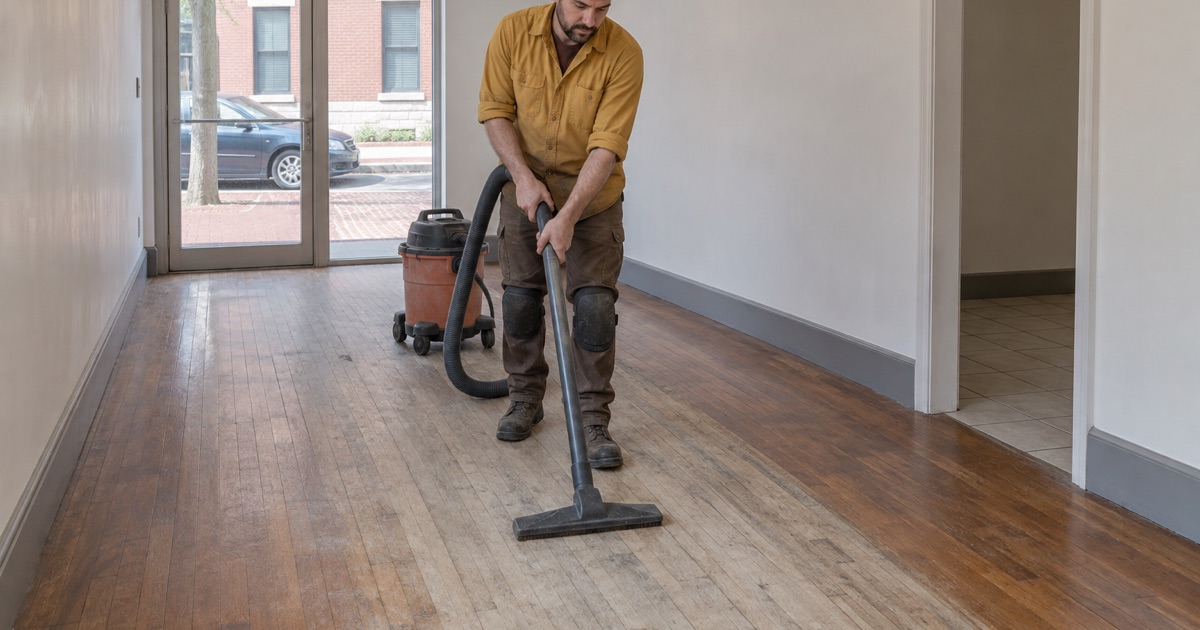
A floor sanded through the finish in the traffic lane needs a full grit sequence with a drum sander, followed by edge work and a final pass with an orbital. We run dustless sanding with a HEPA vacuum on the machines, which matters more in an occupied house than most people expect.
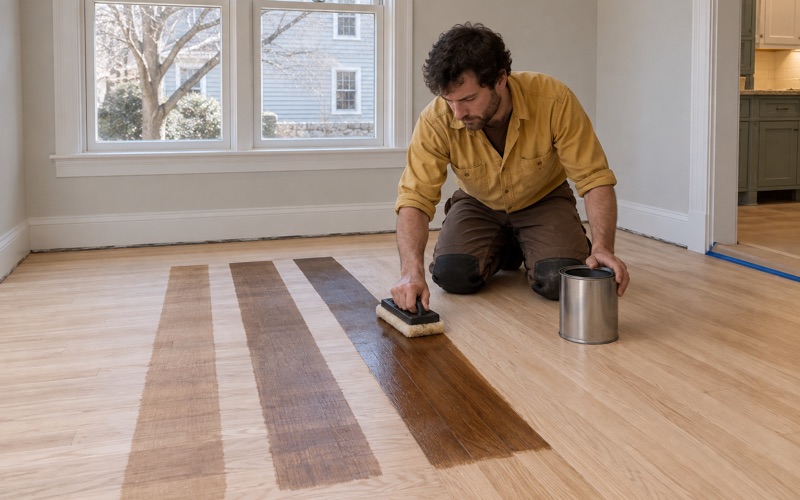
Old red oak strip flooring often carries an orange cast from decades under an aged shellac finish or an oil-modified polyurethane. Once it is sanded back, the color decision is yours, and we lay stain samples on your own floor in your own light before anything is committed. A sample board under a showroom bulb tells you very little.
Rug shadow and sun fade complicate that choice. Where a rug has sat for twenty years the wood beneath it is a different color from the rest of the room, and sanding evens the surface without fully evening the tone. We tell you which of those differences will disappear and which will fade in slowly over the following year.
Moisture on the Low Side of a Forest Hills House
The neighborhood’s terrain does not sit level. Forest Hills is characterized by hilly terrain and wooded areas within and adjacent to its borders, and in general the area slopes upward from Hyde Park Avenue and downward from Walk Hill Street. A house on a grade has a wet side, and it is almost always the low one.
Reading the Floor With a Moisture Meter
Before we specify anything for a lower level or a room on the downhill side, we take moisture readings in the wood and the subfloor and write them down. A number decides the material; a guess decides a callback. Where the readings run high we recommend engineered wood with a substantial wear layer rather than solid hardwood, because engineered construction tolerates the swing.
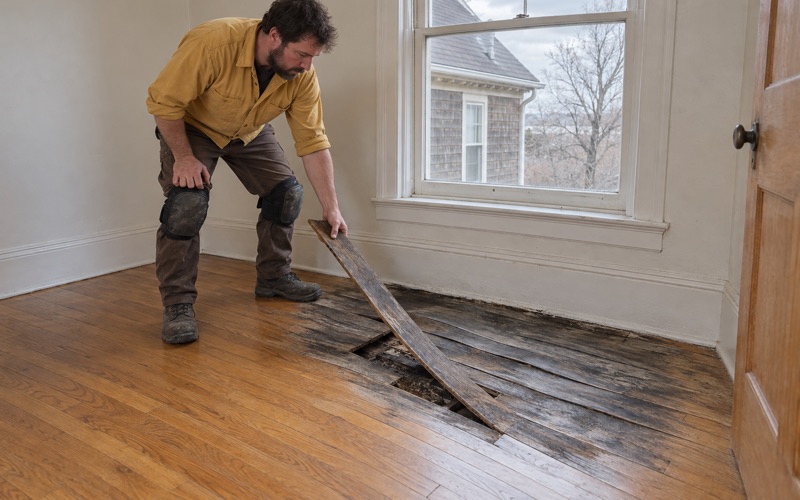
Cupping, where boards rise at their edges, is the first visible sign that a floor is taking on moisture from below. Crowning is the same story after a floor has been sanded flat while it was still wet, and buckling is what happens when nothing is done at all. Each has a different fix and all three start from the same reading.
Board gapping runs the other way. Winter gaps open when the heat is on and the air in the house dries out, and most of them close again by June. We watch across a full heating season before calling a gap permanent and filling or replacing anything.
Water That Arrives All at Once
A burst pipe, an overflowing appliance or a wet lower level is a different problem from slow seasonal moisture. We trace where the water went, dry the assembly, and read it with a moisture meter before any board is replaced, because setting new boards into a wet subfloor guarantees the job comes back.
We document a water-damaged floor room by room for the adjuster, with readings and photographs taken as we go. That record belongs to you and you can use it however you like. What we will not do is tell you what your policy pays for, because that conversation belongs between you and your carrier.
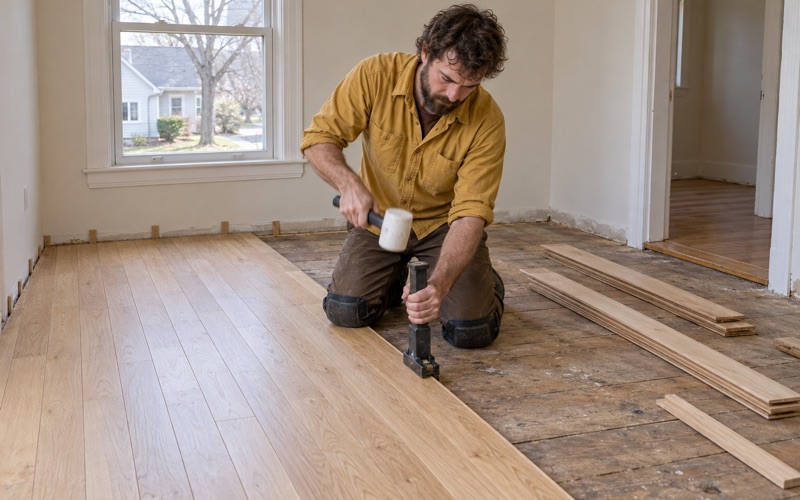
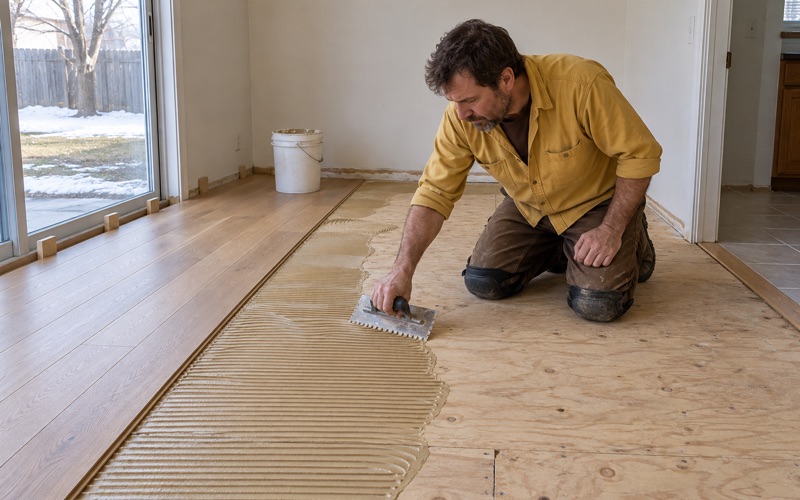
Acclimation matters just as much on the dry side of the job. New material sits in the room it will live in until its moisture content settles, and we leave a proper expansion gap at every wall so the floor can move with the season instead of against it.
Small Commercial Floors Near the Station and Planning the Work
The blocks around Forest Hills station carry small commercial spaces as well as houses, and a floor in a shop, a studio or an office has a different job to do than one in a hallway. It takes more traffic, it takes it in a narrower path, and it cannot be out of service for a week.
Commercial Floors and the Hours They Are Free
We schedule commercial work around the hours a space is closed, and we stage it so the front of the room is walkable before the back is finished. Waterborne polyurethane cures quickly enough to make that possible, which is why it is the usual choice where a business needs its floor back fast.
Our finishes are chosen to fit the Massachusetts VOC limits for wood coatings, which are stricter than the federal ones. That narrows the product list in a way worth knowing before a specification is written, and it is a common reason a coating that worked in another state is not available here.
Rental Units and Written Estimates
The City of Boston’s Inspectional Services Department is the building authority here, since Forest Hills is part of the Jamaica Plain neighborhood and carries no official designation of its own. Owners of rental property deal with that department rather than a town office, and it helps to know whose name is on the paperwork before a project starts.
For landlords we write itemized estimates, which is what Massachusetts requires before a tenant can be charged for floor damage. An itemized document separates the boards from the finish from the stairs, so nobody is arguing later about what a lump sum was meant to cover.
Working Around a Household
In owner-occupied two- and three-families we work one floor at a time, so the household on the other floor keeps living in the house. That takes longer on paper and costs far less in disruption than moving everyone out for a week.
Two things stop a job on the spot. Old resilient floor tile and the black mastic under it get identified rather than disturbed, and the work pauses until the right trade has handled it; the same goes for painted surfaces in a house built before 1978. Neither is a delay we apologize for.
Beyond that the sequence is straightforward: we look at the floor, measure it, tell you what it is made of and what it has left, and put the options in writing. Postwar oak strip floors in houses built in the 1950s and 1960s are usually worth sanding and refinishing rather than tearing out, and we check the board thickness before we say so.
- 20+ Years On Wood Floors
- Written Itemized Estimates
- Stain Samples On Your Own Floor