
Waltham Wood Flooring stains hardwood floors throughout Waltham, MA, serving surrounding cities including Belmont, Watertown, Lexington, Newton, Arlington, and after 20+ years the rule we hold to most firmly is that nobody chooses a color from a chart. Stain samples go down on your own floor, in the room they are for, and get looked at in daylight and again under lamps at night before anything is committed.
The reason is that stain is not paint. It is pigment soaking into wood, so the result depends on the species, the cut, the density of each board, the age of the floor and how much of its original patina survived the sanding. The same can of stain produces genuinely different colors on red oak, white oak and maple, and a color that looked right on a supplier’s board can be unrecognizable on a hundred-year-old floor.
The second half of the work is getting that color to land evenly. On species that absorb unpredictably, we raise the grain before staining so the wood takes pigment uniformly rather than in patches. That stage is decided by the species and the color you have chosen, not applied to every floor as a matter of routine.
Choosing A Color That Works In Your Rooms
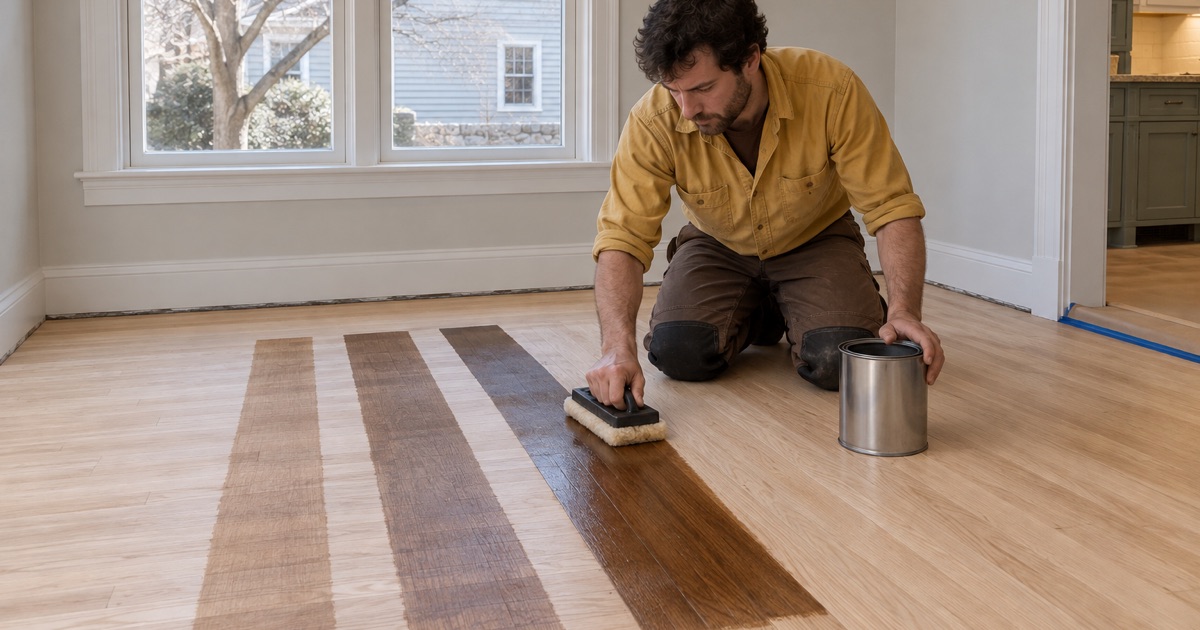
Color decisions made on the floor itself are almost always different from the ones made on a chart, and they are the ones people are still happy with years later.
Samples On Your Own Sanded Floor
Once the floor is sanded we lay the shortlisted colors directly on it, in reasonable-sized patches, in the rooms they are for. Small swatches mislead — a color reads differently across an area than in a square, and the eye judges a floor as a whole surface rather than as a sample.
How The Room’s Light Changes It
A north-facing room, a room with a single window and a room with lamps on in the evening are three different viewing conditions for the same color. We leave the samples down long enough for you to see them under all of them, because a stain chosen at midday in a bright room can look entirely wrong at seven in the evening.
Matching What Is Next Door
Where the newly stained floor will be seen alongside an existing one, the target is the neighboring floor rather than a catalog color. We test directly against it, adjust, and test again. An aged floor is a moving target, which is why sanding and finishing both areas together is the more reliable route when it is available.
How Different Species Take Color
Species is the largest single variable in a stain result, and it is fixed before the conversation starts. Whatever is already on the floor of an older house is what you are coloring, and no amount of product selection changes how that particular wood absorbs pigment. Knowing the species tells us which colors are realistic and which will fight the floor the whole way.
Red Oak And White Oak
Red oak is the New England default and stains predictably, though its natural pink undertone persists through lighter colors. White oak is cooler and more neutral, which is why it carries gray and natural finishes more convincingly. The open grain of both takes pigment readily, so coverage is rarely the problem.
Maple And Eastern White Pine
Hard maple is closed-grain and dense, and absorbs unevenly enough that an unconditioned floor commonly goes mottled. Eastern white pine is soft with variable density between the growth rings, which produces its own kind of patchiness. Both can be stained well, but they need preparation rather than a straight application.
Old Floors With Their Own History
A floor a century old has absorbed a great deal over its life, and sanding removes the surface but not everything below it. Areas around old radiators, former rug lines and previously repaired sections can take stain differently from the field. We test in several places rather than one, so those areas show up at the sampling stage.
Water Popping And Even Color
This is the stage that most separates an even floor from a patchy one, and it is invisible in the finished result when it has been done properly. Nobody looks at a finished floor and identifies water popping; they notice its absence, in a color that sits lighter in some boards than others. It adds a stage to the schedule and it is not optional on the floors that need it.
What It Is
After the final sanding pass, the floor is wetted evenly so the crushed surface fibers swell and stand up. The wood is left open rather than burnished closed, which is exactly the condition it needs to be in for pigment to penetrate consistently across every board.
When A Floor Needs It
Darker colors need it most, because unevenness is more visible the more pigment is involved. Species that absorb unpredictably need it. A clear finish over red oak generally does not. We decide it against the species and the chosen color rather than treating it as standard on every job.
What Happens Without It
An unpopped floor takes stain shallowly and inconsistently, so the color sits lighter than the sample, wears through sooner in the traffic lanes, and often shows the sanding pattern through it. None of that is correctable afterward without sanding back and starting the color again.
Taking An Existing Floor Somewhere Different
Most staining work here is not a new floor being colored; it is an old floor being moved away from the color it has drifted into. That is a different problem from choosing a color for new wood, because there is an existing tone to work with or against rather than a blank surface. It is also why the sanding stage so often changes what people want.
Why Old Floors Read Orange
The orange in an old oak floor is very rarely the wood. It is decades of oil-modified polyurethane ambering, or an older shellac finish doing the same, over red oak that was a much cooler color underneath. Sanding to bare timber usually reveals a floor people are surprised by.
Natural And Clear Finishes
A waterborne finish over bare wood holds the floor close to its natural tone and stays there, rather than warming year on year. For many houses that is the whole project — no stain at all, just the removal of what was on top and a finish chosen not to reintroduce it.
Gray, Dark And The Practical Limits
Very dark and gray floors are achievable, and both are less forgiving than a mid-tone. Dark colors show dust, foot marks and every scratch that reaches the wood; gray depends heavily on the underlying species. We show you what your actual floor does with those colors before you commit, because on some boards the honest answer is that it will not hold.
- 20+ Years On Wood Floors
- Written Itemized Estimates
- Stain Samples On Your Own Floor