
Waltham Wood Flooring deals with hardwood floor water damage throughout Waltham, MA, serving surrounding cities including Belmont, Watertown, Lexington, Newton, Arlington, and after 20+ years the pattern is familiar: a supply line behind a dishwasher, a radiator valve, a washing machine hose, a failed water heater, or water finding its way into a finished lower level. The floor is usually the first thing anybody notices and the last thing that should be touched.
The controlling rule in this work is that nothing is decided while the wood is still wet. Water traveling under a floor produces a moisture gradient through each board, and the cupping or buckling you can see is that gradient made visible. We trace the source, dry the whole assembly, and read the flooring and the subfloor with a moisture meter over a period of days before forming any view about what has to be replaced.
Floors are also evidence. Insurance claims are settled from records, so we document water-damaged floors room by room — dated readings, the direction and extent of the movement, photographs and an itemized repair scope — and hand that over whether or not we do the repair. Documenting it well costs nothing and is the difference between a claim that settles and one that is argued about.
What Water Actually Does To A Wood Floor
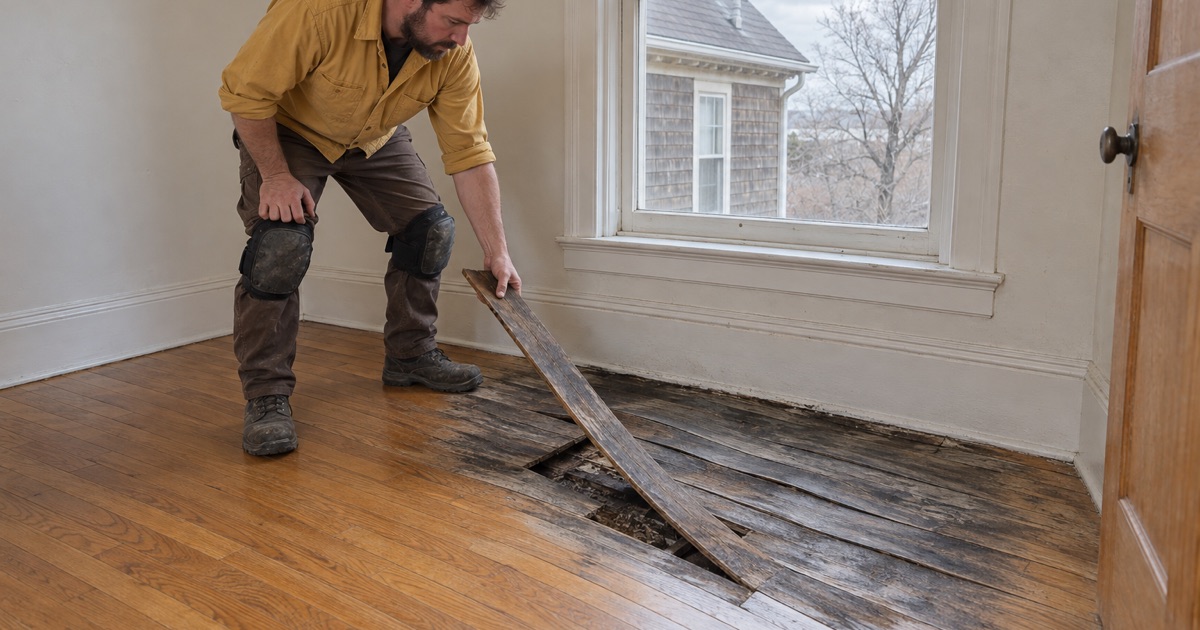
The visible damage is a symptom of moisture moving through wood, and each pattern tells you something different about where the water is and where it came from. Reading those patterns correctly is most of the diagnosis, because they indicate direction as well as severity. A floor wet from below behaves differently from one wet from above, and the two call for different responses.
Cupping
Cupping is boards taking on moisture from below and swelling more at the bottom than the top, so the edges rise above the center. It is the most common presentation after a leak, and it is also the most often misread, because a cupped floor frequently returns close to flat once the assembly underneath has fully dried out.
Crowning And Buckling
Crowning is the opposite profile, with the center standing above the edges, and it usually means a floor was sanded flat while still wet and then dried. Buckling is more severe again: the flooring has lost contact with the subfloor and lifted, which means the expansion gaps have been consumed and the boards have nowhere left to move.
Staining, Finish Failure And Odor
Standing water gets under the finish and leaves dark bordered stains, and prolonged wetting causes the coating to blanch or lift. Where water sat long enough for microbial growth to start in the subfloor, odor is a sign that the problem is below the flooring and will not be solved by anything done on the surface.
Finding The Source And Drying The Assembly
Every hour spent locating the source is returned several times over in the repair, because the same floor damaged twice is a floor replaced. Drying is also not a single step that either happens or does not; it is a process measured against readings that have to keep falling. We treat both stages as part of the flooring scope rather than as something that happens before we arrive.
Tracing Where The Water Came From
The visible damage is rarely centered on the leak. Water runs along joists, follows the underside of subfloor panels, and surfaces where it finds a seam, so we work back from the pattern of wet readings rather than from the worst-looking boards. In a lower level, we also establish whether the moisture is a discharge at all or vapor coming up through the slab.
Moisture Readings Over Time
One reading is a number; a series of readings is information. We take readings in the flooring and the subfloor across the affected rooms and repeat them at intervals, tracking the trend until it stops moving. That series is what tells us the assembly is genuinely dry, and it is also the backbone of the record an adjuster will want.
Drying Before Any Board Is Replaced
No flooring work begins while readings are still falling. Replacing boards into a wet subfloor puts new wood into the same conditions that damaged the old, and sanding a swollen floor flat guarantees a crowned surface later. The drying stage is not a delay in the repair; it is the part of the repair that determines whether the rest works.
Repair, Replacement And What Belongs Below Grade
Once the assembly is dry, the scope is a measurement question rather than a judgment call. A straightedge and a moisture meter between them settle what stays and what goes, room by room. That is also the point at which an estimate written in the first week can turn out to have been far larger than the floor actually needed.
Floors That Recover On Their Own
A surprising number of cupped floors flatten substantially as they dry and need only a sand and refinish afterward, sometimes not even that. This is the single biggest reason not to commit to replacement in the first week. We reassess against readings and a straightedge once the wood has stabilized and tell you honestly what is left.
Board Replacement And Subfloor Repair
Where boards have buckled, delaminated or stained through, they are cut out and replaced with matching stock woven into the surrounding courses. Any subfloor that has gone soft is replaced back to sound material first, and joists are checked where the water sat long enough to reach them.
Lower Levels And Below-Grade Floors
A floor that keeps getting wet from below is a material problem as much as a water problem. Solid hardwood below grade will move regardless of installation quality, so where readings show ongoing vapor drive we specify an engineered floor over a vapor retarder rather than reinstalling the material that just failed.
Where The Water Usually Comes From In These Houses
Age and heating system between them account for most of what we are called out to, and knowing the common sources shortens the search considerably. None of it substitutes for following the readings, since an unusual source behaves exactly like a common one once the water is in the assembly. It does mean the likely candidates get checked first rather than last.
Appliance Connections And Supply Lines
Dishwasher supply lines, refrigerator icemaker tubing, washing machine hoses and water heater tanks account for a large share of sudden discharges, and all of them fail out of sight behind or beneath something. The damage typically shows first at the nearest seam in the flooring rather than at the appliance, which is why the wet area and the source are rarely in the same place.
Steam Heat, Radiator Valves And Old Piping
A great many Waltham houses still run on steam or have done within living memory, and radiator valves, air vents and the pipe penetrations through the floor all leak slowly rather than dramatically. Years of small wetting around a single radiator leaves staining, cupping and sometimes a soft subfloor confined to one corner of a room.
Envelope Leaks And Lower-Level Moisture
Water arriving through a roof, a window head or a foundation wall behaves differently from a plumbing failure: it is usually seasonal, it recurs, and it wets an area near an exterior wall. In a finished lower level, the question is often whether there is a leak at all or vapor moving up through the slab, and the two call for opposite responses.
Documenting The Damage For A Claim
We treat the documentation as a deliverable in its own right, because it is the part of the job you cannot recreate later. Once a floor has been dried, sanded or replaced, the evidence of what it looked like wet exists only in whatever was written down at the time. We produce that record whether or not we end up doing the repair.
Room-By-Room Records
Each affected room gets its own record: dated moisture readings for flooring and subfloor, the extent and direction of cupping or buckling, the condition of the finish, and photographs taken before anything is moved or dried. Rooms that are unaffected are recorded as unaffected, which matters as much as the damage does.
An Itemized Repair Scope
The estimate separates drying, board replacement, subfloor and structural repair, and refinishing into their own lines rather than presenting one number. That separation is what lets an adjuster agree part of a scope quickly instead of querying all of it, and it is what makes the eventual settlement legible to you.
Where Our Role Stops
We describe what the floor shows and what the readings indicate. We do not opine on liability between neighbors, on coverage under your policy, or on what an adjuster should conclude. Staying inside that line is what makes our documentation useful to both sides of a claim rather than to neither.
- 20+ Years On Wood Floors
- Written Itemized Estimates
- Stain Samples On Your Own Floor