Waltham Wood Flooring has spent more than twenty years sanding, refinishing and repairing wood flooring in Malden, and a large share of that work sits in buildings the owner does not live in. The person who signs the estimate is rarely the person walking the floor. That single fact changes how we quote a job, how we schedule it and what we tell an owner is worth doing.
Most of what we are asked for here is not a new floor. It is the floor already down there, strip flooring laid generations ago, covered at some point with carpet or sheet vinyl, and walked on by one household after another since. The first question is always how much usable wood is left above the tongue.
We sand and refinish, we weave in repairs, we replace boards, and we install new floors when the old one has nothing left to give. We also say when a floor has nothing left to give, in writing, itemized, before anyone commits money to it. Owners tell us that second half is the harder one to get.
Wood floors in the rental housing Malden has held for decades
Malden does not only spend federal housing money on itself. The city leads the North Suburban Consortium, made up of Arlington, Chelsea, Everett, Malden, Medford, Melrose, Revere and Winthrop, and the group’s HOME Investment Partnerships funds are administered from here. Since the consortium’s creation in 1991 it has developed approximately 1,900 affordable HOME units, including an active portfolio of more than 600 HOME rental units.
Those funds are administered by the Malden Redevelopment Authority, which as of July 1, 2021 does business as the City of Malden’s Office of Strategic Planning and Community Development. We have no role in any of that and no standing to speak for it. We raise it because housing meant to stay in service for decades gets judged on a longer horizon than a unit somebody intends to turn over and sell.
Old stock, held a long time
Of Malden’s 27,876 housing units, 12,572, or 45.1 percent, were built in 1939 or earlier, and 70.9 percent predate 1980. A floor in that stock has already outlived several heating systems and most of the furniture that ever sat on it.
The tenure pattern matters as much as the age. Renters occupy 15,298 of the city’s 26,042 occupied units, 58.7 percent, and many of them are in small buildings: 3,198 renter households live in two-unit buildings and another 2,548 in buildings of three or four units. That is an owner with a handful of floors, not a facilities department with a capital plan.
What is actually under the carpet
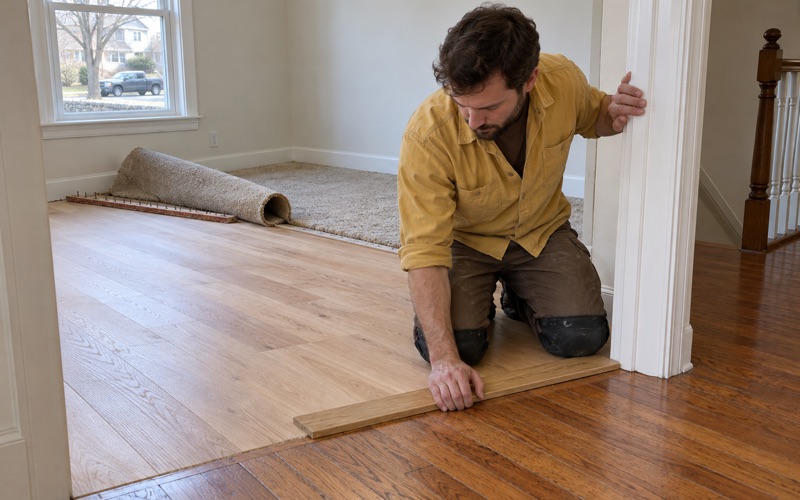
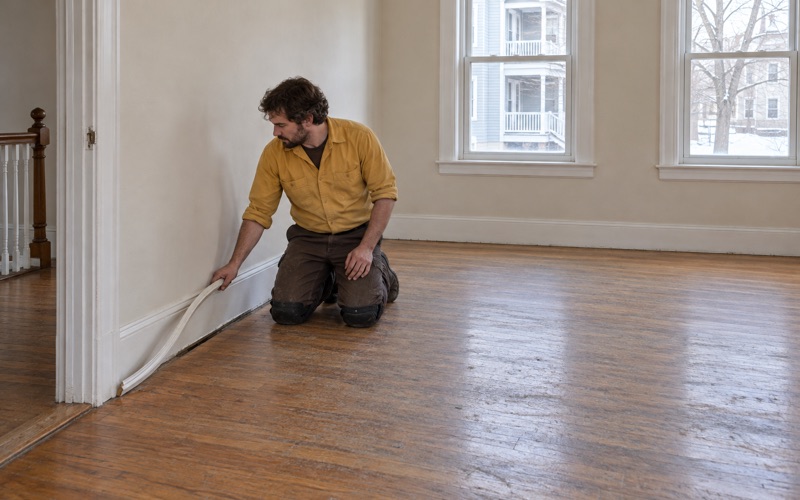
Pulling carpet is how most of these jobs start. Under the pad we find tack strip nail holes along every wall, rosin paper stuck to the boards in patches, and a tongue and groove strip floor fastened with cut nails or flooring cleats depending on when it went down.
Sometimes what comes up is not carpet at all. Old resilient floor tile and the black mastic under it turn up in kitchens and hallways in buildings of this age, and we identify it and stop rather than sanding or scraping it. The right trade handles that material, and the floor waits until they have.
Looking for wood-flooring closer to Dover? See Dover Wood-Flooring.
What twenty years of tenancies do to an original strip floor
Wear in a long-tenanted unit is never evenly spread. It reads as a map of how people actually moved through the rooms: the line from the door to the kitchen, the pivot in front of the sink, the strip of hallway outside the bathroom.
None of that is a failing on the part of the tenants. It is simply what a floor does when it is used hard every day for decades by people who never chose it, and it is entirely readable to anyone who looks at it properly before quoting.
Traffic lanes and seasonal movement
Traffic lanes are the first thing we look for, finish worn off to bare wood down the middle of a hall while the boards under a bed still carry their original sheen. Bare wood in a lane takes stains the rest of the floor shrugs off, which is why two rooms in one unit can need very different work.
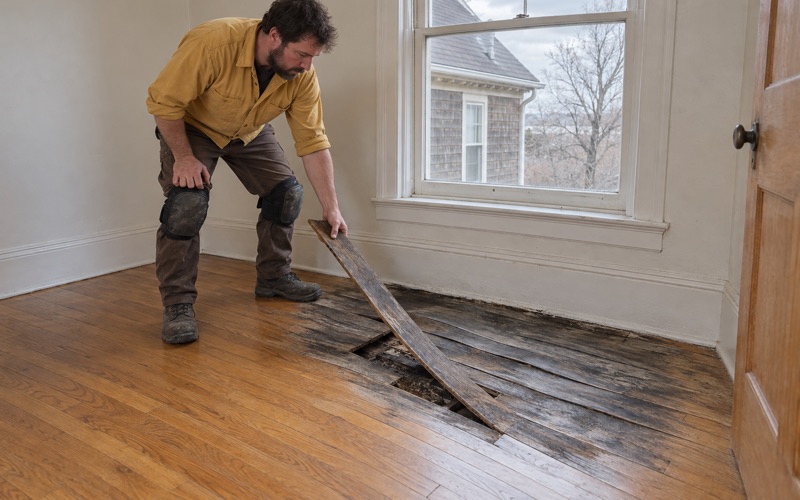
Then there is movement. Dry winter heat opens winter gaps and board gapping between strips, a wet season closes them again, and a floor that has taken real moisture shows cupping at the board edges or crowning across the middle. Buckling, where boards lift off the subfloor entirely, means something more than seasonal, and we look into the joist bays before quoting a sanding.
Stains, fade and shadow
A stain in the finish and a stain in the wood are two different jobs. Sun fade and rug shadow usually sand out, because they live in the top of the board. Pet urine stains and water stains from a long-running leak under a sink or behind a washer often do not, because they have gone into the grain and sometimes into the subfloor.
We test rather than guess, since the difference decides the estimate. Telling an owner a floor will come back uniform and then delivering a dark halo in the middle of a room is not a conversation anybody wants at the end of a job.
Insects in an older building
Occasionally the problem is not wear at all. Fine exit holes with small piles of frass beneath them point to powderpost beetle or old house borer activity in the boards or the framing below, and that finding turns a refinish into a sequence.
We do not treat insects and we do not pretend to. What we do is flag it, show the owner exactly where it is, and hold off on finish work until whoever handles that has been through the building.
Refinish or replace: reading a landlord’s floor honestly
An owner wants a number and a yes or no. The honest answer comes from measurements taken on site rather than from the age of the building, and we would rather spend twenty minutes taking them than talk anybody into a sanding the floor cannot survive.
Measure the boards before promising a sand
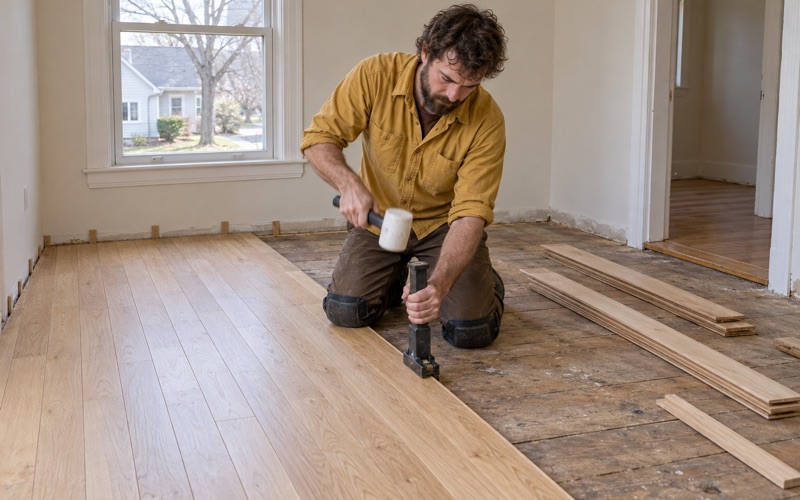
Every sanding removes wood. What is left above the tongue determines whether a floor can be sanded again, so we check thickness at doorways, at floor vents and anywhere a board has already been lifted. Postwar strip floors in buildings put up in the 1950s and 1960s are often good for another pass, and we would far rather sand and refinish one than tear it out.
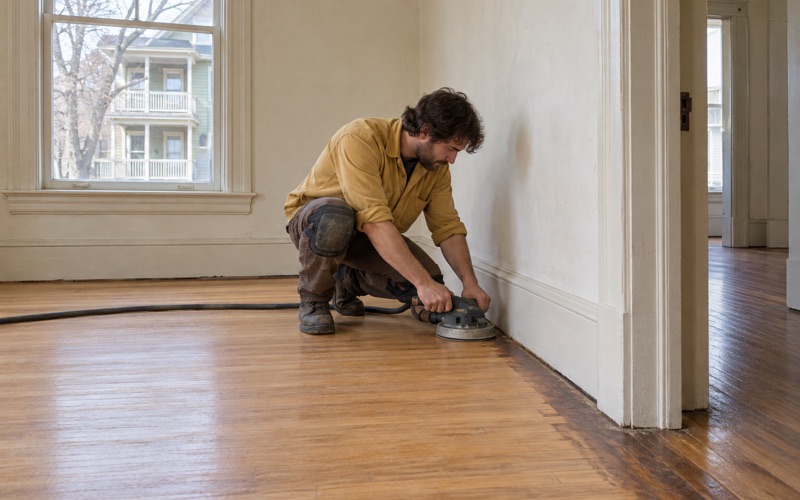
Where the wood is thin but the finish is the problem, a screen and recoat does the job without the full grit sequence. Where a drum sander would be too aggressive for what remains, an orbital sander and a lighter schedule can still bring a floor back to serviceable.
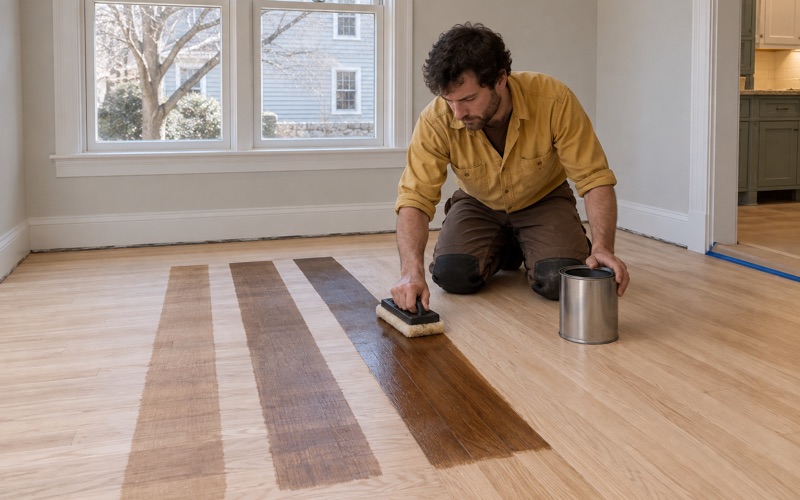
When an owner wants a different color out of the same boards, we lay stain samples on that floor, in that room’s own light, before anything is committed to. A sample on a showroom panel tells you very little about how the wood already underfoot will take it.
Patch, weave, and the holes a building leaves behind
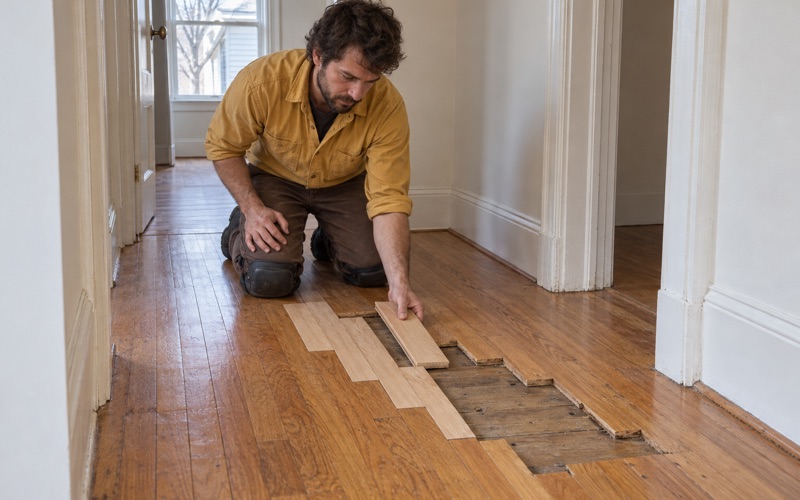
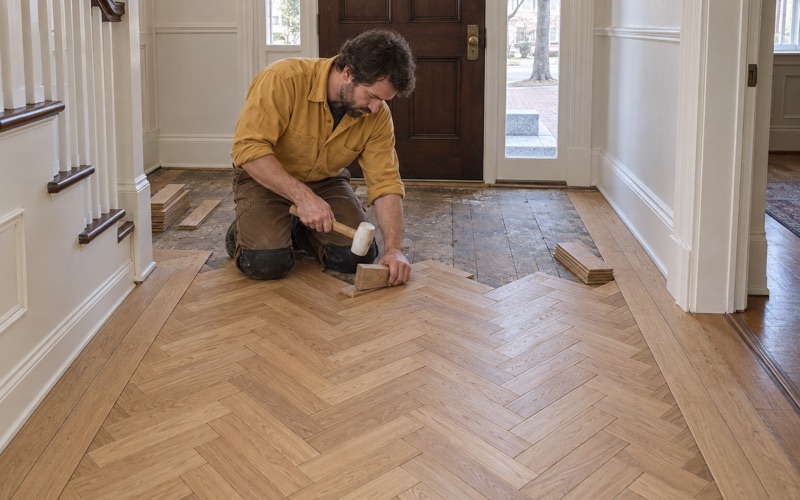
Old buildings carry scars. Steam radiators and their pipes leave holes through the boards when they come out, and we patch those with matching boards woven into the existing runs rather than filling them, because a filled hole stays visible from the doorway for the rest of the floor’s life.
The same goes for the line a removed wall leaves and the gap where an electrical outlet was moved. A weave-in repair and board replacement done properly reads as floor. Done as a rectangle of new wood dropped into old, it reads as a scar, and every future tenant sees it first.
Putting the decision in writing
We itemize estimates for landlords line by line, and we document water-damaged rooms one at a time with moisture meter readings, which is the record an adjuster asks for. It is also what Massachusetts requires under M.G.L. c.186 s.15B before a tenant can be charged for damage to a floor.
An itemized estimate protects the owner in the other direction too. When a floor is genuinely past refinishing, a written breakdown of why turns a replacement into a planned expense instead of an argument.
Working around tenants, and what Malden’s repair money covers
A floor job in an empty house is a scheduling problem. A floor job in a building that stays occupied is a sequencing problem, and the sequence is half of what the owner is buying.
One floor at a time
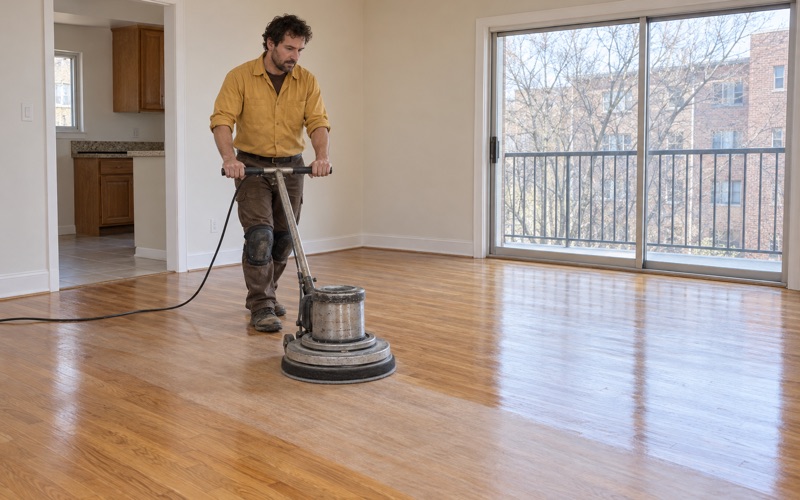
In owner-occupied two and three-families we work one floor at a time, so the household on the other level keeps living in the house while their neighbors’ floor is out of service. Dustless sanding with HEPA vacuum extraction keeps the rest of the building usable in a way older equipment simply did not.
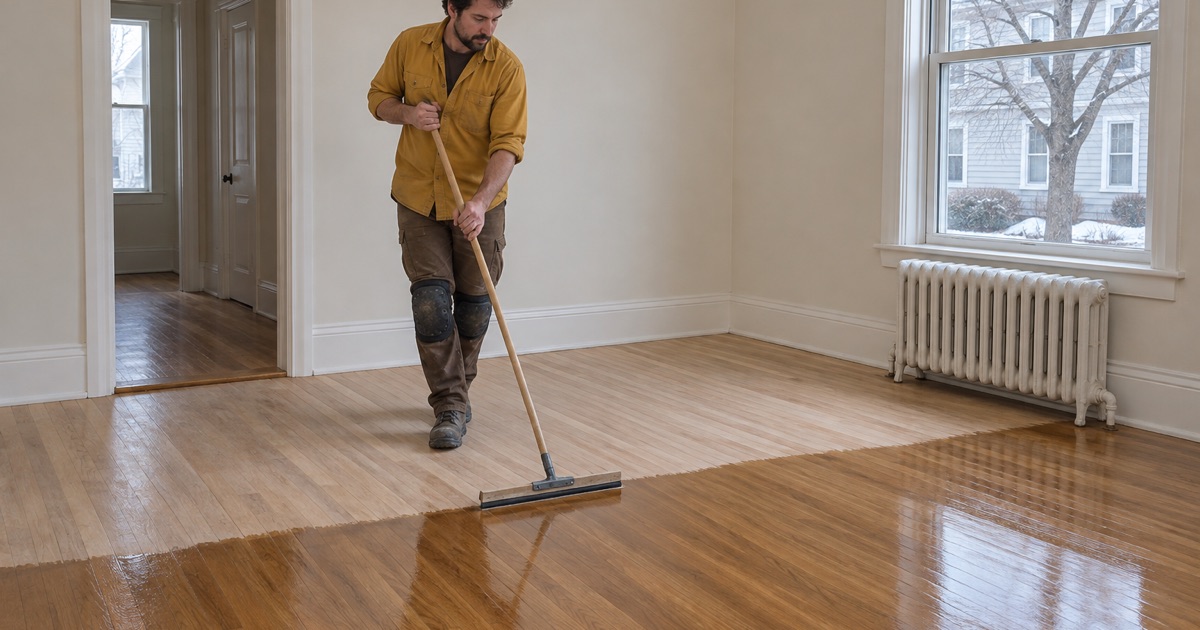
Finish choice is part of the schedule. Waterborne polyurethane returns a room to use faster than oil-modified polyurethane, and we pick finishes that meet the Massachusetts VOC limits for wood coatings under 310 CMR 7.25, which are tighter than the federal ones. We also test for old wax residue and cleaning-product film and strip it first, because a new finish laid over either one peels.
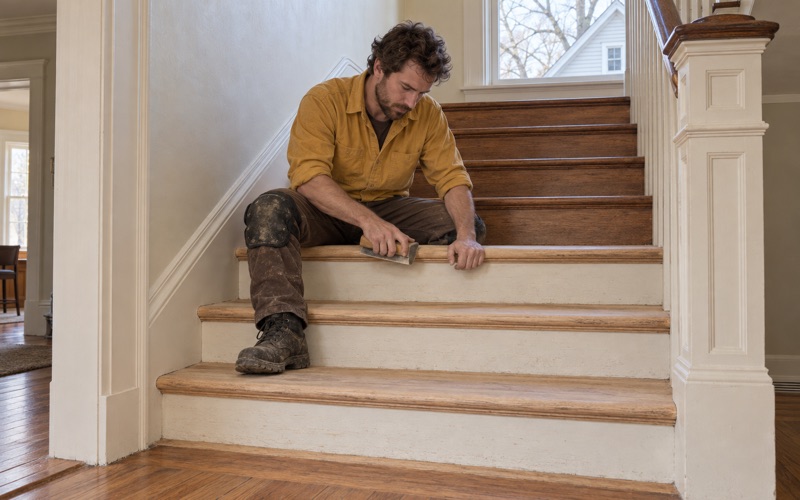
Stairs get quoted tread by tread rather than by the square foot, because a staircase is not a floor and pricing it like one is how a number ends up wrong. In a building that stays occupied the stairs are also the one surface nobody can walk around, so we fit them to the household’s day rather than ours.
Lead-safe practice in pre-1978 buildings
Before we sand anything painted, we establish the build year and look hard at every painted surface in the work area. Massachusetts runs its own lead-safe renovation rules alongside the federal EPA RRP Rule, and in housing this old the assumption runs the safe way until the paint says otherwise.
That matters more in an occupied building, not less. Containment and cleanup are the difference between a sanding job and something a tenant carries around the building on their shoes.
What the city’s repair programs will and will not pay for
Malden’s own housing rehabilitation program is worth knowing about, and worth knowing the edges of. Its published list of eligible work names roofing, heating, electrical, plumbing and HVAC work, along with lead abatement, radon mitigation and mold remediation. Flooring is not on that list.
That is not a technicality when a building is being budgeted. Assistance there runs as zero-percent CDBG loans repaid over fifteen years and as zero-interest, no-payment Lead and Healthy Homes loans forgiven after a set period, and the program reports a waitlist. We say all of that early, so an owner plans the floor as their own line rather than waiting on money that was never pointed at it.
- 20+ Years On Wood Floors
- Written Itemized Estimates
- Stain Samples On Your Own Floor