Waltham Wood Flooring has worked on wood flooring in Medford for more than 20 years, and a large share of what we do here starts with a floor that has failed rather than a floor somebody has grown tired of. A board that gives underfoot, a dark stain creeping out from a bathroom doorway, a strip floor gone soft where it meets an entry — those are repairs, and they get scoped in a completely different way than a refinishing job does.
That distinction carries more weight in Medford than in most places nearby, because the city’s own housing money names floors out loud. Medford’s Housing Rehabilitation Loan Program publishes a list of eligible repairs, and “Walls/ceilings/floors” is one of the lines on it. Very few municipal repair lists around here mention floors at all.
We handle the repair side the same way whether a program is involved or not: find out what is actually wrong beneath the finish, write down what has to come out and what goes back, and price it so that another person can read it and check it. This page is about how a floor job in Medford gets scoped, bid and supervised when the homeowner is not the only one signing off on the specification.
When a Medford floor is a repair, not a remodel
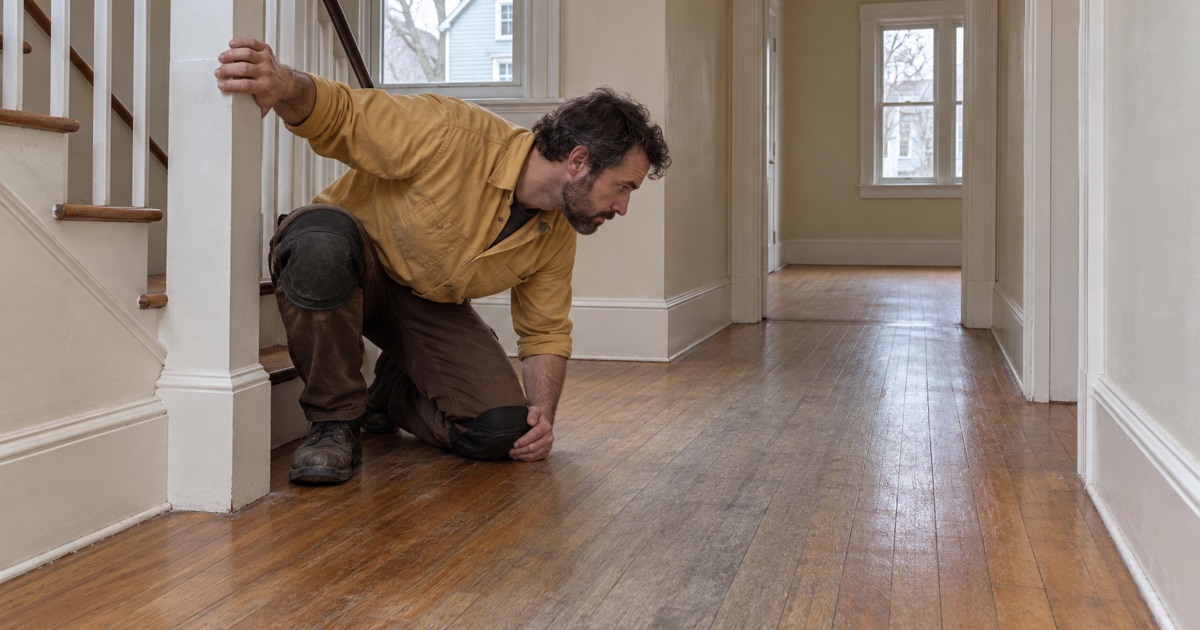
The first question we answer in a Medford house is whether the floor has failed or whether somebody has simply stopped liking it. A floor that is worn through in the traffic lanes, faded by sun along a south window, or shadowed where a rug sat for fifteen years has a finish problem, and a screen and recoat or a full sanding usually settles it. A floor that moves, sounds hollow, or has gone dark and spongy in one corner has a structural problem, and sanding it would only hide the thing that needs to be fixed.
The two jobs share a trade name and almost nothing else. Refinishing works from the top down through a grit sequence and never disturbs what the boards are fastened to. A repair starts by taking boards up, and the estimate is not finished until somebody has looked at what is underneath them.
The failure signs we look for first
Cupping across the width of the boards, crowning where a floor was sanded flat while still wet, and buckling where a strip floor has lifted away from the subfloor all point at moisture rather than wear. We read the boards with a moisture meter before forming an opinion, and we keep reading until the source is identified — a burst supply line, an appliance that overflowed, a lower level that runs damp all summer.
Board gapping is the symptom that fools people most often. Winter gaps open during the heating season and close again in June, and a floor that gaps evenly across a room is behaving the way wood behaves. Gaps that are wide in one area only, or boards that have separated with a lip you can feel, are telling a different story and deserve a look from below.
What the city’s repair list does and does not say
On Medford’s Housing Rehabilitation Loan Program page, “Walls/ceilings/floors” sits in a list alongside foundation repairs, heating systems, hot water heaters, insulation, lead paint inspection and abatement, windows and roof work. The company that line keeps tells you what kind of repair the list has in mind. What the page does not do is spell out what falls inside that floors item.
We do not read anything into that silence and we would not advise a homeowner to either. Our part is to describe accurately what is wrong with one particular floor and what it would take to put it right, in writing, so that whoever reviews the work has a real scope in front of them instead of an assumption.
Looking for wood-flooring closer to Somerville? See Wood-Flooring in Somerville.
Rot, soft spots and what turns up once the floor is open
Most of the floors we open in this city were installed before the war. Of Medford’s 25,587 housing units, 12,498 — 48.8 percent — were built in 1939 or earlier, and 75.9 percent went up before 1980. That mix decides what we find underfoot: cut nails and wide pine boards in the oldest houses, red oak strip flooring over a plank subfloor in the interwar ones, and thinner postwar oak in the houses of the 1950s and 1960s.
Age on its own is not a defect. A hundred-year-old oak floor that has stayed dry is usually in better condition than a twenty-year-old one that sat under a leaking dishwasher for a season, and we would far rather sand the old one than pull it out.
Where older Medford floors give way
Failure clusters in a few predictable places. Bathrooms go first, normally at the toilet flange and along the door saddle where water leaves the room on bare feet. Entry doors come next, because snowmelt and street salt arrive on boots all winter and sit at the threshold until somebody wipes them up.
Steam radiators produce two separate kinds of damage, and we see both. There is water from a valve or a failed union, which darkens and softens the boards in a ring, and there are the holes left behind where a radiator and its riser were taken out altogether.
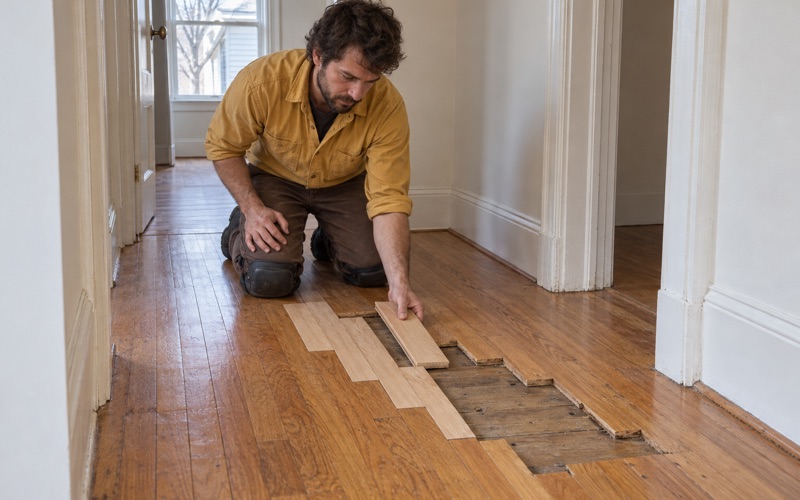
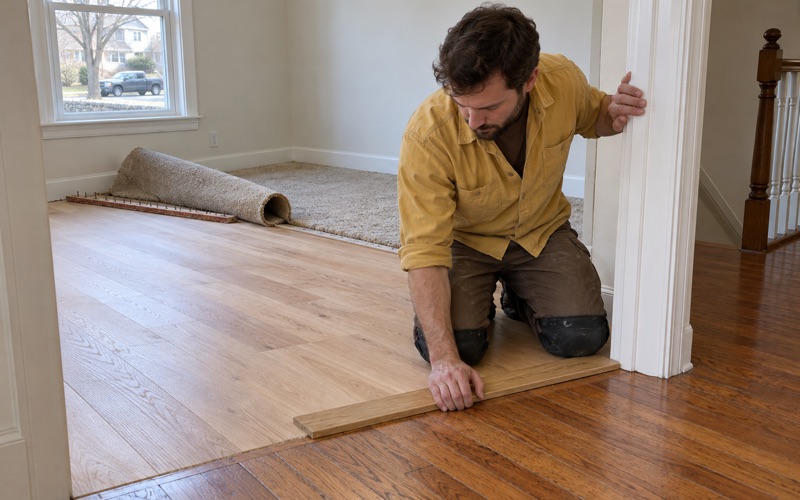
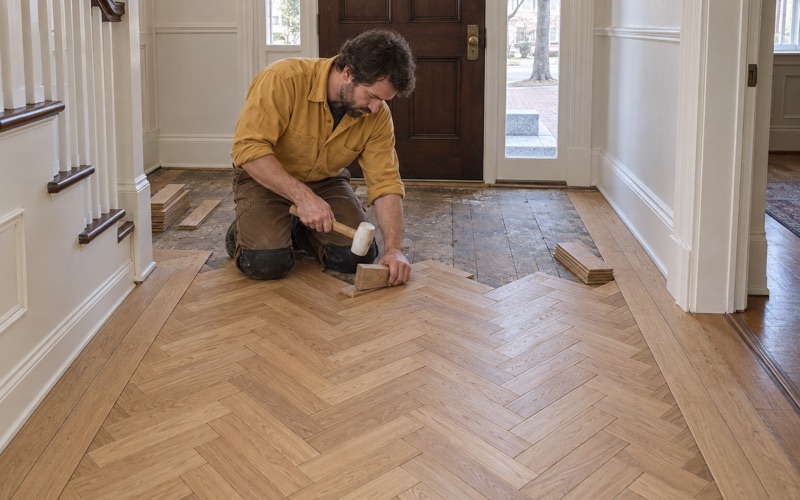
Those openings are a signature repair for us. We patch them with matching boards woven into the surrounding floor and running in the same direction, so the finished area reads as floor rather than as a rectangle somebody filled — the same method we use where a wall has come down or an outlet was moved and the floor was left with a scar.
Subfloor replacement is its own job
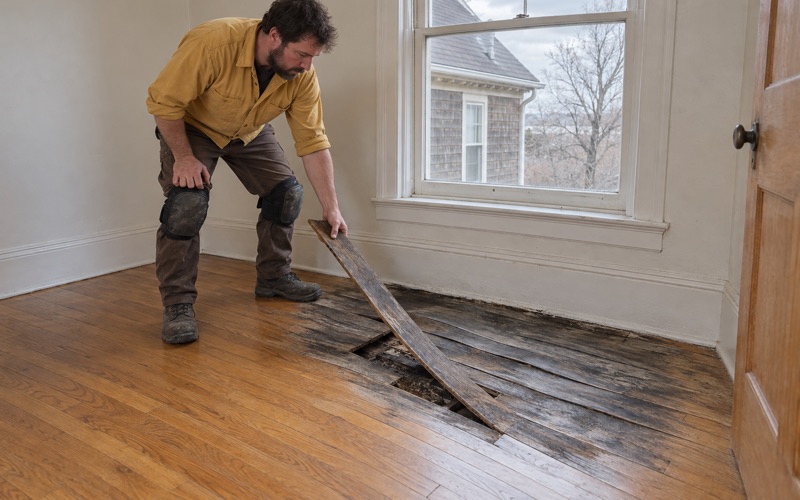
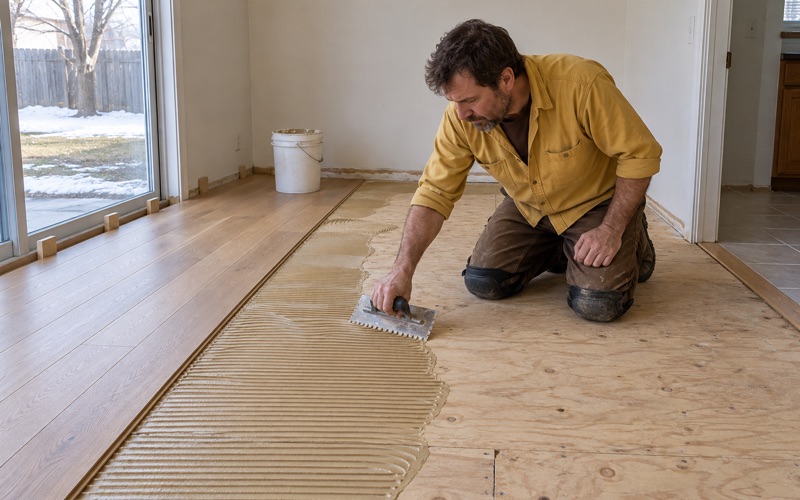
As soon as the finish boards come up, the subfloor decides the rest of the estimate. If the planks or sheathing underneath are sound, we replace boards, weave the repair in and move on. If the subfloor is soft, delaminated or rotted through it has to come out, and if a joist has taken water the work stops being a flooring job until the framing has been made good.
That is why we will not price a rot repair as a square-foot figure over the phone. We price the exploratory opening and the known work, describe the conditional work in plain language with what it would cost, then re-price once the floor is actually open. A floor scope written before anyone has looked underneath is the one that turns into a change order three weeks later.
Writing a floor scope somebody else has to bid on
A repair scoped through Medford’s program is not written by the homeowner, and it is not written by us either. City staff hire a qualified rehabilitation specialist to determine the scope of work and to identify contractors through a bidding process, which means the specification exists before any contractor is chosen and every bid answers the same document.
That is a better way to buy floor work than most homeowners ever get, and it changes what a contractor has to be good at. The number still matters, but so does whether the bid answers the scope line by line, in terms the person who wrote it can check against the floor.
The funding shape behind the scope
The program itself is an interest-free, deferred payment loan of up to $50,000, offered to Medford homeowners who live in their homes, with a lottery conducted to select applications. It is administered by the CDBG and Grants Manager in the city’s Office of Planning, Development and Sustainability, and all CDBG activities primarily benefit low- and moderate-income residents.
Owner-occupancy is the condition worth noticing, because it narrows the field to a specific group of Medford houses: 13,159 of the city’s 24,339 occupied units, 54.1 percent, are owner-occupied. Medford is also one of the communities in the North Suburban Consortium.
We administer none of this and have no role in who is selected. The city’s own page is the only place to read the current terms, which do change, and the people who run the program are the people to ask about them.
What an itemized estimate has to show
We write estimates itemized rather than lumped, because a lumped number cannot be compared against anything or checked by anyone. Demolition and disposal, subfloor replacement, finish flooring, transitions such as thresholds, reducers and quarter round, sanding and finish each carry a line of their own with a quantity beside it.
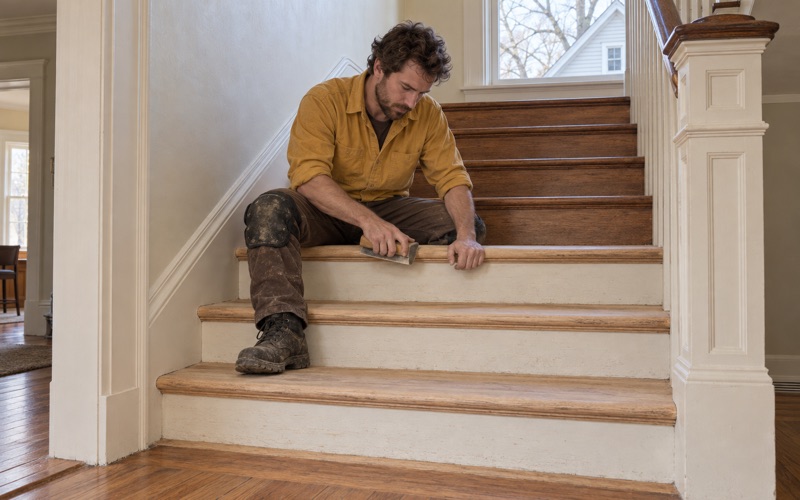
Stairs are quoted tread by tread. A staircase has treads, risers and nosings, every one of them worked by hand, and none of it behaves like square footage — a stair price folded into a floor price is the single most common place a floor bid goes wrong.
Where a condition genuinely cannot be known until the floor is open, we say so on the estimate and name what would trigger the additional work. Water damage we document room by room with meter readings, which is the record an adjuster or a reviewer can actually use. Landlords get the same itemized document, since Massachusetts requires an itemized written estimate before a tenant can be charged for damage to a floor.
Floor work alongside heating, insulation and lead work
A floor on a rehabilitation list is rarely the only item in the house. When insulation, a heating system, wiring or lead work are happening in the same few weeks, the floor has to be sequenced around them instead of dropped into the middle of them.
The order we ask for is straightforward. Anything that opens a wall, a ceiling or a joist bay goes first, finish flooring goes down afterward, and sanding and coating go last, once the dust-producing trades have finished and the house can be closed up for a couple of days.
Pre-1978 paint and old resilient tile
Before any sanding begins we check the build year and look carefully at painted surfaces, because Massachusetts runs its own lead-safe renovation rules for housing built before 1978 and the great majority of Medford’s stock predates that by decades. A painted stair or a painted border is not a decision to make on the spot with a machine already plugged in.
Old resilient floor tile and the black mastic beneath it get the opposite treatment: we identify it and leave it exactly where it is. When it turns up under carpet, under a later floor or under a sheet good in a back hallway, our work stops there and does not resume until the right trade has handled it.
What goes back down, and how it disappears
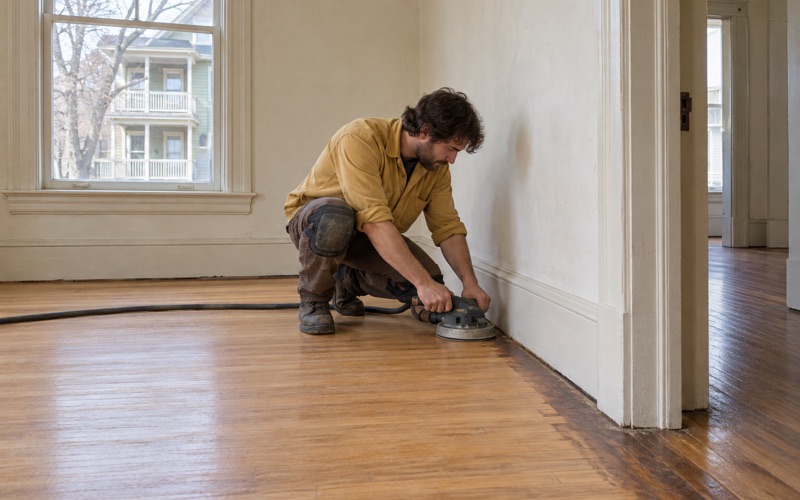
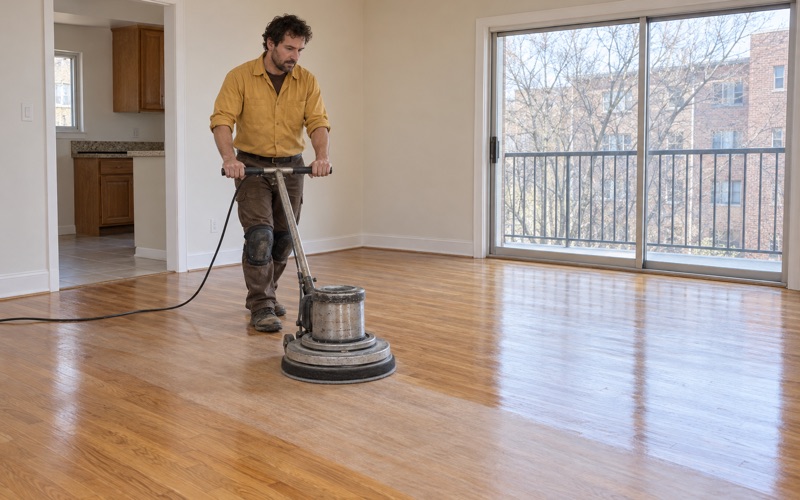
When the repair is finished the new boards still have to vanish into the old ones. We acclimate replacement material inside the house, hold the expansion gap at the walls, lay rosin paper where it belongs, and sand the repaired area into the surrounding field through a full grit sequence rather than feathering a patch at the edges. Old wax and cleaning-product residue is tested for and removed first, or a new finish sits on top of it and peels within the year.
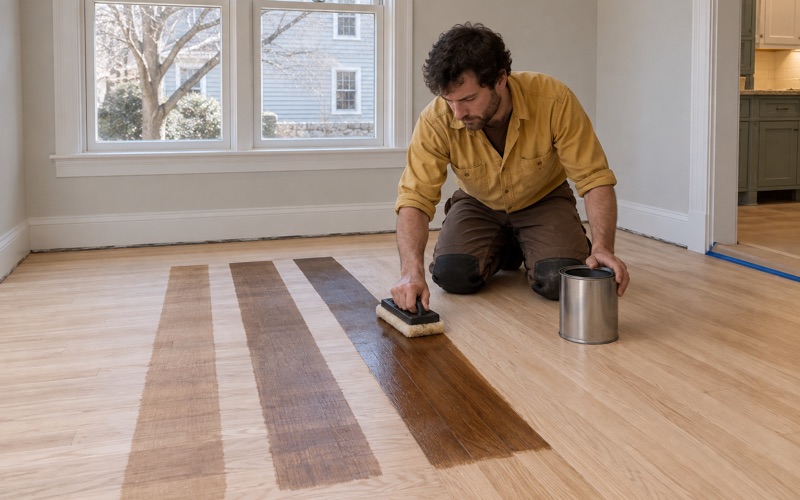
Color gets decided on your own floor in your own light, with stain samples laid down and looked at across a full day rather than picked off a fan deck. Finishes are chosen from products that meet the Massachusetts VOC limits for wood coatings, which are stricter than the federal ones, and the sheen level is the last thing we settle before the first coat.
Lower-level rooms are matched to the moisture we actually measure there, which usually means engineered material with a real wear layer instead of solid boards. And a postwar oak strip floor gets its remaining thickness checked before a drum sander ever comes out — plenty of Medford’s mid-century oak has years left in it, and a floor that has been torn out cannot be put back.
- 20+ Years On Wood Floors
- Written Itemized Estimates
- Stain Samples On Your Own Floor