Waltham Wood Flooring has spent more than twenty years on wood flooring in Melrose, MA, and most of what we do here happens inside occupied buildings rather than empty ones. Apartments, condominium units and the upper floors of older houses come with a schedule attached: a move-out date, a move-in date, and a narrow window between them. Our work is built around finishing inside that window instead of leaving a floor half-repaired.
That means sanding, refinishing, patching and board replacement done in sequence, with the dust contained and the disruption kept to the unit we are standing in. We look at a floor before we quote it, checking board thickness, fastener type, the finish already on it, and whether a stain is sitting on the surface or has gone through into the wood. A floor that has been recoated three times is a different job from one nobody has touched since it went down.
We also keep repairs honest. A defect in a floor can be covered or it can be fixed, and only one of those survives the next person who walks across it. Everything below describes how we handle that distinction on Melrose rental and condominium floors.
Wood Floors and a Melrose Pre-Occupancy Rental Inspection
Melrose runs its inspections through the Inspection Services Department, and the city’s own fee schedule and department pages name a Voucher Inspection, a Certificate of Fitness and a Pre-Occupancy Rental Inspection as distinct products, each carrying a re-inspection fee of $25. The same department handles the state-mandated certificates of inspection and the multifamily inspections that go with them. That office, on the ground floor of City Hall at 562 Main Street, is the counterpart we plan around when a unit changes hands.
Why a Second Visit Is the Expensive One
The $25 re-inspection fee is small next to what a second visit actually costs, which is time. A unit waiting to be looked at twice is a unit nobody is living in, and deferred floor work is the reason we most often get a call on short notice.
We would rather be in a unit before the first visit than between two of them. A patch or a recoat done while the rooms are empty is the cheapest version of the job, because we can run a sander through without working around furniture and let a finish cure without anyone walking on it.
The Standard a Certificate of Fitness Applies
The standard a Massachusetts certificate of fitness or pre-occupancy rental inspection applies is 105 CMR 410, the Minimum Standards of Fitness for Human Habitation. Section 410.500, as amended effective May 12, 2023, has an owner maintain buildings and structural elements in good repair, including keeping them “free from holes, cracks, loose plaster, or defects that render the area difficult to keep clean, create an injury risk, or provide an entry or harborage for pests.”
No Melrose source we have seen names flooring as an item on any inspection form, and we do not tell anyone that it is one. What we can say is that the language in 410.500 describes things that happen to wood floors: an open gap at a threshold, a board lifted at one end, a hole left where a radiator pipe came through. Those are worth fixing on their own merits, and they are cheap to fix compared to what they turn into.
Looking for wood-flooring closer to East Boston? See Wood-Flooring Services in East Boston.
Floors in Melrose’s Apartment and Condominium Buildings
Of the 12,401 occupied housing units in Melrose, 4,073 are renter-occupied, or 32.8 percent. Where those renters live is the part that changes our work: 2,876 of the 4,073, or 70.6 percent, rent in a building of five or more units, and only 629 rent in a two-unit building.
That is a different city from the one the two- and three-family stock suggests. Most rental floors here sit in a corridor building with shared stairs, a single loading entrance and neighbors on both sides of the wall who are not going anywhere.
It also means the work gets judged by the neighbors as much as by the person paying for it. We keep hallways clear, hold the machine hours to the daytime window a building manager gives us, and clean the common route at the end of every day.
Getting Equipment Into an Occupied Building
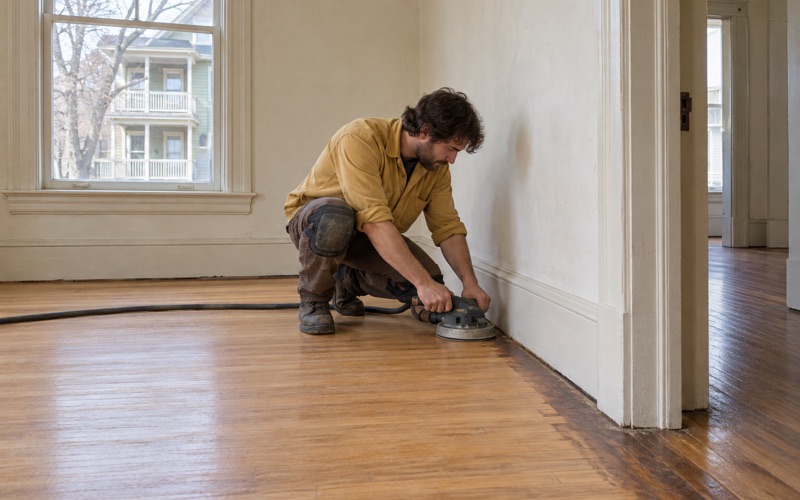
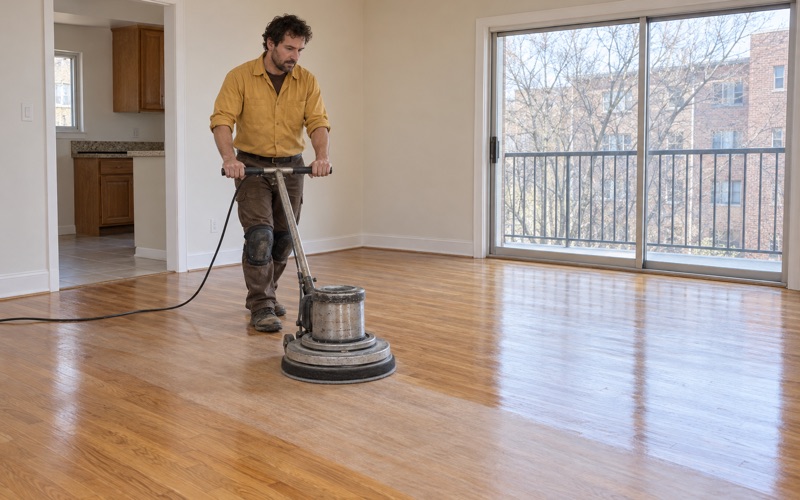
A drum sander, an orbital sander and a HEPA vacuum all have to reach the unit before anything starts, and in a fifty-unit building that means a service elevator, a scheduled window and a protected route through common hallways. We plan that route first and lay rosin paper anywhere we have to carry equipment across a finished surface.
Dustless sanding matters more in this kind of building than in a detached house, because the air a unit breathes is not only its own. We pull the vacuum through the whole grit sequence rather than only at the end, and the unit’s door stays sealed while the machines are running.
Condominium Units and Lower-Level Floors
Not every floor in these buildings belongs to a renter. A structure-type proxy puts 479 owner households in Melrose buildings of five or more units, which is the closest read available on owned condominium stock. Those floors get the same work with one difference: the owner is usually living there while we are in the unit, so we sequence room by room and hand rooms back as they cure.
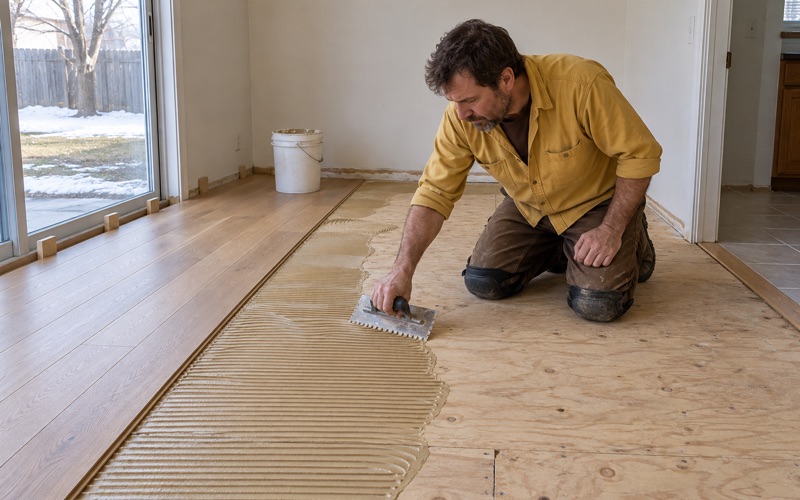
Lower-level and ground-floor units are the ones we test before quoting rather than after. We take a moisture meter reading in the room itself, and where the number says so we will recommend engineered wood with a real wear layer instead of solid hardwood. Guessing at that is how a new floor starts cupping in its first humid summer.
Repairing a Floor Defect Instead of Covering It Over
The fastest way to make a floor defect disappear is to put something over it: a rug, a threshold plate, a filler stick in a near-enough color. None of that is a repair, and all of it comes back. Our default on a rental or condominium floor is to take the damaged boards out and put wood back in their place.
Weave-In Repairs and Board Replacement
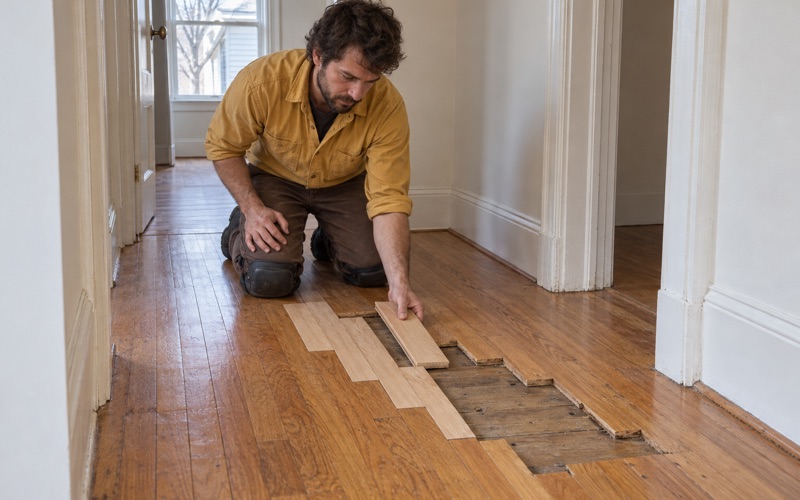
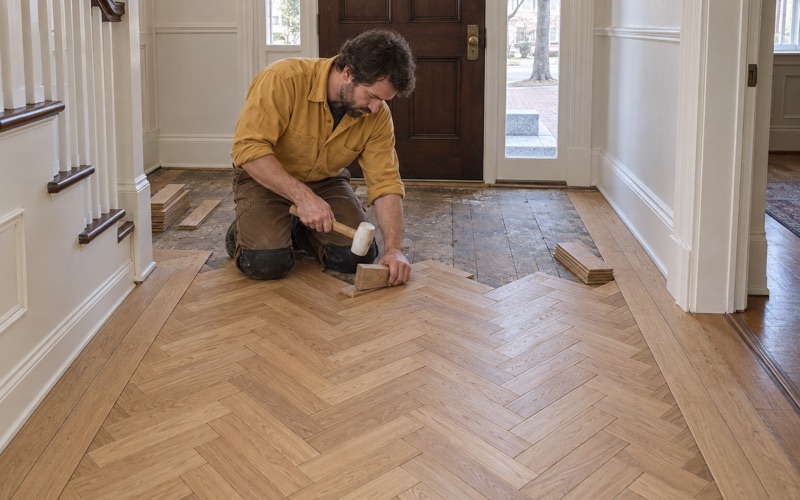
Where a steam radiator and its pipes came out, the floor is left with holes no filler will ever match. We cut those out and weave matching boards into the surrounding field so the patch runs with the existing rows instead of sitting in the floor as a square. The same approach covers a floor opened up where a wall came down or an outlet was moved, and the test is simple: the repair should read as floor rather than as a scar.
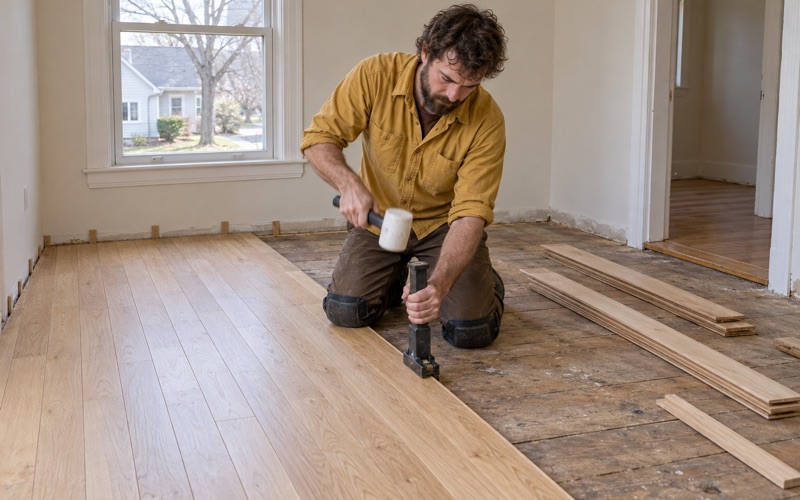
Matching means species and cut, not only color. Most of what we lift in these buildings is red oak strip flooring, and a white oak or maple board dropped into it takes stain differently no matter how carefully it is sanded. We check the tongue and groove profile and the fastener underneath, whether that is cut nails, cleats or staples, before committing to a patch.
Water, Moisture and What It Does to Boards
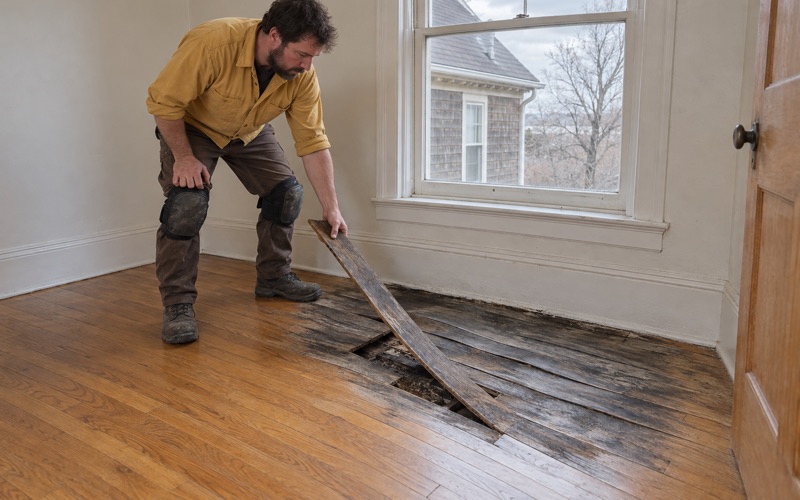
Water is the other reason boards come out. A burst pipe, an overflowing appliance or a slow leak under a dishwasher shows up first as cupping, then as crowning once the floor dries unevenly, and as buckling where the boards have nowhere left to expand. We trace the source, dry it and read the floor with a moisture meter before replacing a single board.
The same section of 105 CMR 410 also has all surfaces dried within 48 hours of a leak or flood, which is a tighter clock than most floors get. We document water damage room by room for an adjuster, and estimates for landlords go out itemized line by line rather than as one figure, so the record of what was damaged and what it cost stands on its own.
Planning Floor Work Around a Melrose Inspection
The scheduling question Melrose owners ask us is when to do the floor, not whether to. The answer is almost always before the unit is shown and before anything is scheduled with the city, because a floor is the one surface in an apartment that cannot be used while it is being worked on.
Doing it in the gap between tenants also avoids the worst version of the job, which is sanding one room at a time around somebody’s furniture while they are still living in the unit. That version costs more, takes longer and finishes worse.
Older Buildings and What Gets Checked First
Melrose housing is old by any measure: 52.2 percent of its 12,771 units were built in 1939 or earlier, and 84.0 percent were built before 1980. That has a practical consequence for us, which is that we check the build year and any painted surfaces before a sander is switched on, since Massachusetts runs its own lead-safe renovation rules for homes built before 1978.
Old floors carry their own surprises. Wax and cleaning-product residue has to be found and removed or a new finish peels off it within a season; a shellac finish behaves nothing like polyurethane under a screen and recoat; and where we find old resilient floor tile with black mastic under it, we stop and leave it undisturbed until the right trade has dealt with it.
Sanding, Finishing and How Long the Unit Is Out
Postwar oak strip floors, the 1950s and 1960s stock, are usually worth saving rather than tearing out, and we measure the board thickness above the tongue before committing to a full sand. Where there is wood left to work with, a full grit sequence and a new finish costs less than a replacement floor and keeps the original material in the unit.
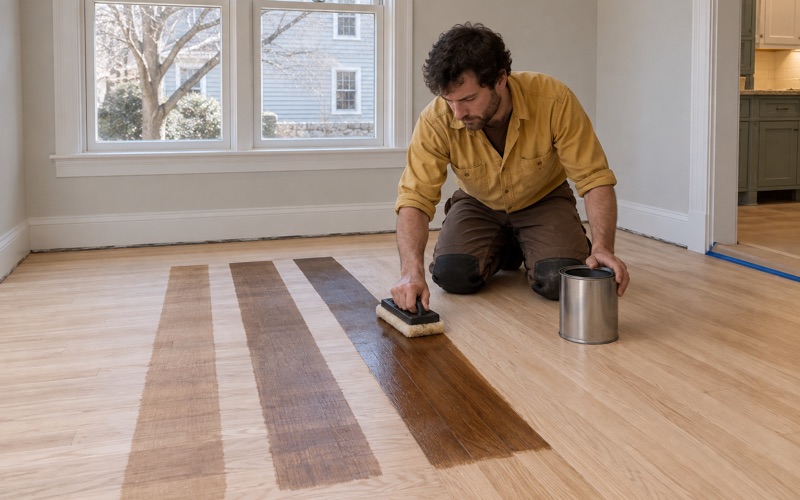
Finish choice sets the schedule as much as the sanding does. We work within the Massachusetts VOC limits for wood coatings, which are stricter than the federal ones, and we lay stain samples on the floor itself, in that unit’s own light, before a color is settled. A waterborne polyurethane takes foot traffic sooner than an oil-modified one, and on a turnover that difference is the whole plan.
Stairs, Thresholds and the Edges of the Job
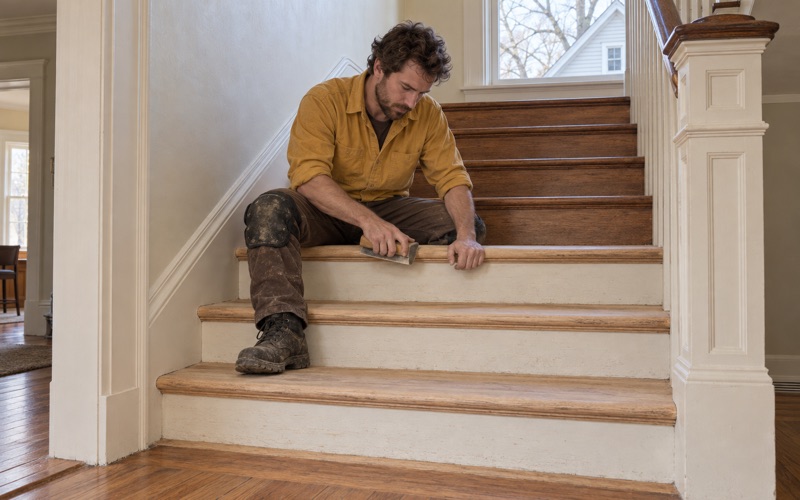
Stairs are quoted tread by tread rather than by the square foot, because a staircase is not priced like a floor. Treads, risers and nosings each take separate work, and in a building with a shared stair only the unit’s own flight is part of the job.
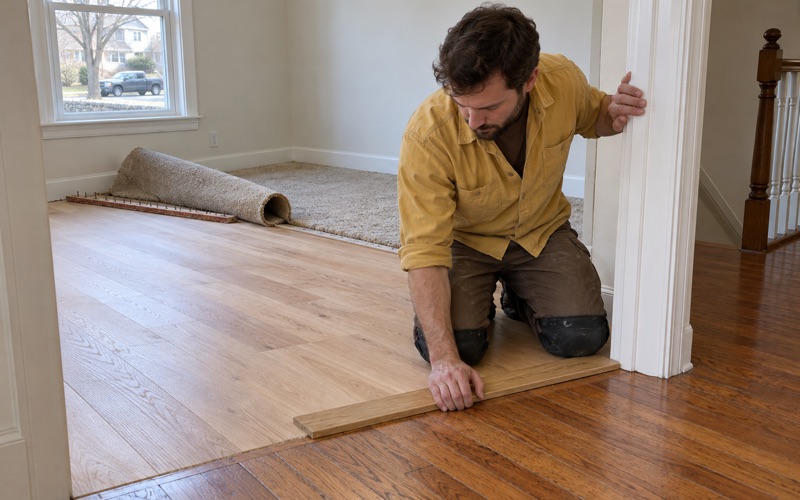
The same goes for the edges: reducers, thresholds and quarter round are where a repaired floor either looks finished or looks patched. We would rather spend an extra half day on those transitions than hand back a floor that reads as repaired the moment someone steps into the room.
- 20+ Years On Wood Floors
- Written Itemized Estimates
- Stain Samples On Your Own Floor