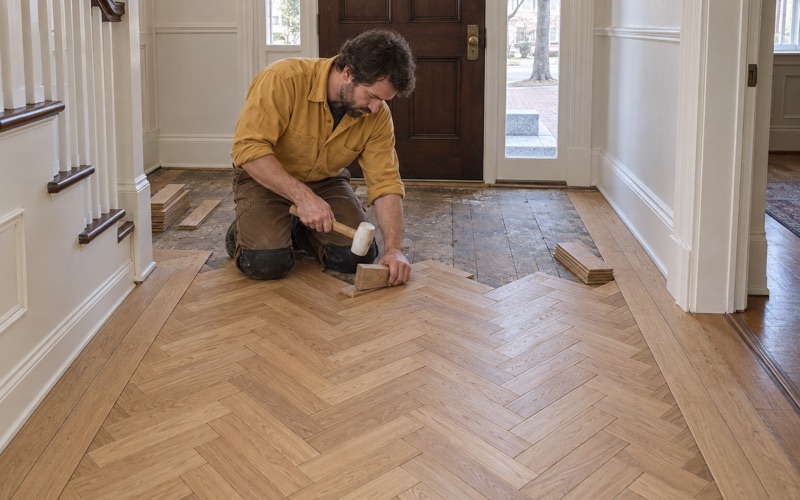
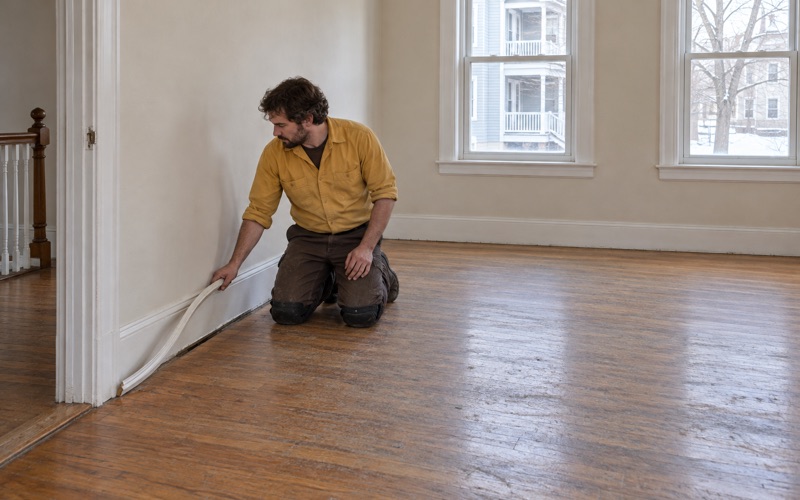
Waltham Wood Flooring has spent more than twenty years on wood-flooring in North End apartments, condominium units and the stairs that connect them. Almost none of that work happens in an empty building. There are households above and below the floor being sanded, one stair run serving all of them, and a schedule that has to survive contact with neighbors.
The three problems we are called for most in these units are a finish worn through where the traffic lanes run, boards that took on water arriving from somewhere else in the building, and a floor that has gone hollow, loose or uneven underfoot. Each one is a different job. The first is often a screen and recoat, the second starts with a moisture meter rather than a pry bar, and the third has to be opened up before anyone can quote it.
We check board thickness before agreeing to sand an old floor, read moisture where the water actually went, and put the findings into an itemized written estimate rather than a single square-foot number. Stairs are quoted tread by tread, because a staircase is not priced by the square foot.
Wood Floors and the State Sanitary Code in a North End Walk-Up
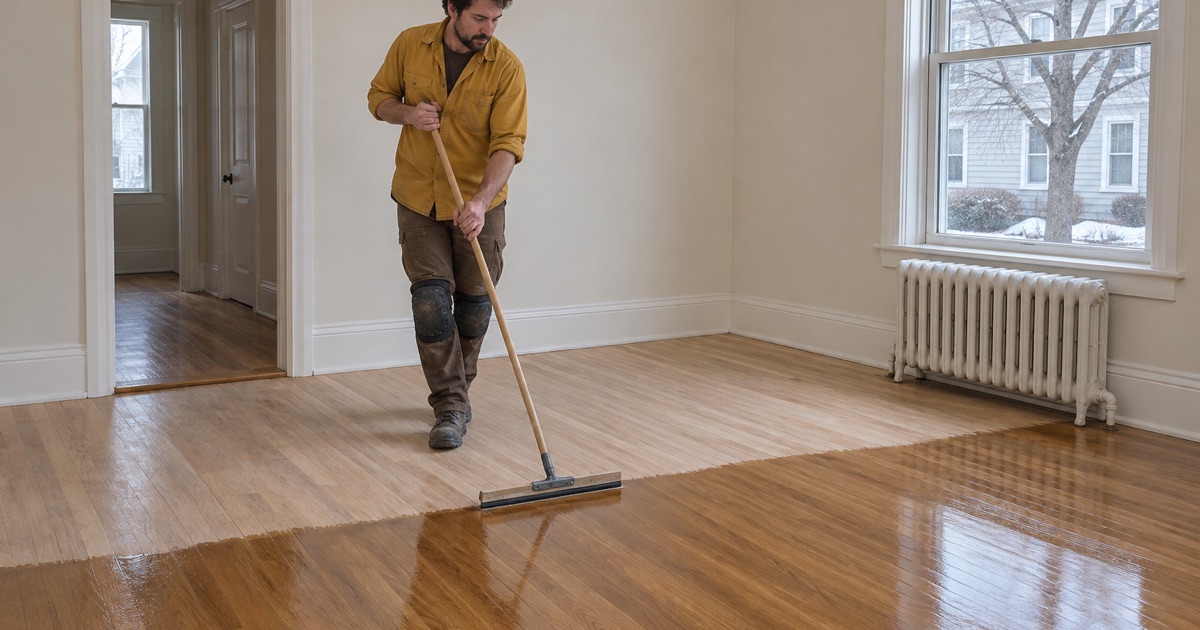
Owners ask us which flooring standard applies inside a Boston apartment, and the honest answer is that the State Sanitary Code does not carry one. 105 CMR 410 has no flooring line item of its own, and it names no species, no thickness and no sheen level. A wood floor is reached instead as part of the building and its structural elements.
A Structural Element, Not a Finish Specification
105 CMR 410.500 is titled “Owner’s Responsibility to Maintain Building and Structural Elements”, and as amended by Mass Register Issue 1495 effective May 12, 2023 it requires every owner of a residence to maintain all buildings and structural elements in compliance with accepted standards, in good repair and in every way fit for the intended use. Subsection (A)(2) is the clause a floor usually meets.
It requires those elements to be “Free from holes, cracks, loose plaster, or defects that render the area difficult to keep clean, create an injury risk, or provide an entry or harborage for pests.” Read against a floor that has been walked on for a century, that language reaches open board gapping, a splintered or lifted board, and a section that has cupped high enough to catch a shoe. None of those are flooring questions in the code’s vocabulary; they are defects in a structural element.
The same framing explains why a floor problem and a moisture problem are one item rather than two. Subsection (A)(1) asks that structural elements be watertight and free from excess moisture or the appearance of mold, and a wood floor is the surface where that condition shows itself first. Cupping across the grain, a dark stain spreading along a seam and a musty smell under a rug are three readings of the same thing.
What a Code Report Records About a Floor
When an apartment is inspected, the inspector must write down all violations, and the tenant may ask for a signed copy of the code report before the inspector leaves. That report helps us because it describes the defect in the code’s own terms rather than in trade terms. What it does not do is tell us whether the fix is a weave-in repair, a board replacement or a full resand.
So we read the floor ourselves alongside it. We check whether the boards still carry enough wood above the tongue to take another sanding, whether the movement is seasonal winter gaps or a subfloor and joist problem, and whether exit holes and frass in an old pine subfloor point at powderpost beetle rather than ordinary wear.
Looking for wood-flooring closer to Malden? See Wood-Flooring Services in Malden.
The 48-Hour Drying Duty When a Leak Reaches the Floor Below
The same section adds a clock. 105 CMR 410.500(B) states that “In the event of leaks and flooding, the owner shall ensure all surfaces have been dried within 48 hours from the time they are notified or the end of the event, whichever is sooner”, language that arrived with the May 2023 amendment. Two days is not long for a wood floor with water under it.
The Water Usually Starts in Someone Else’s Apartment
North End housing is stacked and mostly rented. City of Boston Planning Department 2025 estimates put 4,671 of the neighborhood’s 6,286 occupied units in the hands of renters, 74.3 percent, and ACS 2024 five-year figures for ZIP 02113 — a labeled proxy for the neighborhood rather than a boundary match — show 2,959 of 4,763 units, 62.1 percent, in buildings of three to nine units.
In a building of that shape, a supply line, a dishwasher or an overflowing tub two floors up lands on a floor whose occupant never saw the event begin. That matters to the 48-hour duty, because the clock runs from notification or the end of the event, whichever comes sooner. The people who have to be told are rarely the ones standing in the water.
When we are called into that situation we ask what sits above the damage and when it happened, not only where the stain is. A slow supply-line drip and one overflow event leave different patterns in the same species, and the scope of the repair follows the pattern rather than the square footage of the room.
What Forty-Eight Hours Buys a Wood Floor
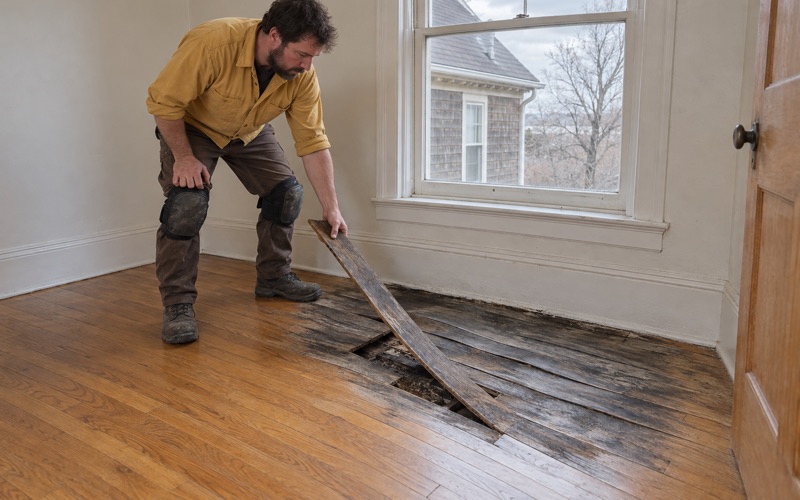
We trace water back to where it entered, read the floor and the subfloor with a moisture meter, and dry before deciding anything. A floor that is merely cupped at the two-day mark often flattens as it gives up moisture, and pulling those boards early wastes them. A floor that has begun buckling, or that sits over a saturated subfloor, is a different conversation and we say so early rather than late.
Drying is also what makes the rest of the work honest. We document water-damaged floors room by room for the adjuster and set the repair out in an itemized written estimate, which is what Massachusetts requires before a tenant can be charged for floor damage. Boards are woven in or replaced only after the readings settle, and refinishing waits until the moisture content is where it belongs.
Holes, Cracks and the Stairs That Serve These Floors
Not every floor defect sits on the same schedule. The tenant-facing Housing Code Checklist, keyed to 105 CMR 410, separates ordinary violations from a short list of emergency conditions, and that distinction changes how quickly a repair has to be arranged.
When a Floor Defect Becomes a 24-Hour Item
The checklist states that a board of health must, within 12 hours after an inspection, order a landlord to make a good faith effort to fix certain violations within 24 hours. Among them is “Roof, foundation, or other structural defects that may expose you to fire, burns, shock, accident, or other danger”, cited to 105 CMR 410.630(A)(12) and 410.500. That emergency list, like the rest of the code, carries no separate flooring entry.
What reaches it is the accident risk. A tread that gives underfoot, a board broken through at a former radiator pipe hole, an opening left where a wall came down and the floor beneath it was never carried — those read as structural defects that can hurt someone rather than as cosmetic wear. We put them first in the schedule and stabilize them before the refinishing conversation starts.
A recorded defect also sets the order of the work. Making a broken board or a failed tread safe is a small job next to refinishing a whole unit, and the two do not have to happen in the same week. We are glad to split them, and we mark in the estimate which part is the safety item.
Stair Treads, Railings and Guards in a Four- or Five-Story Building
The checklist carries a second emergency condition that lands squarely on a staircase: “No safe railing or guard for stairway, porch, balcony, roof or similar spaces”, cited to 410.630(A)(16) and 410.520. In a four- or five-story walk-up the stairs take more traffic than any floor in any single unit, and they show it first at the nosing.
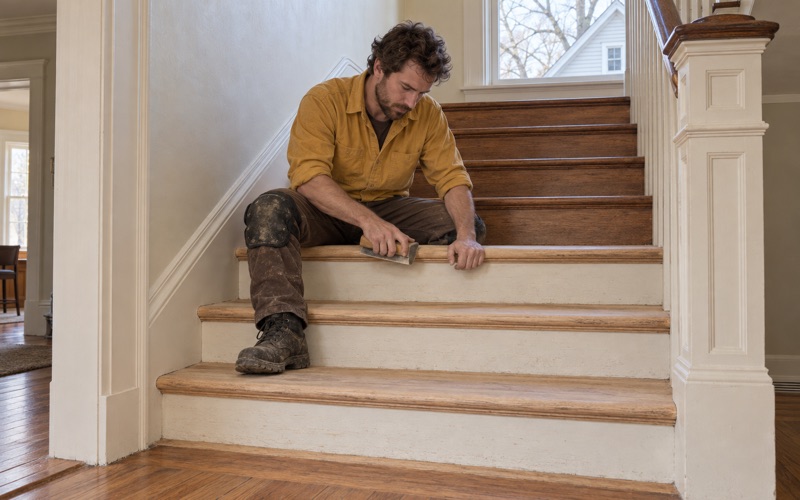
That is why we quote stairs tread by tread. A worn stair nosing, a loose tread over a dry stringer and a wobbling rail are three separate repairs at three different costs, and a square-foot price hides all of them. Refinishing a stair run is also a sequencing problem when it is the only way in and out of the apartments above.
Planning Floor Work in a North End Rental or Condominium Unit
Most of the floors we work on here are old, and what sits above or beneath them decides the sequence more often than the wood does. Beginning in the 1880s, North End residents replaced dilapidated wooden housing with four- and five-story brick apartment buildings, most of which still stand today, and after the 1970s developers converted tenements into larger apartments and condominiums. The ZIP 02113 stock reflects that history, with 67.8 percent of units built in 1939 or earlier and 88.2 percent before 1980, again as a labeled proxy.
What We Check Before a Sander Touches the Floor
We confirm the build year and look hard at painted surfaces first, because Massachusetts runs its own lead-safe renovation rules for homes built before 1978, and almost everything in this stock falls on the wrong side of that date. Baseboards, stair risers and window aprons are where painted material meets a sander.
Under the wood there is a second question. Old resilient floor tile and the black mastic beneath it get identified rather than disturbed, and the work stops until the right trade has handled it. Old wax and cleaning-product residue is tested and removed before any new coating goes down, because a waterborne polyurethane laid over wax peels instead of bonding.
Ground-floor and below-grade units get their own moisture readings before anything is specified. Where those readings stay high across a season, engineered wood with an honest wear layer is the right answer rather than solid hardwood, and we tell you which one the numbers actually support.
Repairs That Read as Floor, and a Color You Approve First
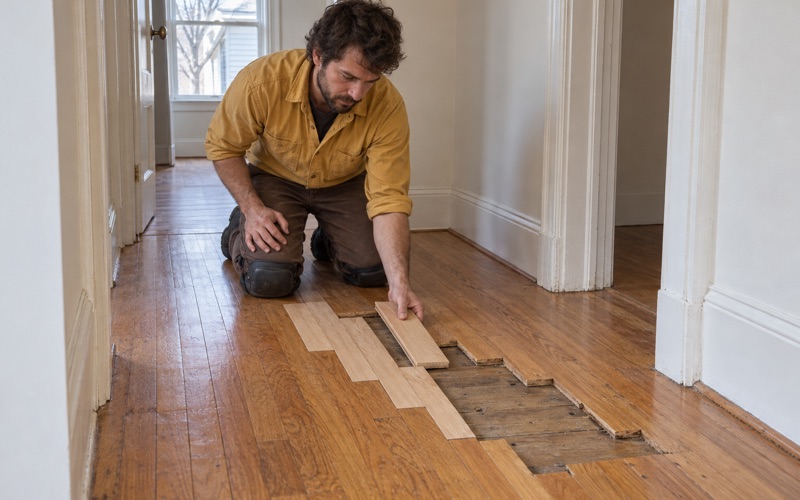
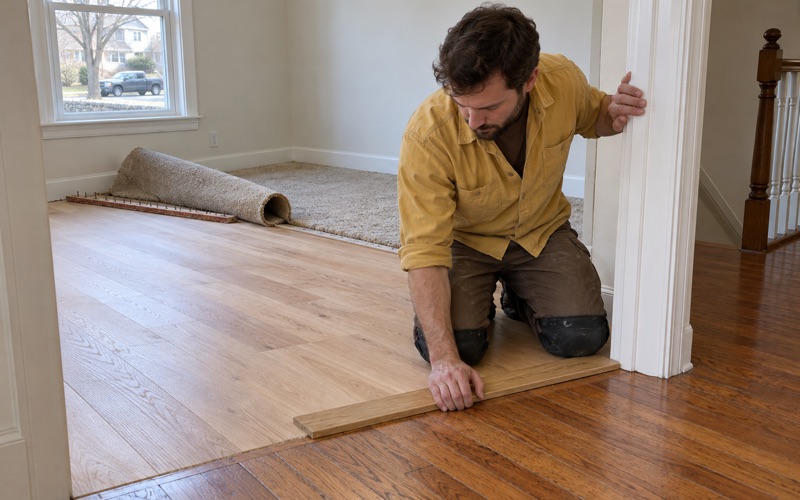
Holes left where steam radiators and their pipes came out are patched with matching boards woven into the floor instead of filled, and the same approach covers a spot where a wall came down or an electrical outlet moved. Done properly the patch reads as floor rather than as a scar, which matters more in a small unit where the whole room is visible at once.
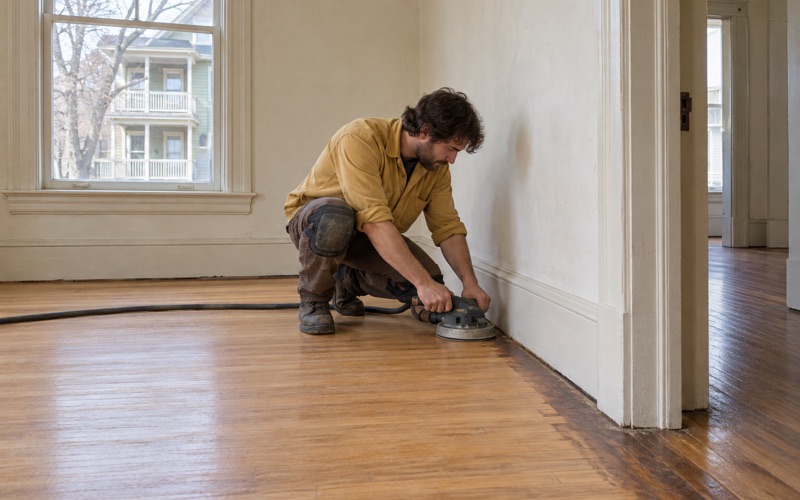
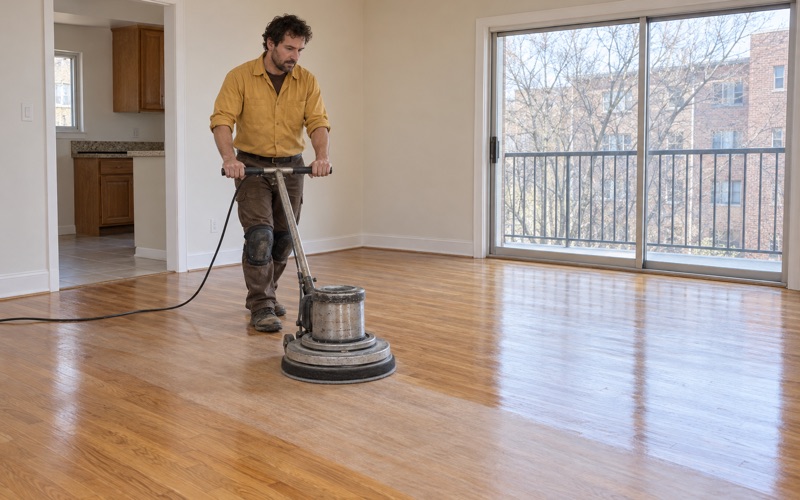
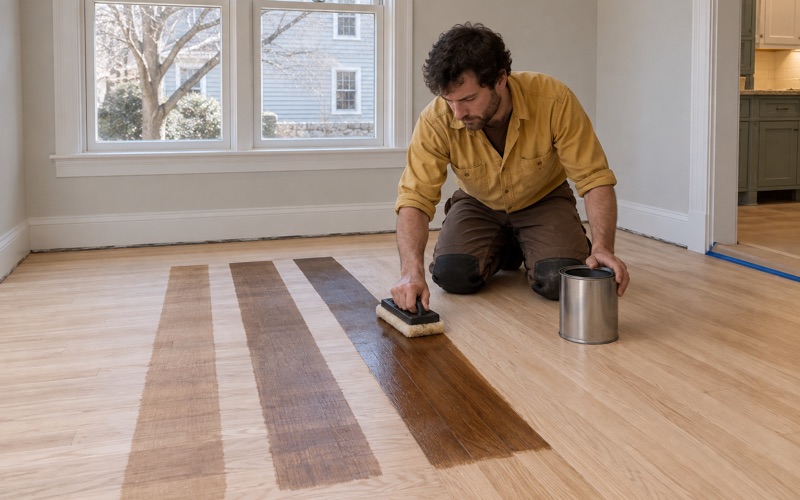
Color is settled on your own floor, in your own light, from stain samples laid on the boards rather than from a fan deck. We choose finishes that fit the Massachusetts VOC limits for wood coatings, which are stricter than the federal ones, and match the sheen level to how the room is really used. In an occupied building we also run the grit sequence with dustless sanding and a HEPA vacuum, so the dust stays in the unit it came from.
- 20+ Years On Wood Floors
- Written Itemized Estimates
- Stain Samples On Your Own Floor