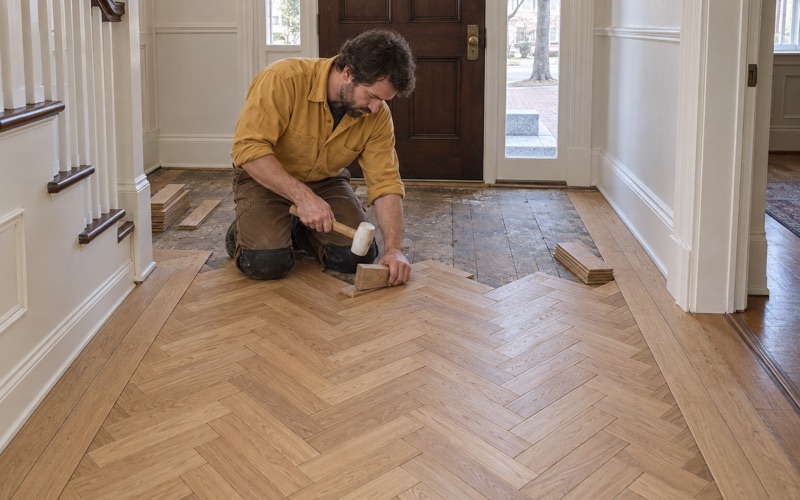
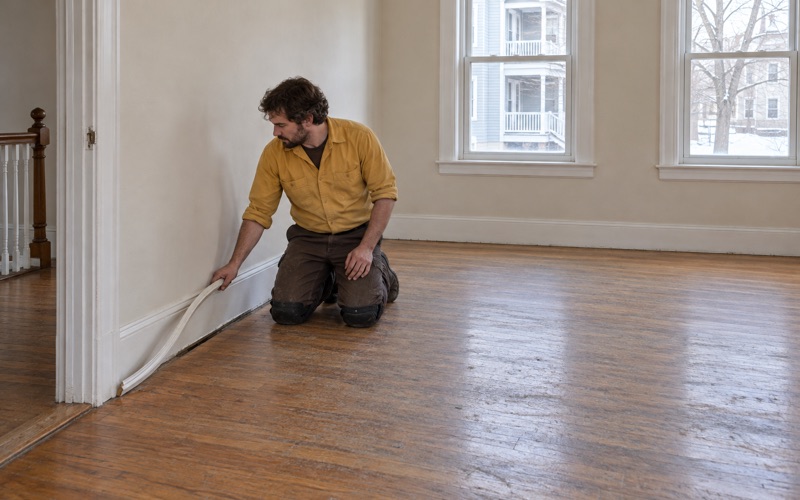
Waltham Wood Flooring has spent more than 20 years installing, sanding and repairing wood flooring in Pinehurst, and on this ground we open a job with a moisture meter rather than a tape measure. What the subfloor is holding decides whether solid hardwood or engineered wood belongs in a room, and it decides the expansion gap we leave at the walls. Getting that reading wrong is the one mistake sanding cannot correct afterward.
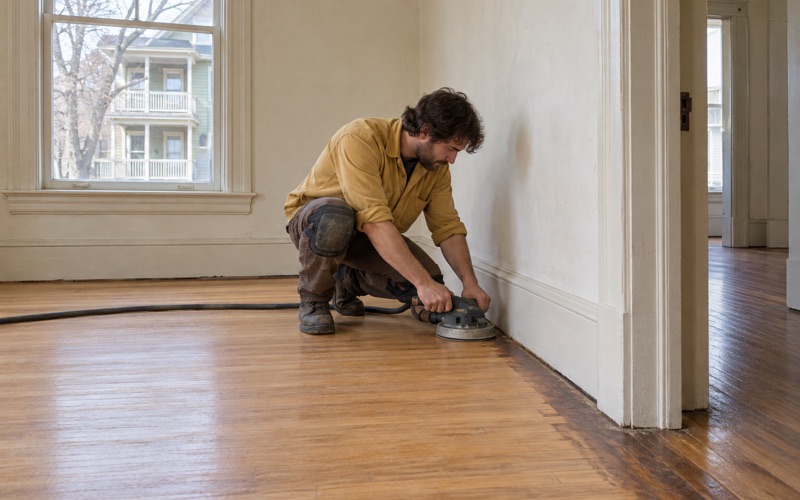
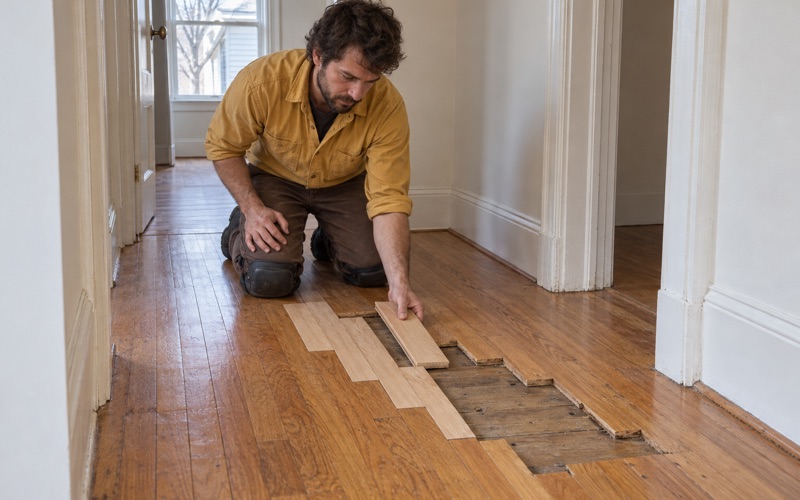
Most of what we do here is repair and refinishing rather than wholesale replacement. Holes left where steam radiators and their pipes came out are patched with matching boards woven into the field, so the repair reads as floor instead of as a filled scar, and the same approach covers a floor opened where a wall came down or an outlet moved. We check board thickness before a sander touches an older strip floor, because a floor already sanded twice needs a screen and recoat rather than a third pass with a drum sander.
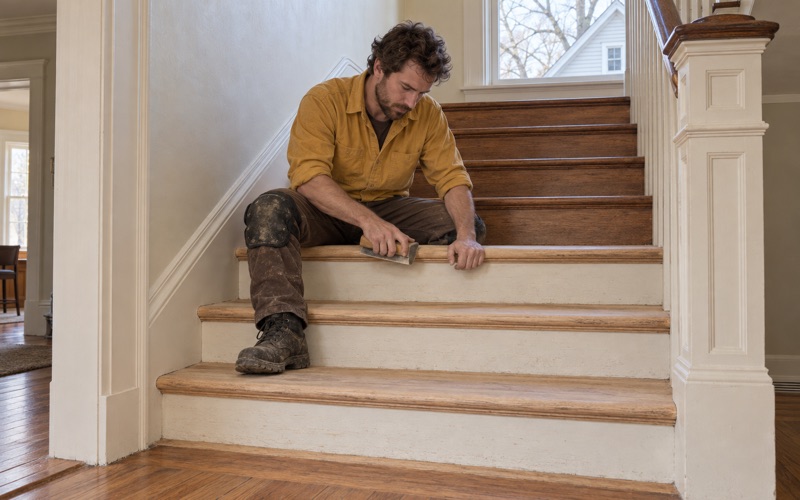
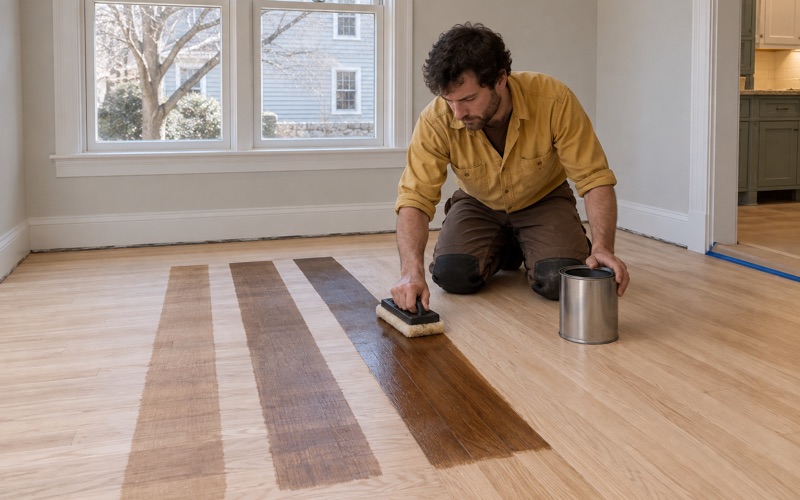
You see the work before you own it. Stain samples go down on your own boards, in your own light, and a staircase is quoted tread by tread rather than folded into a square-foot number.
Wood Floors on Pinehurst’s Brook and Wetland Ground

This is damp inland ground, and it shows up in floors as slow seasonal moisture rather than as an obvious leak. Billerica sits between the Concord and the Shawsheen rivers, and the low, wet pockets that go with a river town do not stop at a property line. We treat a house here as built on damp ground until the readings say otherwise.
A Village of Billerica, Not a Town of Its Own
Pinehurst is an unincorporated village and census-designated place inside the town of Billerica, in Middlesex County. It has no government of its own, which matters the moment a floor project touches anything beyond the finish: every bylaw, board and municipal office that governs the work is Billerica’s, and the paperwork carries the town’s name rather than the village’s.
The census place covers 3.77 square miles in the southeastern part of Billerica, strung along Route 3A, and it borders Burlington to the southeast and Bedford to the southwest. Wyman Road, Webb Brook Road and Allen Road mark its western edge and Baldwin Road its northern one. We raise it because owners here describe an address by the village and then go looking for a village department that does not exist.
Jones Brook, the Shawsheen, and Article XXII
The northern border of the census place follows Jones Brook downstream to the Shawsheen River, so the line drawn around this village is literally a watercourse. Billerica adopted its own Wetlands Protection By-Law, Article XXII, in October 2002, administered by the town’s Conservation Commission alongside the state Wetlands Protection Act.
Under that by-law, construction, earth-disturbing activities, drainage-altering activities and removal of vegetation call for a wetlands permit when proposed within the 100-year floodplain, within 200 feet of a perennial river or stream, or within 100 feet of any other wetland. Most resource areas carry a 100-foot buffer zone, and the inner part of that buffer is treated as a No Alteration Zone of either 25 or 50 feet.
What the by-law reaches is construction and site work rather than finishes. Where a floor project also moves earth, changes drainage or clears vegetation outside, the Conservation Commission is the office that answers for that parcel, and that conversation belongs at the front of a schedule rather than the week the boards arrive.
Looking for wood-flooring closer to Winthrop Town? See Wood-Flooring Services in Winthrop Town.
Checking Moisture Before a Pinehurst Floor Goes Down
An installation on ground like this is decided before the first board is set. We read the subfloor, the flooring and the rooms, write the numbers down, and only then confirm the material and the thickness. A floor laid over a wet subfloor will cup, gap or buckle inside a year no matter how well it was fastened.
What We Meter, and How Many Readings
The 2025 NWFA Installation Guidelines set a wood subfloor at 13 percent moisture content and call for 20 readings per 1,000 square feet. We take them spread across the room rather than clustered in one corner, because a single reading beside an exterior wall describes that wall and tells you nothing about the middle of the floor.
We read the flooring itself as well and compare the two sets. What matters is less any one number than the spread between the boards and what they are going onto. A wide spread means the floor will move after installation, and the answer to that is time and conditioning, never a tighter nailing schedule.
Those numbers go in writing and stay with the job. If a floor is questioned a year later, the readings taken the week it was installed are what settle whether the material or the conditions moved.
Acclimation, Expansion Gaps, and What Goes Under the Boards
Acclimation means conditioning material to the house as it will actually be lived in, with the heat or the cooling running, not boards stacked in an unconditioned garage for a week. We leave the flooring in the rooms it will occupy and re-meter before anything is fastened down.
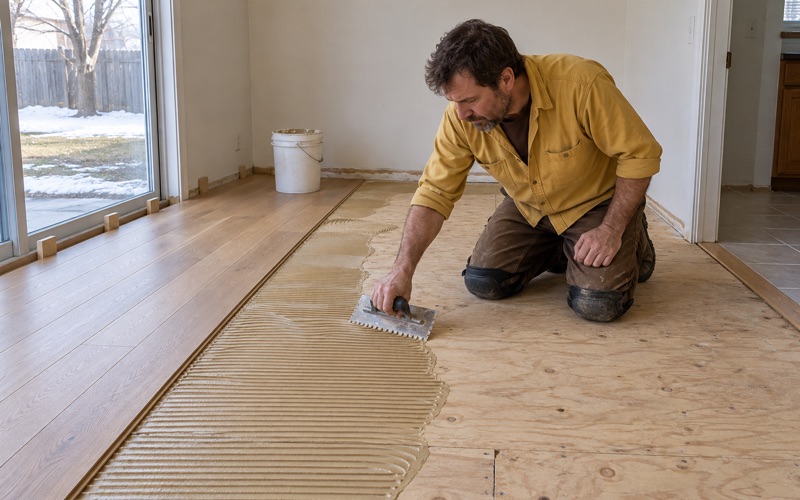
An expansion gap at every wall, rosin paper or the right vapor retarder under the field, and cleats or staples sized to the board are the unglamorous parts that keep a floor flat. On damp ground the vapor retarder is a decision rather than a default, and it follows the readings we took rather than a habit carried in from the last job.
Seasonal Movement in an Inland Forecast Zone
The National Weather Service puts Pinehurst in forecast zone MAZ005, Central Middlesex County, while Boston’s own neighborhoods sit in MAZ015, Suffolk. That is a forecast-product boundary rather than a climate measurement, but it is a fair reminder that an inland Middlesex house and a house in the city are not handed the same conditions, and wood answers to conditions.
Winter Gaps and Summer Cupping
Every solid wood floor in this part of the state moves twice a year. Heating season pulls moisture out and the boards shrink apart into winter gaps; the humid months push it back in and the boards swell, which shows first as cupping along the board edges. Neither is a defect on its own, and a floor sanded flat in February can read wrong in August if that swing was never accounted for.
Crowning, where the center of a board stands proud of its edges, is usually a floor that was sanded while it was still cupped. We would rather wait for a floor to come back down than take the high spots off a wet board, because the board flattened wet becomes the board that is thin and crowned once it dries.
Finishes That Live With the Swing
Finish choice follows the same logic. Waterborne polyurethane, oil-modified polyurethane and hardwax oil wear, yellow and repair differently, and the right pick depends on traffic lanes, pets and how much direct sun the room gets. We keep to coatings that fit the Massachusetts VOC limits for wood finishes, which are stricter than the federal ones.
Old wax and cleaning-product residue is tested for and removed before anything new goes down. A finish applied over residue peels instead of bonding, and a peeling coat has to be sanded off rather than screened, which turns a one-day recoat into a full refinish.
Repairing a Ground-Floor or Lower-Level Floor in Pinehurst
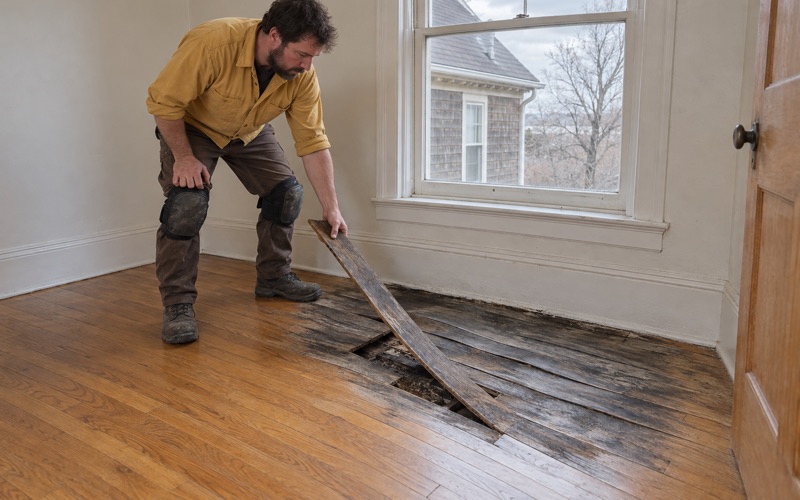
Repairs on the lowest occupied level are the most common call we take in this village, and they usually start with water: a burst pipe, an appliance that overflowed, or moisture that arrived slowly enough that nobody noticed until the boards moved. We trace the source, dry the structure and read the floor with a meter before a single board is replaced.
Weave-In Repairs and Board Replacement
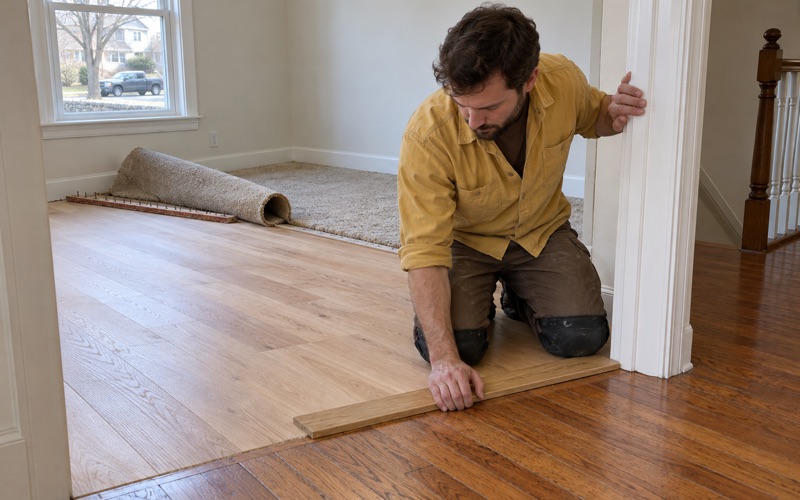
A patch reads as a patch when it stops at a rectangle. We pull boards out in a staggered pattern and weave the new ones into the field so the end joints fall where the eye expects them, matching species, width and cut, with red oak strip flooring going back as red oak and rift and quartersawn matched to quartersawn.
Fasteners matter as much as the boards. An older floor set with cut nails does not behave like one stapled down last decade, so we open a small area first, see how the existing field is held, and set the patch the same way.
Where a floor has to be documented rather than simply fixed, we write it up room by room for an adjuster. Landlords get an itemized written estimate, which is what Massachusetts expects before a tenant is charged for floor damage, and an owner-occupied two-family is worked one floor at a time so the household upstairs keeps living in the house.
Lower Levels, Below Grade, and Engineered Wood
The NWFA treats a level as below grade when soil sits three inches or more above that level’s floor, which puts more lower levels here into that category than owners expect. Below grade we match the material to the moisture actually measured in the space, and that usually means engineered wood with a wear layer thick enough to sand at least once rather than solid hardwood.
When we open an older floor at that level, resilient floor tile and the black mastic under it are identified rather than disturbed, and the work stops until the right trade has handled it. That is a delay of days, and it is the cheapest part of the job compared with what disturbing it costs.
Planning a Floor Project in a Village of Billerica
A great deal of what we sand here is postwar oak strip flooring, and it deserves to be measured before it is written off. Of the 2,339 housing units the census counts in Pinehurst, 1,036 of them, 44.3 percent, were built between 1960 and 1979, and 92.1 percent of the stock is one-unit detached, which tends to mean whole-floor projects rather than a single room. We check thickness over the tongue first, and where there is wood left, a sand and refinish outlasts a tear-out for less money.
On any house from that era we check the build year and look over painted surfaces before sanding starts, because Massachusetts runs its own lead-safe renovation rules for homes built before 1978. That check is quick, it happens at the estimate rather than on the first morning, and it changes the containment we set up rather than whether the floor can be saved.
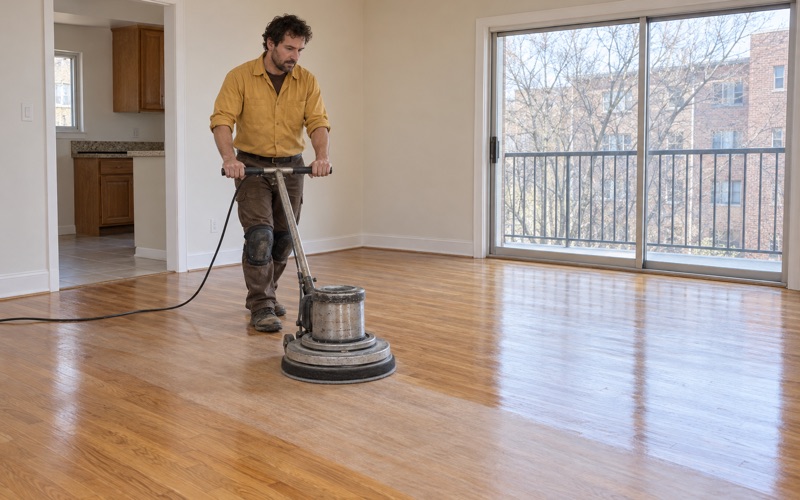
The rest is sequencing around the household: dustless sanding with HEPA vacuums, a grit sequence suited to the species and the floor’s history, and dry times built into the schedule instead of promised away. Tell us which rooms have to stay usable and we plan the order around them.
- 20+ Years On Wood Floors
- Written Itemized Estimates
- Stain Samples On Your Own Floor