
Waltham Wood Flooring replaces carpet with hardwood across Waltham, MA, serving surrounding cities including Belmont, Watertown, Lexington, Newton, Arlington, and in 20+ years the first thing we do on this job is not order material. It is find out what is under the carpet, because in this housing stock the answer is frequently a floor that only needs refinishing.
When the carpet comes up it brings a pad that has often bonded itself to whatever is underneath, several thousand staples, and tack strip nailed along every wall. Taking all of that off without damaging the boards below is careful work rather than demolition, and it has to happen before anyone can judge what is there.
From that point the job goes one of two ways: bring back the floor that was already in the house, or install a new one over a subfloor that has been checked, flattened and read for moisture. We quote both where both are genuinely available, so the decision is yours with the numbers in front of you.
Is There Already A Floor Under There
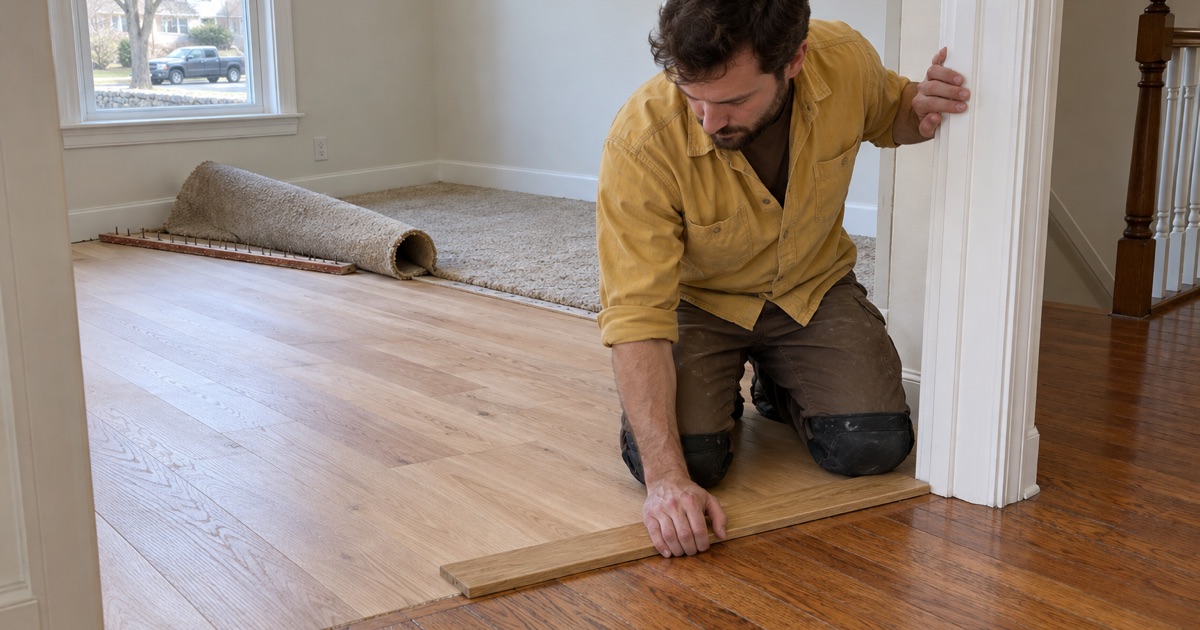
This question is worth answering before any other, and it takes ten minutes. A room with sound oak under the carpet and a room with bare subfloor are entirely different projects, on different budgets and different schedules. Everything else in the decision waits on knowing which one you have.
What The Pre-1960 Housing Stock Usually Hides
About 49.2 percent of Waltham’s housing units were built before 1960, and narrow red oak strip flooring over a board subfloor was the standard of that era. Wall-to-wall carpet arrived decades later and was very often laid straight over it, so a great many carpeted rooms here have a usable hardwood floor sitting underneath.
Checking Without Damaging Anything
We lift a section somewhere invisible — inside a closet, behind a door swing, or at a wall where the tack strip already is — and look at the species, the board width, the condition of the finish and whether the boards run continuously under the walls. That tells us what you have without committing you to anything.
Refinishing Against Replacing
Where the floor underneath is sound, refinishing is nearly always the better value: no material cost, no disruption to door heights or transitions, and an old floor with a hundred years of character on it. Where it has been damaged, heavily patched, or sanded down to its last pass, we say so and price the replacement instead.
Taking Out The Carpet And Everything Under It
The removal stage is where the surprises in this job live, and all of them are better found early. Carpet hides the condition of everything beneath it, including things that are not flooring at all, and none of it can be assessed through a layer of pile and pad. We treat removal as its own stage with its own line in the estimate rather than as five minutes before the real work.
Pad, Staples And Tack Strip
The pad frequently sticks to the finish below and has to be worked off rather than pulled. Staples come out individually, because a staple driven through and snapped off is a mark in the floor forever. Tack strip is prised off the perimeter along with its nails, and the nail holes are dealt with during the repair stage.
Resilient Tile And Black Mastic
In older houses the carpet sometimes covers an earlier floor of nine-inch resilient tile set in black mastic, and both may contain asbestos. We identify what has turned up, stop work in that area, and leave it undisturbed until a licensed abatement contractor has handled it, rather than scraping it up and turning a flooring job into something else entirely.
Transitions, Thresholds And Door Clearances
Carpet and pad together are usually thicker than a wood floor, so the finished height changes at every doorway. Reducers, thresholds and stair nosings are scoped as part of the work, and doors that were cut short for carpet occasionally need attention at the bottom edge so they still meet the frame properly.
Preparing The Subfloor
Everything the new floor will do for the next thirty years is decided by what it is fastened to. Carpet is forgiving of a substrate in a way that wood is not: pad absorbs small irregularities that a rigid board will simply transmit. A subfloor that carried carpet without complaint for decades may still need work before it carries hardwood.
Flatness
We check the subfloor with a straightedge and correct what falls outside tolerance. A dip left under a new floor telegraphs through it permanently and tends to become a hollow-sounding area or, eventually, a loose joint. Older board subfloors in particular develop a shape over a century that is worth correcting while it is exposed.
Fastening And Squeaks
Any subfloor panel or board that moves against a joist gets refastened while there is free access to it. This is the one moment in the life of the room when fixing a squeak costs almost nothing, and it is far easier now than once the flooring, the baseboard and the furniture are back in place.
Moisture Readings And Acclimation
We take readings in the subfloor and bring the new flooring into the rooms it is going into until its moisture content and the subfloor’s agree. Installing to a schedule rather than to readings is the most common cause of winter gapping in an otherwise sound new floor, and it is entirely avoidable.
Choosing What Goes Down
The material decision follows the level of the house and what the new floor will have to meet. Those two facts narrow the options considerably before anyone opens a sample box, which is the useful order to do it in. Taste decides among what is left rather than among everything available.
Matching An Adjoining Room
Where the new floor will meet an existing one, we match species, cut, board width and grain direction, weave the boards into the existing courses at the join, and sand and finish both areas together. Finishing them separately is what leaves a visible line at the doorway.
Solid Or Engineered, By Level
On and above grade over a wood subfloor, solid hardwood is the straightforward choice and can be sanded many times. Below grade or over concrete, the vapor coming through the substrate makes an engineered floor over a vapor retarder the material that actually stays flat.
Prefinished Or Site-Finished
Prefinished flooring is coated before it arrives, installs in a day and has no finish odor, which suits an occupied house. Site-finished flooring is sanded flat after installation for a single unbroken plane, and it is the only option if you want the new floor to blend seamlessly into an older one next door.
- 20+ Years On Wood Floors
- Written Itemized Estimates
- Stain Samples On Your Own Floor