Waltham Wood Flooring has handled wood flooring in Roxbury for more than 20 years, and a large share of that work starts with water rather than wear. Rain-driven water that reaches a floor at ground level behaves differently from a slow leak under a sink, and it leaves a different repair behind. This page is about what heavy rain does to a Roxbury wood floor and what putting one back actually involves.
Most of the floors we are called to here are strip oak, laid tight, nailed down and finished in place. Oak is stable when it is dry and very responsive when it is not, so a floor announces that it has taken water long before anyone lifts a board. Reading those signs correctly is what decides whether a floor gets dried and refinished or opened up and partly replaced.
We work the same way on every water call: find where the water came in, dry the assembly to a measured number, then decide what has to go. Guessing at any of those three steps is what turns a repairable floor into a torn-out one.
Rain, Drainage and Roxbury Wood Floors
Roxbury’s water problem is a rainfall problem rather than a coastal one. Climate Ready Boston, the City of Boston’s December 2016 resilience study, describes the neighborhood as consistently among the least exposed to coastal flood impacts until later in the century, and then spends its Roxbury pages on stormwater instead. For a floor, that distinction matters: the water arrives during a storm, from above and from the street, and it can arrive on a block nobody would call waterfront.
How Rain Reaches a Floor at Ground Level
Water that gets to a finished floor during a storm usually arrives one of three ways: over a threshold at a door sitting low to grade, back up through a drain when the system below the street is full, or down inside a wall from a roof or gutter that could not keep up. Each route wets a different part of the floor first, which is why we trace it before we dry it.
A doorway flood soaks the finish and the board ends nearest the entry, and it is obvious within the hour. A drain backup or a wall leak often wets the subfloor first and only shows at the surface days later, by which time the boards have already begun to move.
What Boston’s Stormwater Report Says About Roxbury Homes
The same report is blunt about the present. Even today, it says, the drainage system can be overwhelmed by heavy rains. It names Melnea Cass Boulevard as already impacted today in heavy rains, with Hampden and Gerard Streets to the south also listed among the areas at risk; those are the report’s observations about streets and drainage, not a statement about any particular building.
Its long-term scenario is larger. The report puts 950 Roxbury buildings and 180 acres, 6 percent of the neighborhood’s land area, at risk of stormwater flooding late in the century, out of roughly 10,000 buildings in the focus area. Residential buildings are 68 percent of that exposed stock, and the report states plainly that the majority of stormwater impacts to buildings occur in residential buildings.
That last line is the one that concerns us. Commercial stormwater exposure is a facilities problem; residential exposure is somebody’s oak floor and the stairs above it. The report notes that BWSC is upgrading pipes and expanding system capacity, which it expects will reduce the flooding, but the floors we get called about are wet now.
Looking for wood-flooring closer to Jamaica Plain? See Jamaica Plain Wood-Flooring.
What Water Does to Strip Oak and the Subfloor Under It
Wood moves with the moisture in it, and it moves unevenly when one face gets wet and the other does not. That single mechanism is behind almost every shape a water-damaged floor takes, and knowing which shape you are looking at tells you how far along the damage is.
Cupping, Crowning and Buckling
Cupping is the first stage: the board edges rise above the center because the underside has picked up moisture the finished face has not. Sanded too early and then left to dry, a cupped floor flattens out and reads as crowning instead, with the center standing proud of the edges. Buckling is the far end of the scale, boards that swelled until the floor lifted off the subfloor, usually along a wall where the expansion gap had already closed up.
Board gapping runs the other direction and is easy to misread in winter. Roxbury floors open up every heating season and close again in summer, so winter gaps are not evidence of water damage on their own. We measure rather than judge by eye, because the answer for a seasonal gap is patience and the answer for a wet floor is not.
The Subfloor, the Joists and What Sits Between
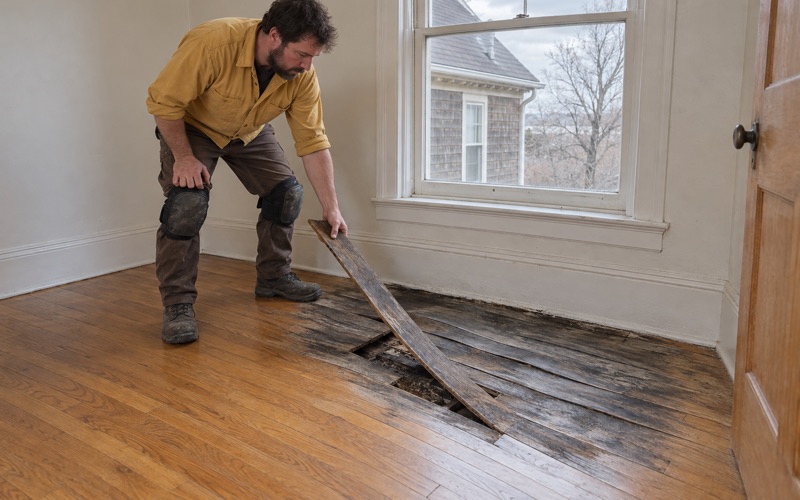
Under a Roxbury strip floor there is usually board or panel subfloor, a layer of rosin paper, and the cleats or cut nails holding everything to the joists. Water that reaches the subfloor stays there long after the surface looks dry, because the finished floor above it slows evaporation to a crawl.
This is where the report’s warning about air quality earns attention. Climate Ready Boston says stormwater flooding could have strong impacts on indoor air quality from mold, and a wet subfloor sealed under a tight finished floor is the kind of assembly that warning is about. That work is not ours. If what we measure points that way, we say so, stop, and let the right trade look before any new floor goes down over it.
One other thing turns up under old floors here: resilient floor tile and the black mastic under it, left in place when someone laid a newer floor on top. If water has loosened it, we identify it and leave it undisturbed rather than sanding or scraping at it, and that part of the job waits for the trade that handles it.
Drying a Water-Damaged Floor in a Roxbury House
A wet floor is not an estimate yet. It is a drying problem with an estimate at the end of it, and the order of those two things is not negotiable.
Reading Moisture Instead of Guessing at It
We trace the water back to its entry point first, then take moisture meter readings across the affected rooms and into the dry ones for comparison. One reading tells you almost nothing; a map of readings tells you how far the water traveled and whether it is still moving.
Drying continues until the floor and the subfloor settle at a stable number that holds over several days, not until the surface feels dry underfoot. Boards set into a still-wet assembly move again as everything around them comes down to normal, and that second failure is harder to fix than the first.
Some cupped floors flatten on their own once the moisture equalizes. Sanding one before it does takes wood off the raised edges that the board needs back when it settles, and a floor sanded wet is a floor sanded twice.
Where Drying Ends and Replacement Starts
Not everything comes back. A board that buckled and split, a board with the tongue broken off its edge, a run where the subfloor stayed saturated long enough to lose its hold on the nails: those come out. The line between them is measurable, which is the entire point of measuring.
Everything else stays. Strip oak that cupped and then came back flat is still a floor worth sanding, and we would far rather refinish most of a room and weave new boards into the rest than pull an intact floor because part of it got wet.
Documenting the Rooms Before Anything Changes
We document water-damaged floors room by room before the work starts: what was wet, how wet, how far it spread, and what the boards were doing when we arrived. If an adjuster is involved, that record is what gets read, and it is far easier to gather before drying equipment changes what the rooms look like.
For rented units we write the estimate itemized rather than as one number for the floor, because Massachusetts requires an itemized written estimate before a tenant can be charged for damage. Owner-occupied units are 24.5 percent of occupied housing in Roxbury, so this comes up more often here than it does in most of the towns we work in.
Board Replacement and Refinishing After Water Gets In
Once the readings hold steady, the floor becomes an ordinary carpentry and refinishing job again. What makes it a Roxbury job is what the water already did and what the house has been through before.
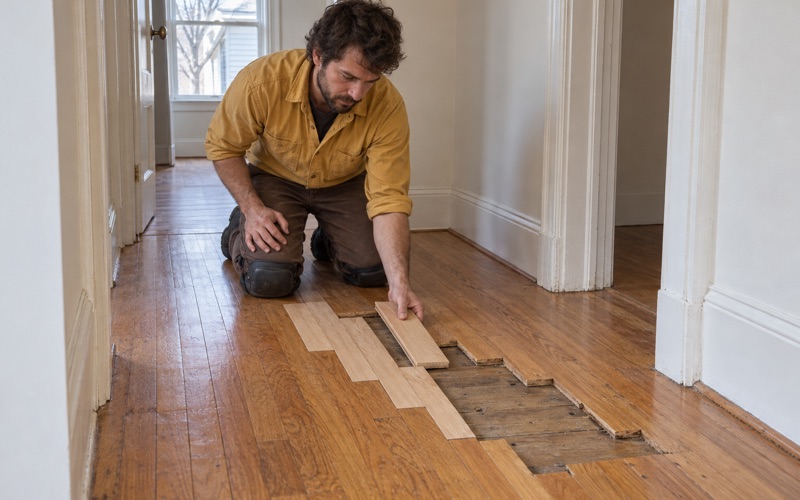
Weaving New Boards Into an Old Floor
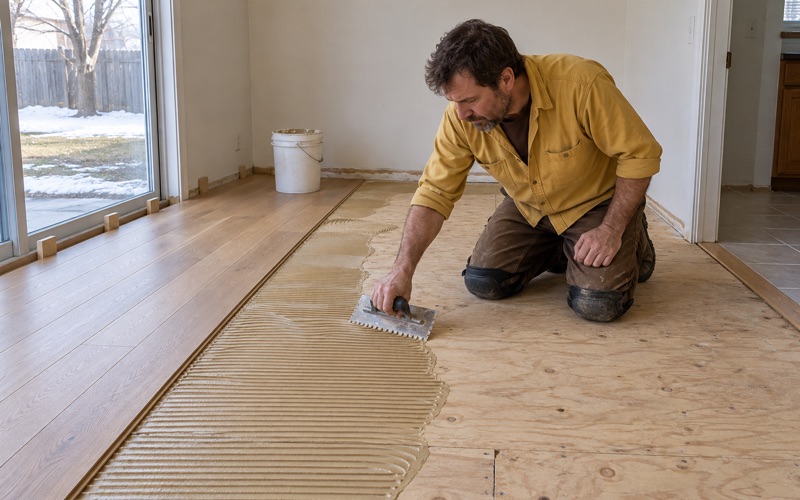
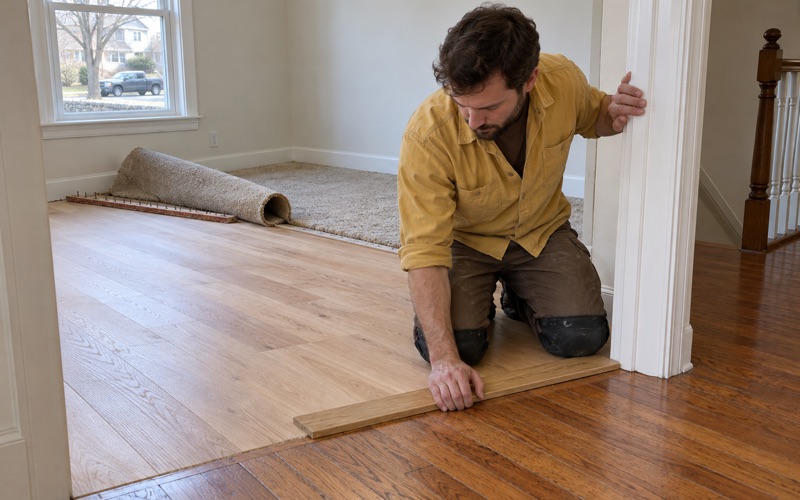
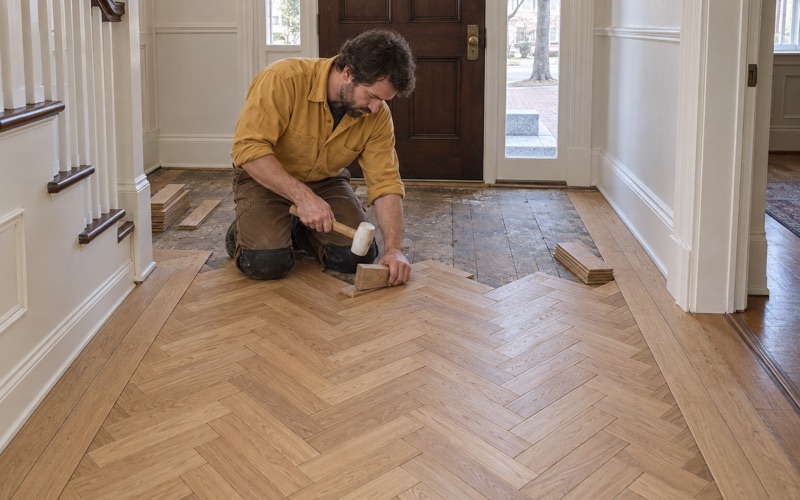
Replacement boards go in woven, never blocked in as a patch. We cut the damaged area back in a staggered line, match species, cut, width and grade, and lace new boards into the existing runs so the end joints fall where the eye does not collect them.
It is the same method we use on the holes left where steam radiators and their pipes came out, and on floors opened up when a wall came down or an outlet moved. Done that way the repair reads as floor. Done as a rectangle of new wood, it reads as a scar for as long as the floor lasts, however good the finish on top of it is.
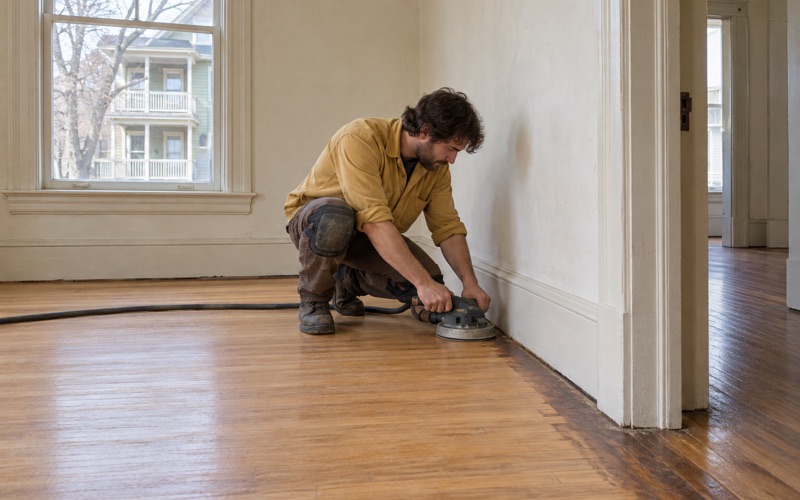
Sanding and Refinishing Once the Floor Is Dry
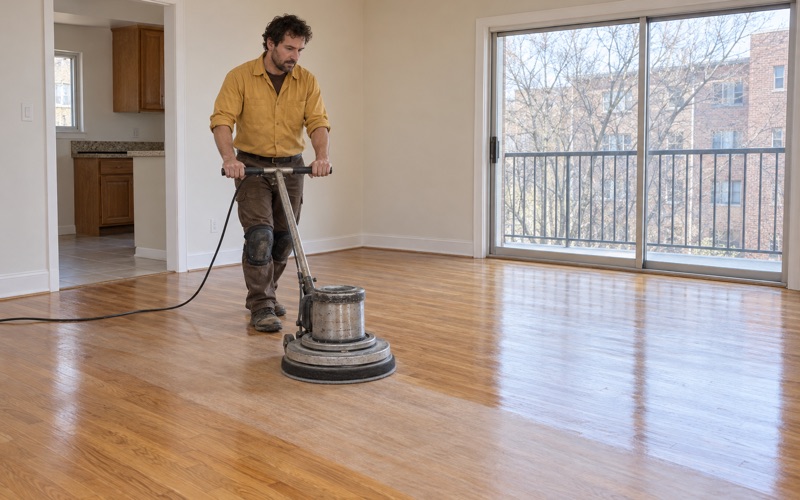
Before a drum sander touches anything we check what is left to sand. Postwar oak strip floors in houses put up in the 1950s and 1960s are usually worth saving rather than replacing, but the wood remaining above the tongue decides that, and a floor already taken down three times has a different answer than one sanded once.
We check the build year and any painted surfaces in the same visit, because Massachusetts runs its own lead-safe renovation rules for homes built before 1978. Roxbury housing skews old: in the 02119 ZIP code area, a labeled proxy for the neighborhood rather than a Roxbury boundary, 61.4 percent of units predate 1980. Old wax and cleaning-product residue gets tested for and removed before anything else, since a new finish over it peels instead of bonding.
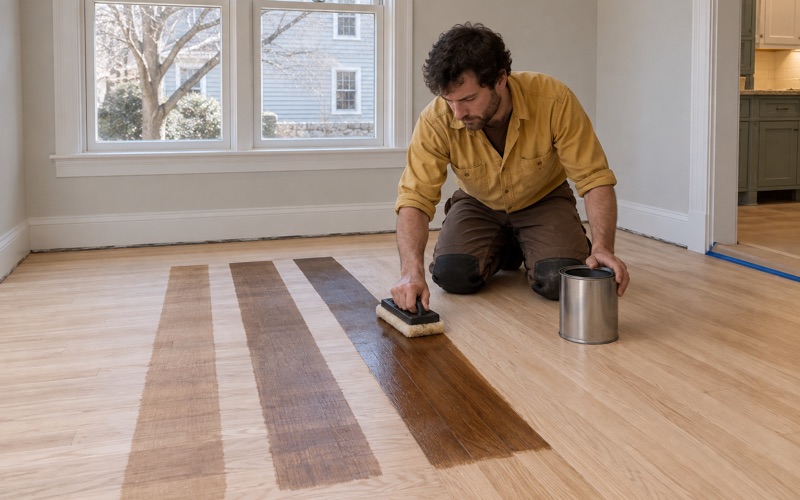
Finish choice comes last. We work inside the Massachusetts VOC limits for wood coatings, which are tighter than the federal ones, and we lay stain samples on your own floor in your own light before a color is settled. Boards that have been wet take stain differently from boards that have not, so a sample on a scrap proves nothing useful about this particular floor.
Planning Floor Work in a Home That Has Taken Water Before
When a floor has taken water once, we plan the next one as though it will happen again. That changes small decisions: where the expansion gap goes, which rooms get finished first, and whether the threshold detail at an exterior door is worth rebuilding while the floor is already open.
It also changes what is worth asking about outside our scope. Climate Ready Boston points property owners toward a resilience audit to identify building-specific improvements such as backflow preventers, elevation of critical equipment and deployable flood barriers, and those are easier to act on while a floor is up than after a new one has gone down.
In owner-occupied two- and three-families we work one floor at a time, so the household on the other floor keeps living in the house while the job runs. Call Waltham Wood Flooring while a Roxbury floor is still wet if you can. The readings taken early are what keep the repair small.
- 20+ Years On Wood Floors
- Written Itemized Estimates
- Stain Samples On Your Own Floor