Waltham Wood Flooring has been doing wood flooring in Somerville for more than twenty years, and the building type that keeps coming back to us is the older multifamily that never came down. These are floors laid under a different set of owners, walked on by a long line of households, and covered and uncovered more than once. Our work starts by reading what is actually left of them.
A floor in a building like this is rarely a blank surface waiting for a coat of finish. It is a record of radiators that were taken out, walls that came down, rugs that sat in one place for fifteen years, and at least one leak nobody wrote down. Before we quote anything we go room by room with a moisture meter and a close look at board thickness, because those two readings decide most of what follows.
Most of what we do here is refinishing and repair rather than replacement, scheduled unit by unit instead of as a whole-building shutdown. That suits a housing stock where somebody is usually living above or below the floor being sanded. The rest of this page is how that work gets judged, priced and sequenced in Somerville.
Floors in buildings that change hands and stay standing
There is a kind of job that shows up here far more than in places built out after the war: an existing multifamily sells, and the new owner’s plan is to repair it rather than empty it. The floor is not part of a gut renovation. It is part of a building that has to keep working while it is being fixed.
Housing money that buys what is already built
Somerville adopted the Community Preservation Act in 2012, at a surcharge of 1.5 percent on net property taxes, and voters approved a change to that surcharge in November 2024. In May 2018 the city awarded $6 million, funded through a bond, to the 100 Homes project run by the Somerville Community Corporation. That money went toward acquiring buildings, not putting up new ones.
The city described the model plainly: the corporation buys multifamily homes, removing them from the speculative market and making them perpetually affordable. At the date of that award the project had acquired 45 units in ten buildings. Buying what is already standing rather than building new sets a different task for a floor crew, and it is one we are asked to do often.
Repaired rather than gutted
Of Somerville’s 37,756 housing units, 59.0 percent were built in 1939 or earlier. In practice that means the floor under the carpet is usually a narrow red oak strip floor, or in the plainest of the old buildings eastern white pine, laid tongue and groove over a board subfloor and fastened with cut nails. It is also usually thinner than it started out, because somebody has sanded it at least once already.
A repair-rather-than-replace job asks us to save that floor where saving it is honest and to say so where it is not. We do not price a whole-room replacement when board replacement and a sand will carry the room another decade. We also do not sand a floor with nothing left to give, because a floor taken past its last sanding fails within a season and takes the finish bill down with it.
Looking for wood-flooring closer to Needham? See Wood-Flooring Services in Needham.
What decades of tenancy leave on an original strip floor
A floor that has been rented on for fifty or eighty years wears in patterns rather than evenly. Reading those patterns is how we separate a cosmetic problem from a structural one, and it is the difference between a two-day screen and recoat and a full sand through the grit sequence.
Traffic lanes, rug shadow and the stains nobody mentions
The first thing we look at is the traffic lane, the darkened worn path running from the entry door through the kitchen, where the finish is gone and bare wood has taken on dirt. Around it there is usually a rug shadow, a lighter rectangle where a rug sat while the boards around it took sun fade. Together those two tell us how much finish is left and whether a recoat would only make the contrast shinier.
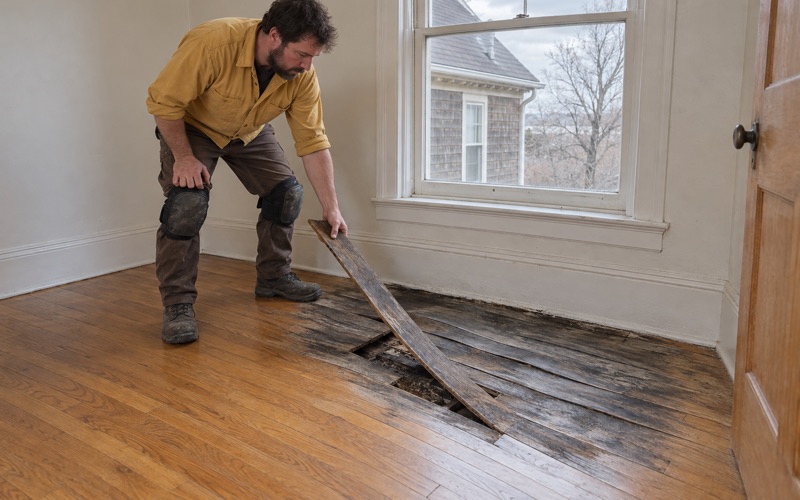
Then there are the stains. Pet urine stains soak through the finish into the wood and often into the subfloor, and a black one does not sand out; those boards come out instead. Water stains near a radiator or under a kitchen wall are a different case, and many of them disappear in the first pass once we know the source is dry.
Gaps, cupping and boards that have moved
Board gapping is normal in a building heated hard through January, and winter gaps that close again by June are not a defect. What we look for is a gap that stays open all year, which usually means the boards shrank for good during a long dry spell, or that an earlier repair used stock nobody let acclimate.
Cupping, where board edges sit higher than their centers, means moisture arrived from underneath. Crowning usually means somebody sanded a cupped floor flat before it had finished drying. Either way we take moisture readings across the room and in the space below it before a sander touches anything, because sanding a wet floor only books a second visit.
What is already on the boards
Old floors carry old coatings. A shellac finish under later coats behaves nothing like a modern polyurethane, and decades of oil-modified coats are the usual reason an oak floor reads orange before anyone has touched it. We identify what is on the boards first, because that decides whether the floor can be recoated at all or has to go back to bare wood.
We also test for old wax and cleaning-product residue, which is common on floors maintained by a long run of different households. Wax is invisible under a lamp and fatal to adhesion, so it comes off before anything goes down. A finish laid over it peels, and it peels after everyone has moved their furniture back in.
Deciding what to keep, board by board
In a building that has changed hands nobody has a drawing of what was done to the floors over the years, so the assessment happens on the floor itself. We walk each room and sort what we find into three piles: refinish, replace, and leave alone for now.
How much floor is left above the tongue
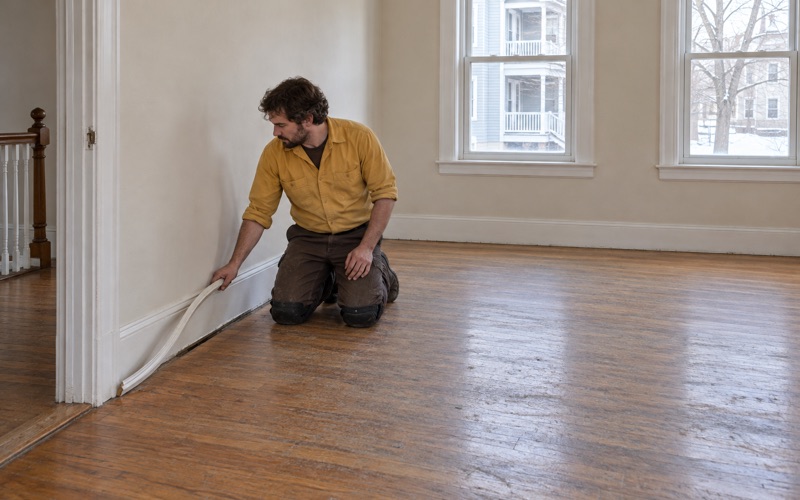
A solid strip floor can only be taken down to the top of the tongue, and every previous sanding has already spent part of that budget. We check thickness at a threshold, at a register cut, or anywhere else an edge is exposed, and we look at the fasteners, since cut nails riding proud of the surface say the floor has already been carried a long way down.
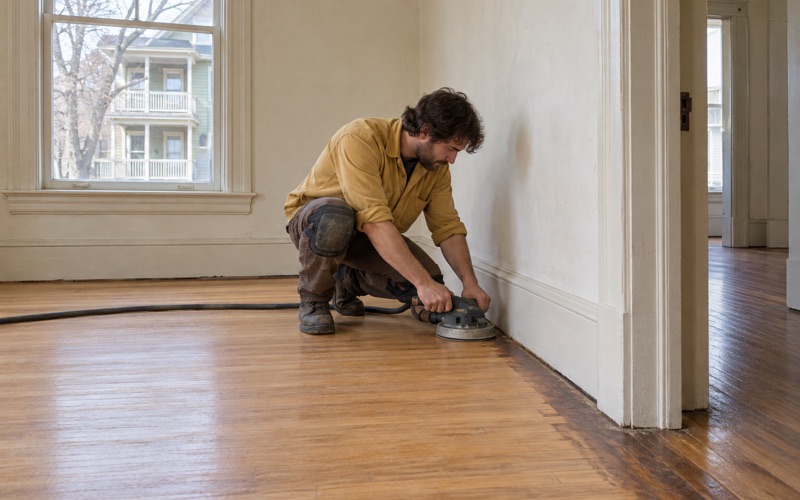
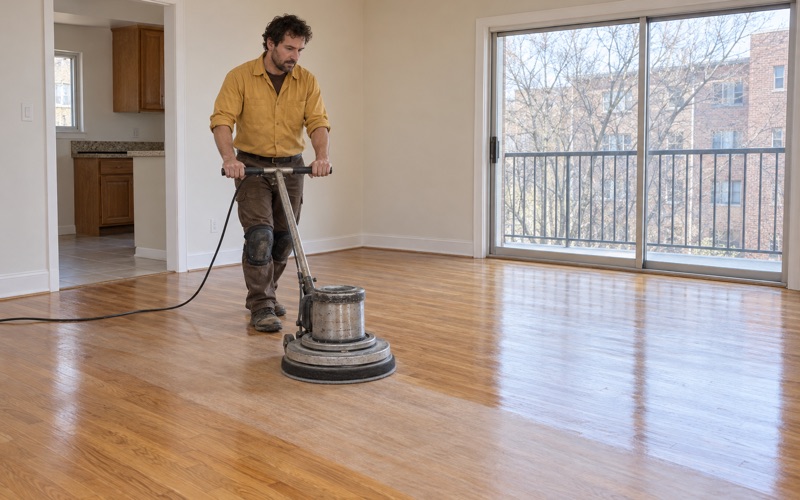
If there is thickness left, a full sand run through a proper grit sequence with a drum sander, and an orbital sander at the edges and closets, brings the floor back further than most owners expect. If there is not, the honest answer is a screen and recoat that buys years without removing wood, or replacement in the one or two rooms that cannot wait. We say which it is before the machines come off the truck.
Old patches, radiator holes and what sits under the tile
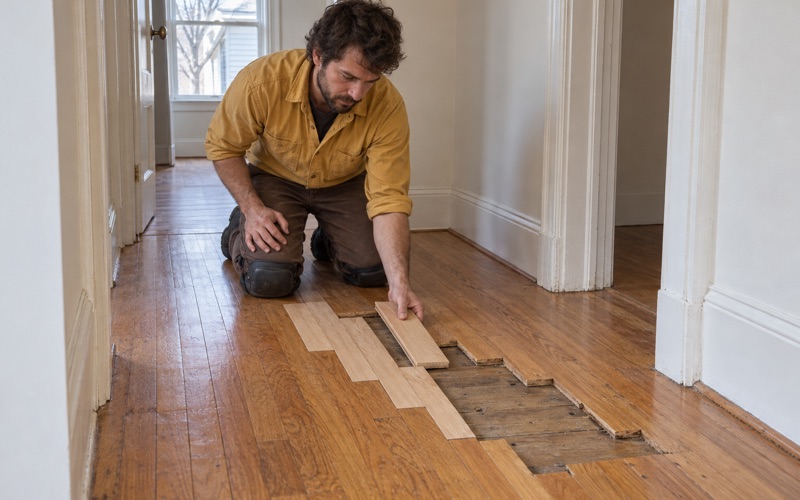
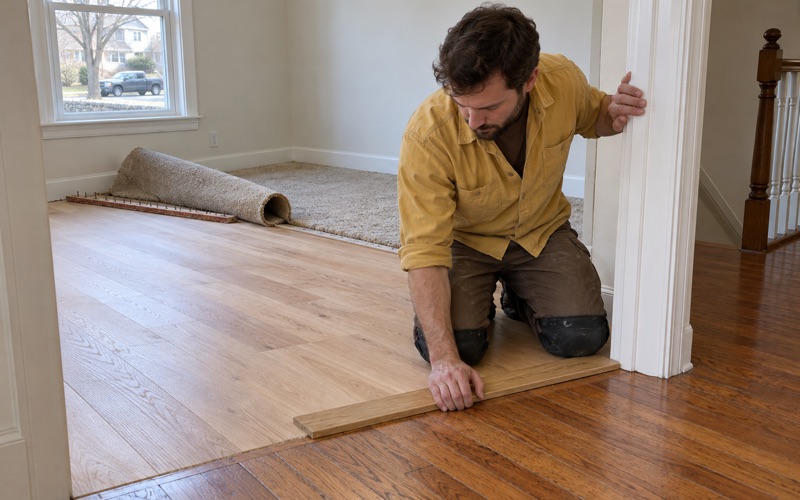
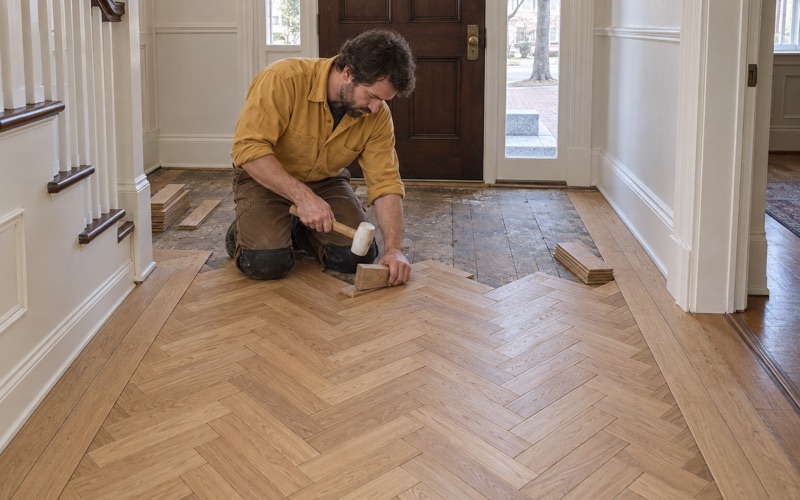
Old buildings collect patches: the square where a steam radiator and its pipe were taken out, the strip where a wall came down, the scar where an outlet or a register was moved. We close those with a weave-in repair, cutting matching boards into the existing courses so the run of the floor carries through the patch instead of stopping at it. Filled holes read as damage for the life of the floor; woven boards read as floor.
In kitchens and halls we also expect resilient floor tile, sometimes with black mastic under it. We identify that material and stop there rather than sanding or scraping it, and the floor waits until the right trade has handled it. The same caution applies to painted trim and thresholds: we check the build year before any sanding starts, because Massachusetts runs its own lead-safe renovation rules for housing built before 1978.
One unit at a time while the building stays occupied
Two-unit and three-or-four-unit buildings hold 55.2 percent of Somerville’s housing units, 10,654 of them in two-unit buildings and 10,189 in buildings of three or four. Almost every floor we quote here has a household on the other side of a ceiling from the work.
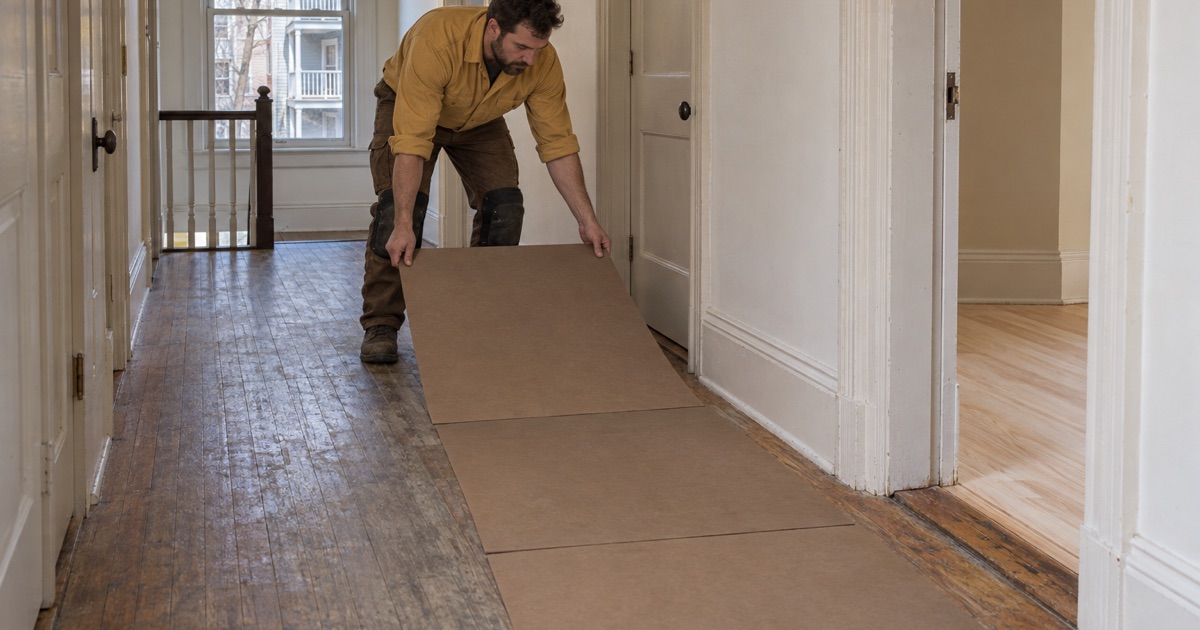
So we schedule by unit rather than by building. One unit gets cleared, papered at the thresholds with rosin paper, closed off and taken through sand, stain and finish, while the other households keep their stairs, their entry and their routine. Nobody has to move out of the building for a floor to be done.
Sequencing sanding, stain and finish around the household upstairs
Sanding is the loud day; finishing is the slow one, and the two get booked differently. We run dustless sanding with a HEPA vacuum on the machines so the dust stays in the unit being worked rather than in the shared stairwell, which matters more in a three-family than in a single house.
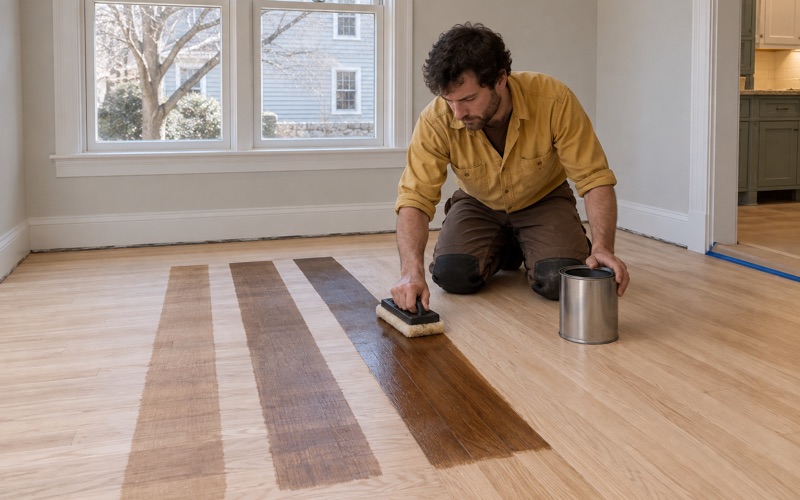
Coatings set the calendar after that. A waterborne polyurethane lets a unit be walked on sooner than an oil-modified one, which is the deciding factor when the occupant has nowhere else to be; both are chosen to sit inside the Massachusetts limits on volatile organic compounds in wood coatings, which are tighter than the federal ones. We settle the sheen level and lay stain samples on the actual floor, in that unit’s own light, before any color is agreed.
Stairs, thresholds and what goes in writing
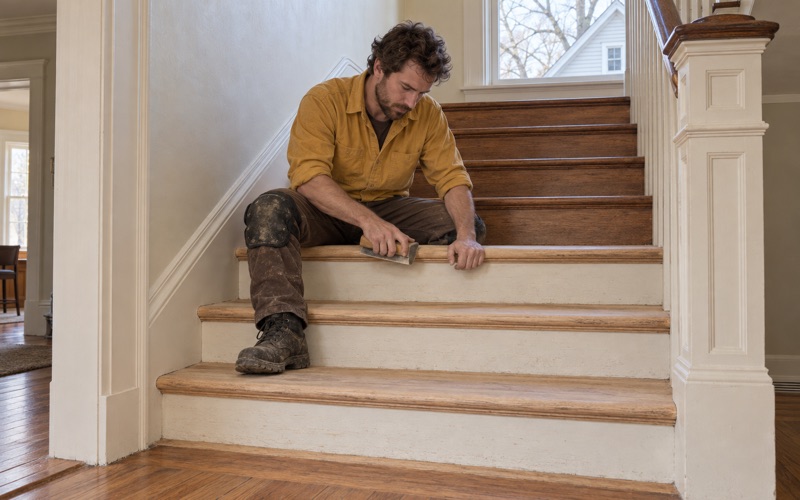
The shared staircase is its own job and we quote it tread by tread rather than by the square foot. Treads, risers and nosings each take different work, none of it can be run with a floor machine, and a staircase priced by area is a staircase somebody ends up arguing about later.
Where a floor came out of a burst pipe, an overflowing appliance or a wet lower level, we trace the source, dry it, confirm it with a moisture meter and document the damage room by room for the adjuster before a board is replaced. For owners renting the unit out, the estimate goes out itemized and in writing, which is what Massachusetts requires before a tenant can be charged for damage to a floor.
All of it comes down to the same thing: an old Somerville floor is usually worth keeping, and keeping it is a matter of measuring first and sanding second. We would rather tell you a room needs twelve replacement boards and a recoat than sell you a floor you already own.
- 20+ Years On Wood Floors
- Written Itemized Estimates
- Stain Samples On Your Own Floor