Waltham Wood Flooring has been doing wood flooring in Stoneham for more than twenty years, and most of the work here starts the same way. A homeowner is standing in a room that has been walked on for decades, trying to decide whether the floor under the finish is still worth saving.
We sand, refinish, repair and replace solid and engineered floors, and we would rather tell you a floor has another life left in it than sell you a new one. That decision is almost always a private one: paid for out of a household’s own money, planned around the household’s own calendar, and then lived with for the next fifteen or twenty years.
So this page is about judgment rather than sales copy. It covers how to tell whether an old floor has another refinish in it, what an honest inspection actually looks at, how to read two estimates that describe different work, and when repairing part of a floor beats redoing all of it.
Floor work here is a private decision, made once
When people ask whether the town is involved in a floor job, we can give a specific answer rather than a vague one. At the Annual Town Meeting held on May 2, 2022, Stoneham created the Stoneham Municipal Affordable Housing Trust under M.G.L. chapter 44, section 55C. Its stated purpose is to provide for the preservation and creation of affordable housing in the Town of Stoneham for the benefit of low and moderate income households, and for the funding of community housing.
That is where the town’s housing instrument points: at preserving and creating affordable housing, run by six trustees, two of them co-chairs, out of 35 Central Street. It is a supply instrument rather than a repair desk for people who already own their houses.
What Stoneham’s public pages do not show is a home repair or rehabilitation loan for existing homeowners. The same search on the same day turned up municipal rehabilitation or home improvement programs on the pages of Woburn, Medford, Malden, Everett and Cambridge, so the method finds one where it exists. That is a finding about what we were able to read, not a statement from the town, and anyone who wants a definitive answer should ask the town directly.
What that means for how you plan the work
Practically, it means a Stoneham floor job gets scoped once and paid for once. No third party is setting the scope, publishing a schedule of eligible items, or handing you a contractor list, which is freeing and also means nobody else is checking the estimate on your behalf.
It also makes sequencing your decision to get right. If a kitchen is coming out next spring or a wall is moving, the floor work should either wait or be staged, because one continuous sanding pass across connected rooms is far easier to live with than two passes separated by a year of construction.
Why the age of the stock is the real constraint
Roughly 70.3 percent of Stoneham’s 10,196 housing units were built before 1980, so most of the floors we look at here are not new floors coming in for their first service. They are floors somebody has already sanded once or twice, and what is left above the tongue and groove is the budget you are actually spending.
And 73.2 percent of the town’s 6,923 owner households, 5,065 of them, live in a detached house, which is where whole-floor-plan work tends to happen. In an owner-occupied two- or three-family we work one floor at a time so the household on the other floor keeps living in the house; in a detached house the only calendar we are working around is yours.
Looking for wood-flooring closer to Melrose? See Wood-Flooring in Melrose.
Does this floor have another refinish left in it?
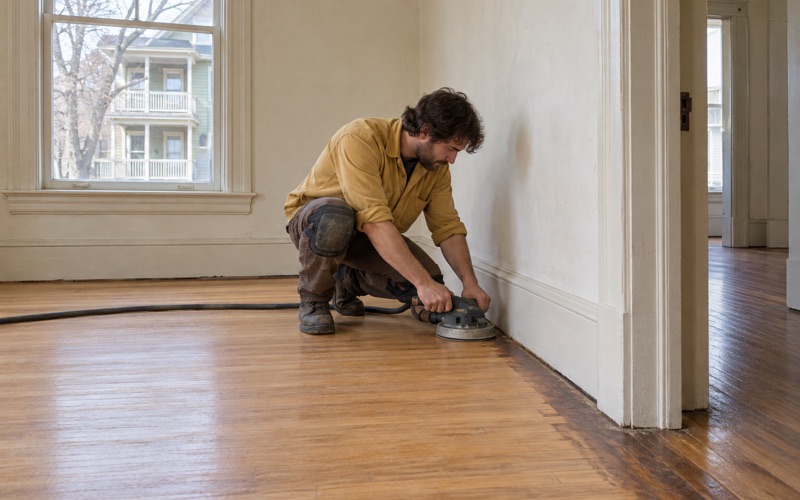
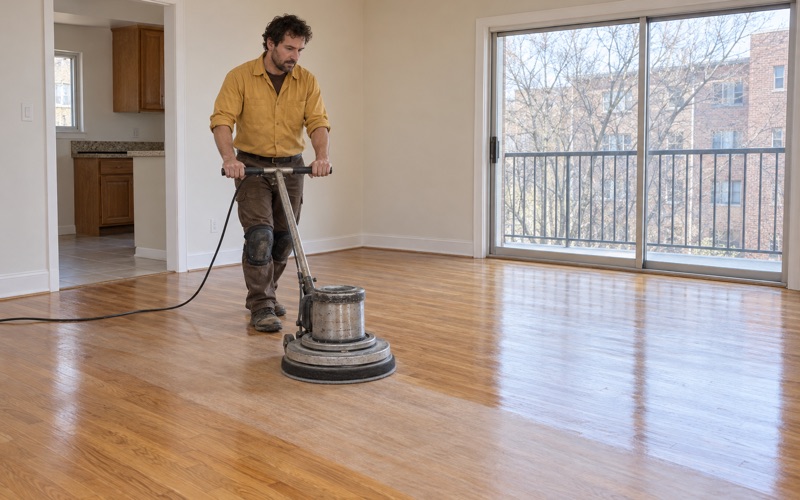
Solid hardwood is a consumable in one specific way: every sanding takes wear layer off, and the usable material above the tongue and groove is finite. On postwar red oak strip flooring there is often more left than people assume, but we measure it rather than guess at it.
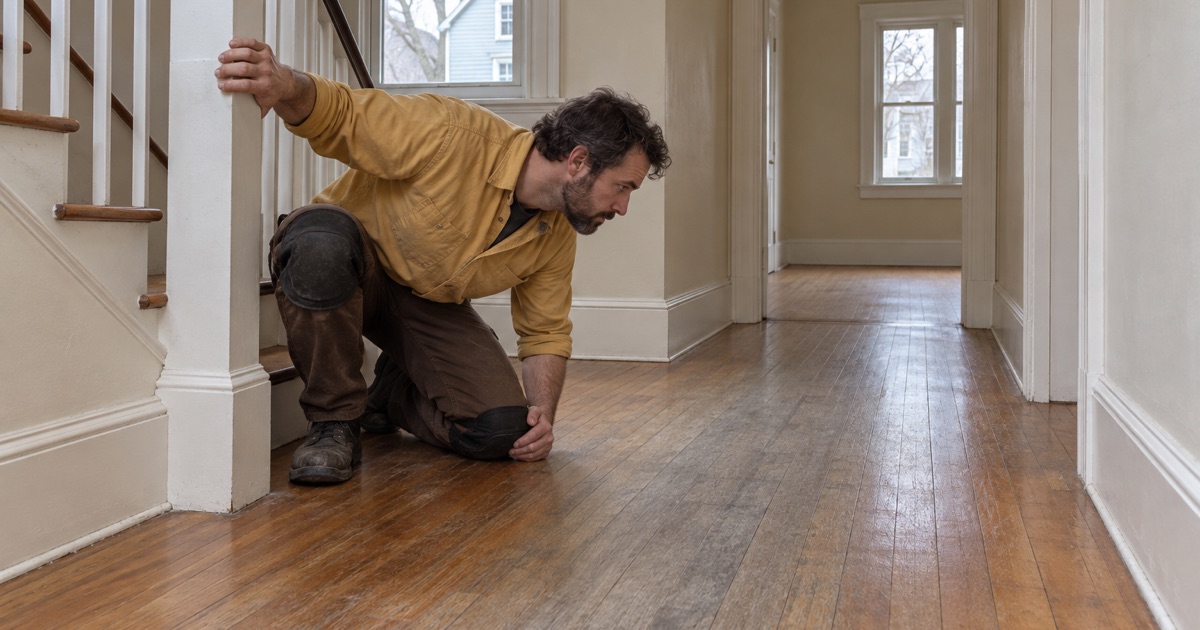
We check thickness at a vent, a threshold or a closet edge where the full section of the board is visible, look at how proud the flooring cleats or cut nails are sitting, and read the face of the board for how deep the wear actually goes. A floor that has been sanded twice and is now cupped from a moisture problem is a different conversation than a floor that is simply tired.
The conditions that decide it
Cupping, crowning and buckling are moisture answers, not sanding answers. Flattening them with a drum sander before the moisture source is fixed buys you a flat floor that moves again next season. Winter gaps that close back up in summer are ordinary seasonal board gapping in a dry-heated house and usually call for nothing at all.
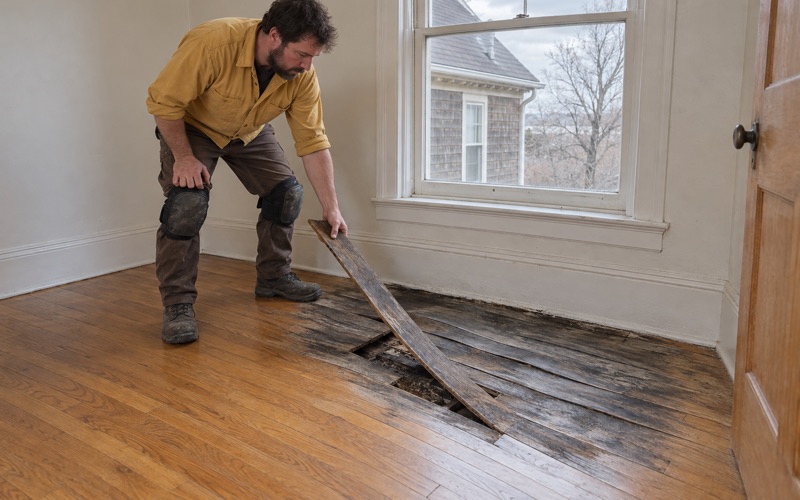
Pet urine stains, water stains, sun fade and rug shadow all behave differently under a sander. Fade and rug shadow generally come out; urine that has gone through the board and into the subfloor generally does not, and we would rather point at the four boards that need replacing than promise a uniform result we cannot deliver.
Insect damage gets its own look. Powderpost beetle and old house borer leave exit holes and frass, and the question is whether the damage is old and inert or currently active, which is what turns a refinishing job into board replacement.
When a screen and recoat is the right answer
Not every dull floor needs sanding. If the finish is worn thin but not worn through, a screen and recoat abrades the existing coating and puts fresh polyurethane over it, which leaves the wear layer intact for a real refinish later. We test for old wax and cleaning-product residue first and remove it, because a new finish laid over wax peels instead of bonding.
What an inspection covers, and how to get a price you can compare
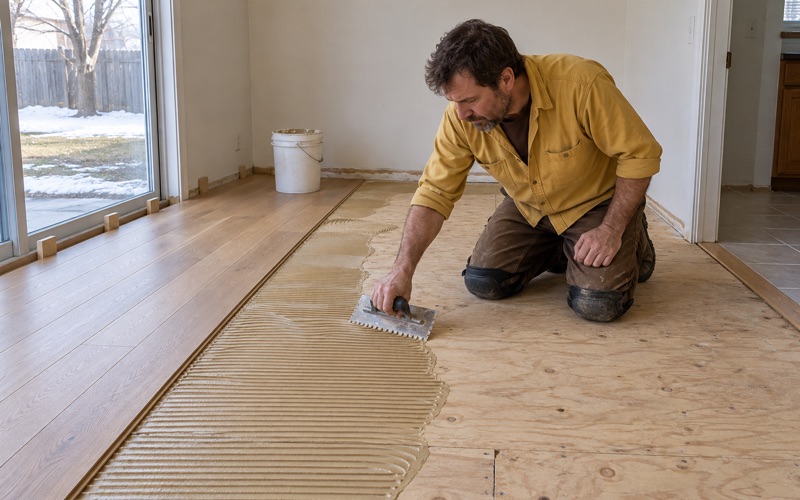
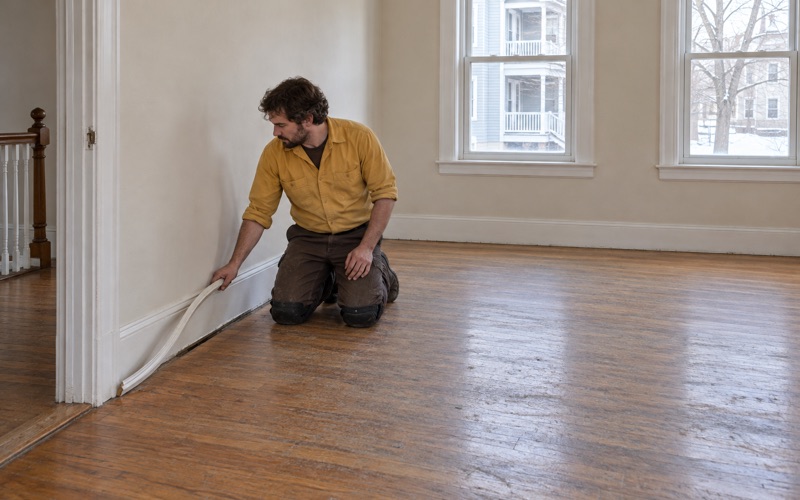
A walkthrough that takes ten minutes and produces a single square-foot number is not an inspection. Ours starts with a moisture meter, in the rooms under discussion and in any lower-level space, because a reading taken below grade is what decides whether solid hardwood or engineered wood belongs down there.
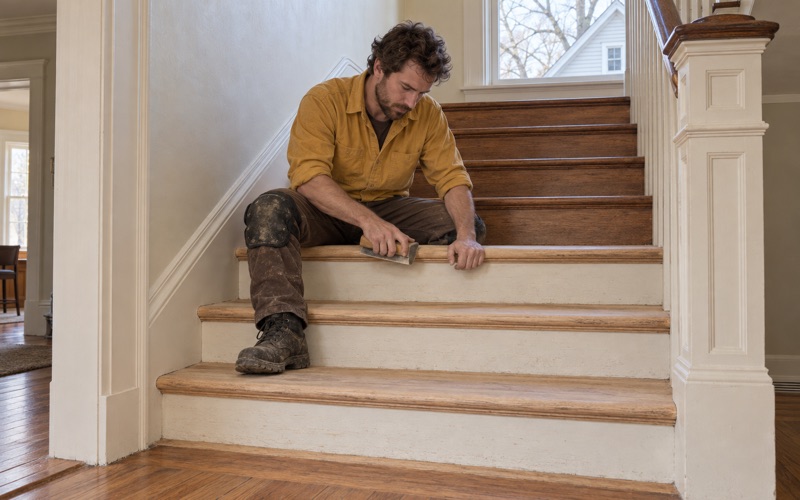
We look at the subfloor and joist direction wherever they are visible, at transitions, reducers and thresholds, at stair treads, risers and nosing, and at what is hiding under carpet. Tack strip holes around the perimeter, carpet pad residue and rosin paper often sit on top of an intact floor nobody in the house knew was there.
The things worth finding before, not during
Old resilient floor tile and the black mastic under it get identified and left alone. We do not disturb either one; work stops there until the right trade has handled it, which is a much better outcome than finding it in the middle of a demolition day.
We also check the build year and any painted surfaces before sanding, because Massachusetts runs its own lead-safe renovation rules for homes built before 1978. In a town where most of the stock predates 1980, that check applies more often than it does not.
Reading two estimates that describe different work
Two quotes that differ by a wide margin usually are not quoting the same job. Ask each one what grit sequence it runs, whether the sanding is dustless with a HEPA vacuum, whether stairs are quoted tread by tread rather than folded into a square-foot figure, and whether the finish is waterborne polyurethane, oil-modified polyurethane or hardwax oil, at what sheen level and in how many coats.
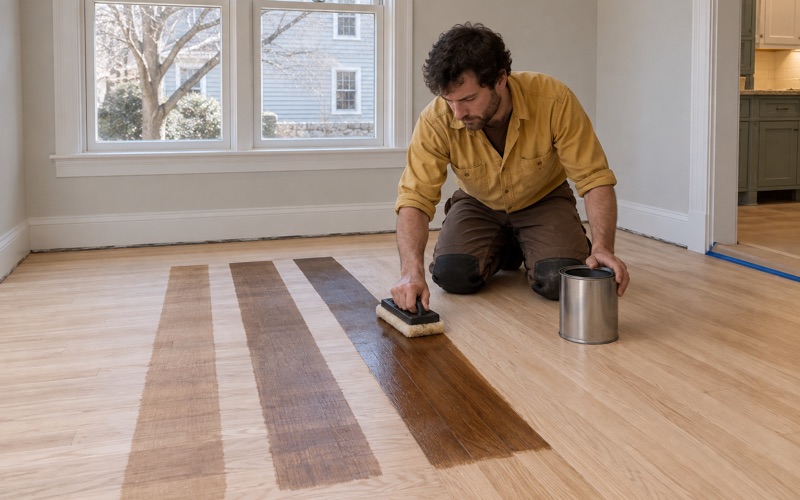
Then ask what is included beyond the open field: weave-in repairs, quarter round, thresholds, water popping before stain, and whether stain samples get laid on your own floor in your own light before a color is settled. Our estimates are itemized in writing, which is also what a landlord in this state needs on hand before a tenant can be charged for floor damage.
Finish choice carries a local constraint too. Massachusetts sets its own VOC limits for wood coatings that are stricter than the federal ones, so a product a crew used happily somewhere else is not automatically a product that belongs on your floor here.
Repairing part of a floor instead of redoing all of it
A whole-house refinish is sometimes the wrong purchase. If the damage sits in one room, one hallway or one traffic lane, a repair plus a targeted refinish gets you a floor you are happy with without spending wear layer in six rooms that did not need it.
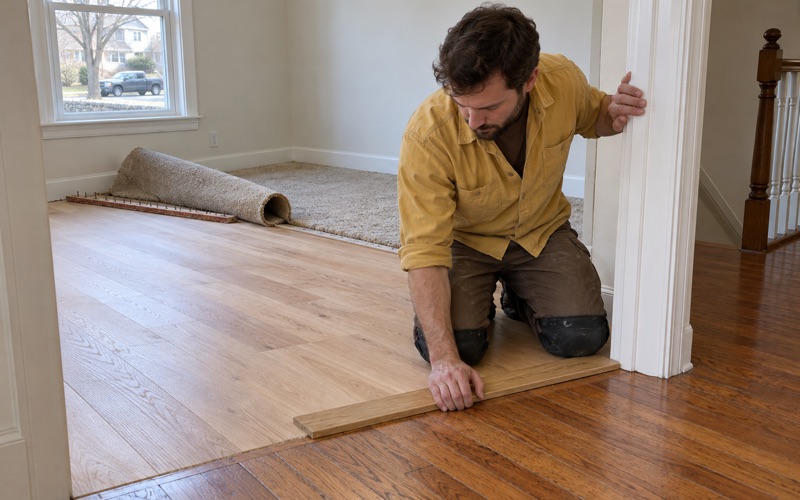
The catch is that partial work has to be planned around where the floor naturally breaks. A doorway, a threshold or a change in board direction gives a refinish somewhere to stop; the middle of an open run does not, and a stopped finish line in the wrong place stays visible for the life of the floor.
Patches that read as floor
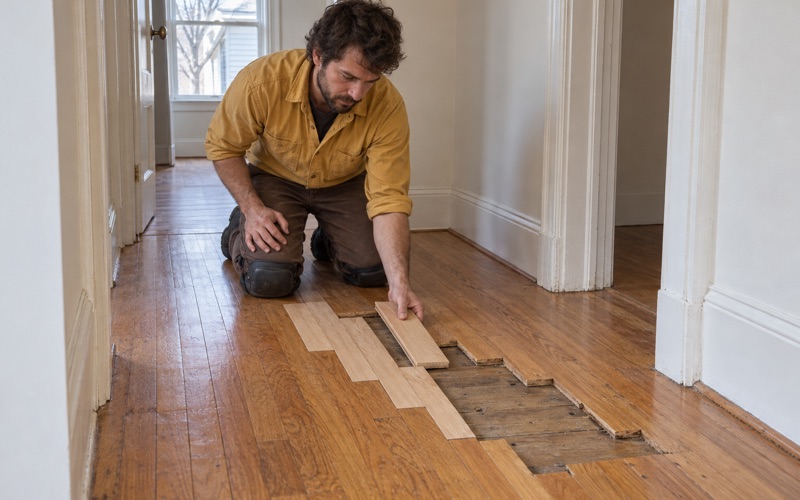
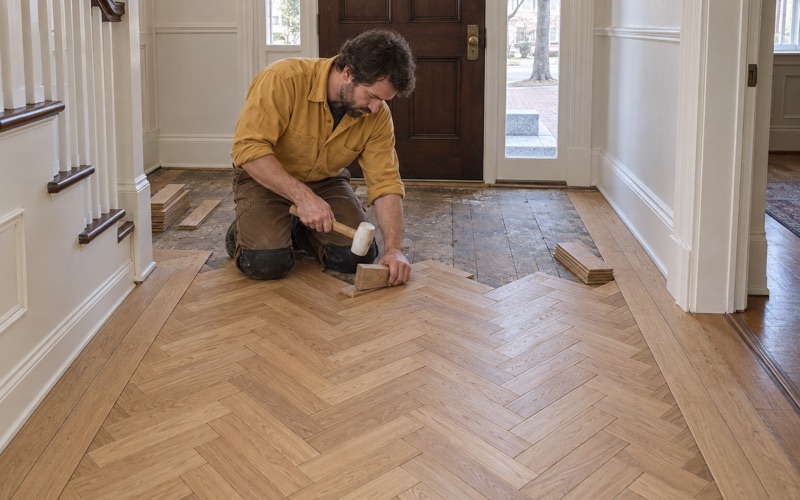
Holes left where steam radiators and their pipes came out get patched with matching boards woven into the floor rather than filled, so the repair reads as floor instead of as a plug. The same approach applies where a wall came down or an electrical outlet moved and left a scar across the boards.
Matching means species, grade and cut, not color alone. Red oak, white oak, maple and eastern white pine all take stain differently, and rift and quartersawn boards will never disappear into a plainsawn floor no matter how carefully the color is mixed.
Water damage and the record of it
Water from a burst pipe, an overflowing appliance or a wet lower level gets traced back to its source, dried, and read with a moisture meter before a single board is replaced. Setting new boards into a subfloor that is still wet simply produces a second repair.
We document water-damaged floors room by room for an adjuster, with the readings and the extent written down. Where a claim goes is between you and your carrier, but the record should exist before the floor is opened up.
That is the whole of our approach in Stoneham: measure first, say plainly what the floor can and cannot do, and put a scope in writing you can hold up next to somebody else’s. If the honest answer is that your floor has another twenty years in it and needs a recoat rather than a sanding, that is the answer you will get from us.
- 20+ Years On Wood Floors
- Written Itemized Estimates
- Stain Samples On Your Own Floor