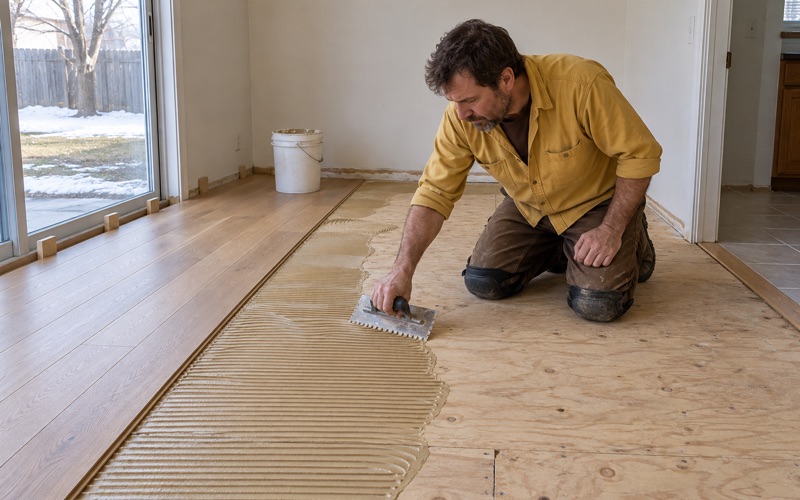
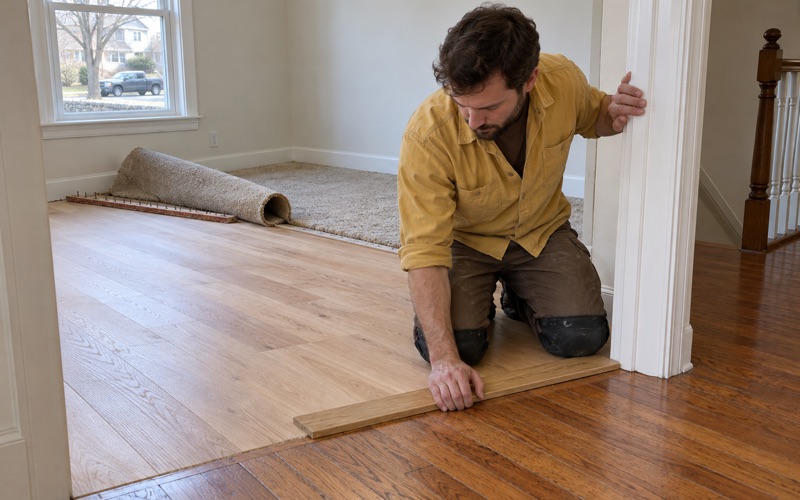
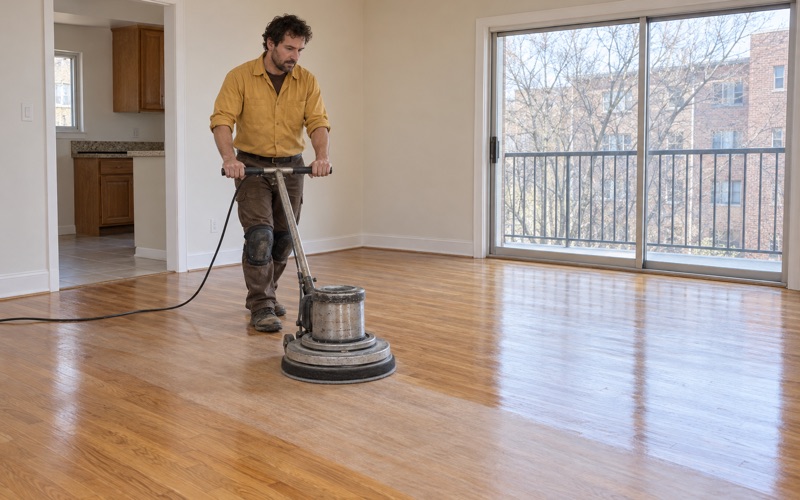
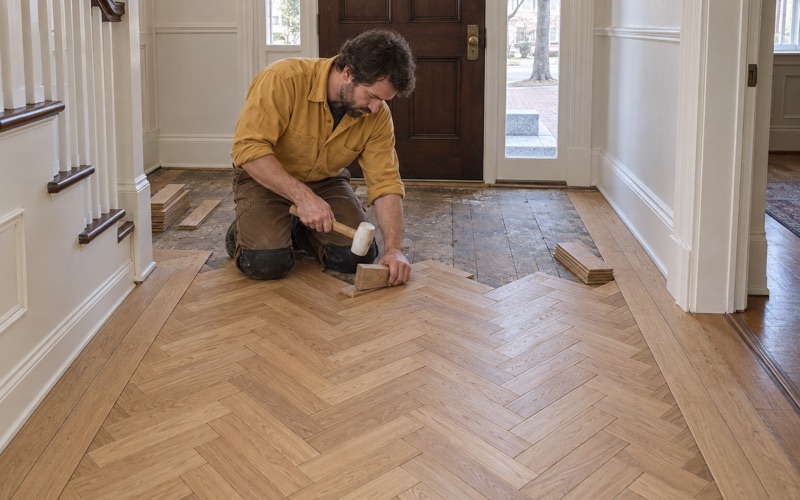
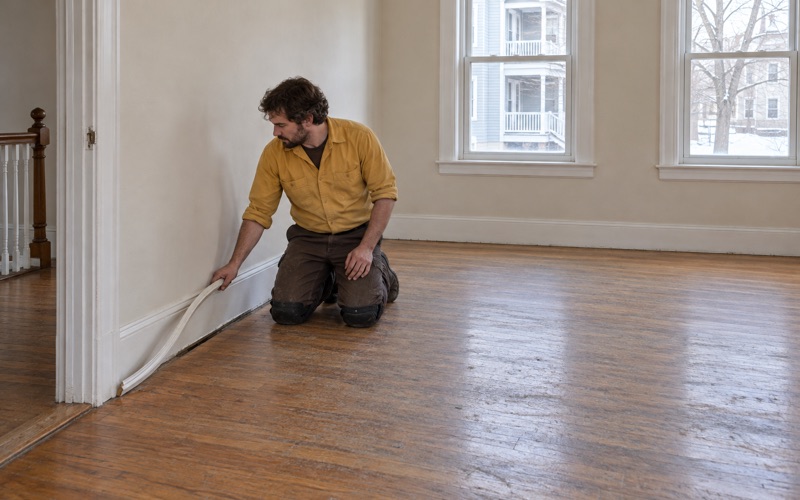
Waltham Wood Flooring installs, sands and refinishes wood flooring in Winthrop Town, and we have been doing that work for more than 20 years. Most of it is a floor that already exists: red oak strip flooring found under carpet and tack strip, a maple floor worn through along its traffic lanes, boards cut away where a steam radiator and its pipes came out. The question is rarely what to buy. It is what the floor already on the joists can still give back.
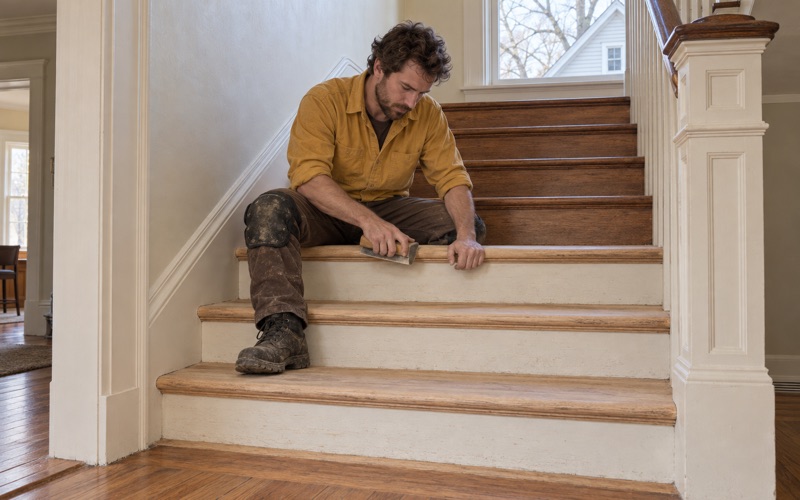
We work the way the building lets us. A floor gets a moisture meter reading before a board is replaced, the build year and any painted surfaces get checked before a drum sander touches anything, and a staircase is quoted tread by tread rather than by the square foot. Where a floor is sound but tired, a screen and recoat is the honest answer and we say so.
A good share of our work here is in units somebody other than the owner lives in, because that is where a floor has a deadline attached to it. Winthrop registers and inspects those units on a fixed cycle, and floor work is cheaper and calmer done ahead of that than after it.
Wood Floors in a Winthrop Rental Unit
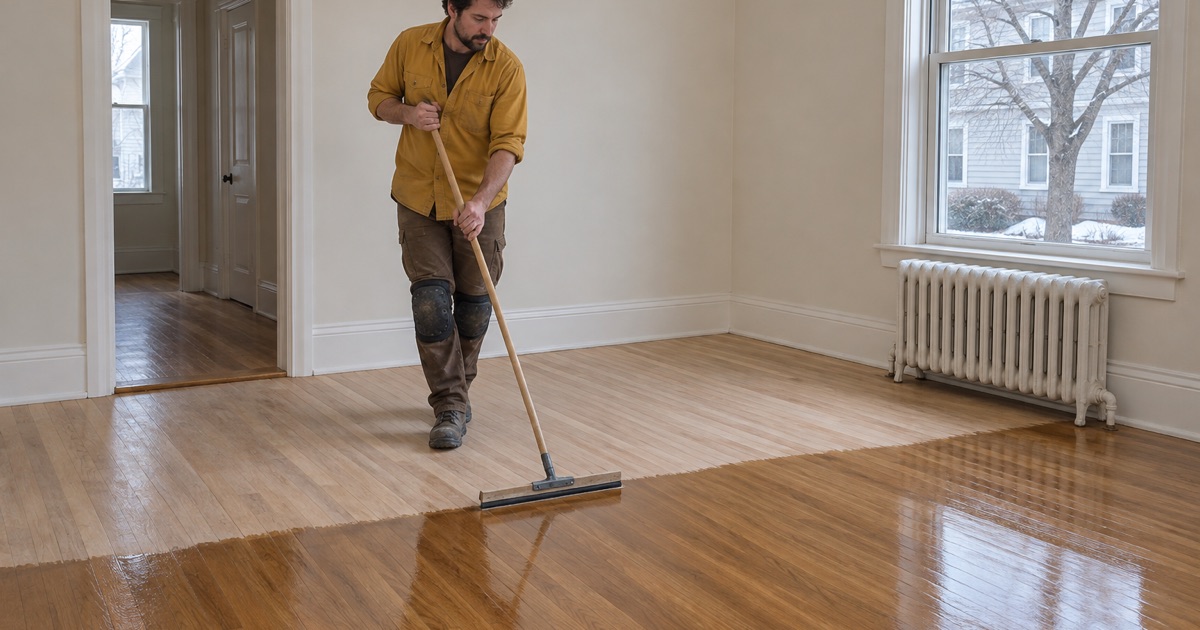
Winthrop’s rented floors are old floors. Of the town’s 8,361 housing units, 55.1 percent were built in 1939 or earlier and 86.8 percent before 1980, so the board under a tenant’s rug is usually red oak strip flooring or eastern white pine over a plank subfloor, fastened with cut nails. Those floors have almost always been finished more than once, and the previous finish is rarely the one anyone remembers.
That history is why we check before we sand rather than after. A thickness read at a floor vent or a threshold, a moisture meter reading in two or three rooms, and a test of what the last coat actually was — shellac finish, old wax residue, an oil-modified polyurethane laid over both — tell us whether a floor has another full sanding left in it.
Two-unit houses, and the units the rules leave alone
Two-unit buildings account for 2,088 of Winthrop’s 8,361 units, and many of them are the owner-upstairs arrangement the town’s rental ordinance treats differently. Chapter 8.40 exempts units in dwellings containing three or fewer rental units where one of those units is occupied by the owner. An owner living in half of a two-family sits in a different position from the same owner who moves out and lets both floors.
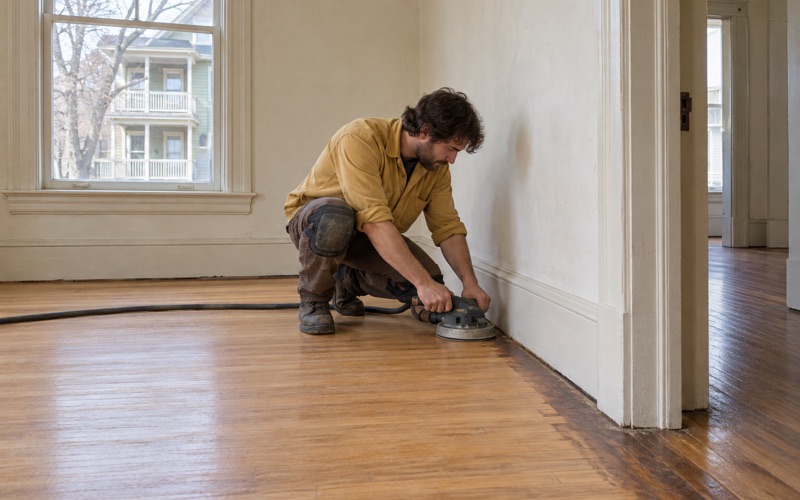
We work those owner-occupied two- and three-families one floor at a time. Sanding and coating the downstairs while the household upstairs keeps living in the house is a sequencing problem more than a technical one, solved by ordering the rooms, containing dust with dustless sanding and a HEPA vacuum, and agreeing which stair flight stays walkable on which day.
What a tenancy does to a floor
Rented floors wear in patterns we can read on the first walk: traffic lanes down a hallway, rug shadow where a rug sat through years of sun fade, pet urine stains that went through the finish and into the grain, water stains at a radiator or a lower-level doorway. Not all of those are sanding problems.
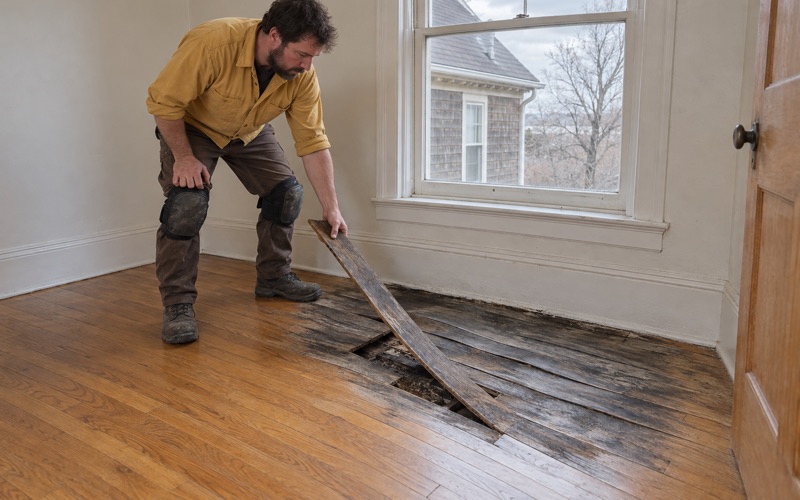
Pet urine that has reached the wood is a board replacement, and cupping that is still moving is a moisture question before it is a sanding question. We separate those from ordinary wear at the estimate rather than after the drum sander has already been through the room.
Looking for wood-flooring closer to Belmont? See Wood-Flooring in Belmont.
What Winthrop’s Four-Year Cycle Means for a Floor
Winthrop runs rental registration and inspection under Ordinance Chapter 8.40, ordained in support of the Board of Health’s authority under G.L. c.111, §127A and §127B. An owner offering a rental unit first registers with the Board to obtain a Certificate of Registration, and all non-exempt rental units must be inspected at least once every four years. Registration and inspection cost $75.00 per rental unit, with no fee for one re-inspection in a 24-month period except on a property the town has designated a Problem Property.
Four years is a long interval, and that is the part worth planning around. This is not an inspection tied to a new tenant arriving; the cycle comes back whether the unit has turned over five times in between or not at all. A floor that is marginal today will be four years more marginal by the time it comes around again.
A certificate that does not travel with the building
The Certificate of Registration states that the unit complied at the time of inspection, and it is not transferable to subsequent owners. For anyone buying or selling a two- or three-family here, that is worth knowing early: the paperwork a seller holds does not come with the deed.
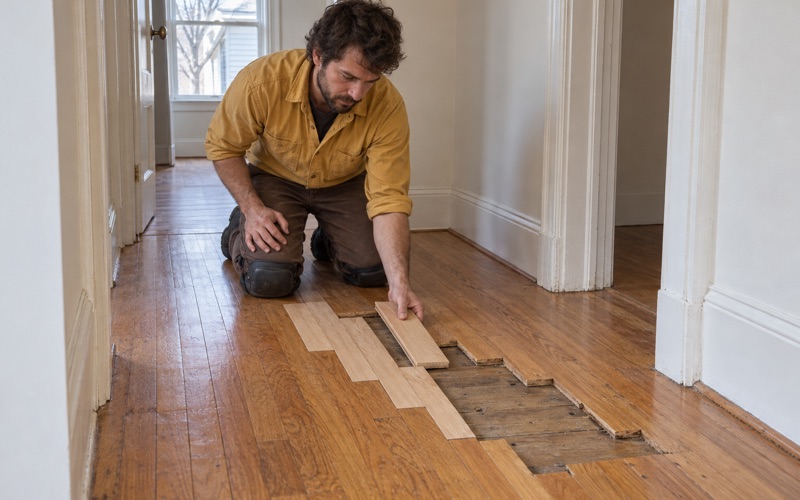
We get asked to look at floors during that window more often than at any other time, usually with a short calendar and a list of rooms. A weave-in repair and a resand fit in that window comfortably. A floor that needs boards sourced and matched does not always.
When a violation is cited
The consequence written into the ordinance is blunt. Where an inspector observes State Sanitary Code violations, the certificate is denied, a written order cites each violation, and no Certificate of Registration issues — and the unit may not be occupied in any manner — until each cited violation is corrected.
That turns a repair into an occupancy problem, which is a far more expensive kind of problem. The same weave-in repair or board replacement, done in an empty unit in a quiet month, costs what it costs; done against a written order, it costs that plus the time the unit cannot be lived in.
The Standard a Winthrop Floor Is Measured Against
The ordinance itself names no floor and no flooring item. What it applies is the State Sanitary Code — Chapter II, 105 CMR 410.000, the minimum standards of fitness for human habitation — and the section that reaches a wood floor is 410.500, the owner’s responsibility to maintain building and structural elements.
As amended effective May 12, 2023, that section asks that buildings and structural elements be maintained in compliance with accepted standards, in good repair and in every way fit for their intended use, including free from holes, cracks, loose plaster, or defects that render the area difficult to keep clean, create an injury risk, or provide an entry or harborage for pests. Read against a wood floor, that is language about holes and hazards rather than about sheen level.
Wear is not the same category as a defect
An orange oak tone from a 1960s refinish, a faded line under a window, winter gaps that open in January and close again in June — that is a floor showing its age. A loose stair nosing, a board buckled up out of plane, a splintered gap wide enough to catch a bare foot, or cupping severe enough that the board edges stand proud belong to a different category.
We write the two apart when we estimate, because they carry different budgets and different urgency. An owner deciding what to do before a busy season deserves to see which line items are cosmetic and which are not.
A leak has 48 hours
105 CMR 410.500(B) puts a clock on water: in the event of leaks and flooding, the owner ensures all surfaces have been dried within 48 hours from the time of notification or the end of the event, whichever is sooner. A wood floor is the surface that makes that hard, because the face dries first while the subfloor and the joist bays underneath do not.
When a pipe lets go or an appliance overflows in a unit we are called to, we trace where the water actually traveled and read it with a moisture meter before a single board comes up. Cupping over a subfloor that is still wet will come back after a sand, so we dry first and document the rooms as we go, which also gives an adjuster something to work from.
Planning Floor Work Around a Winthrop Registration Inspection
The practical shape of this work is a vacant unit, a fixed number of days and an owner who wants the floors finished before the next thing happens. We quote in that form: rooms listed separately, stairs priced tread by tread, repairs kept off the resand line, and a finish chosen to fit the Massachusetts VOC limits for wood coatings, which are stricter than the federal ones and affect how soon a coat can be recoated.
Two checks happen before the sander runs. We check the build year and any painted surfaces, because Massachusetts runs its own lead-safe renovation rules for homes built before 1978 and most of Winthrop’s stock is older than that. We also identify old resilient floor tile and the black mastic under it rather than disturbing it, and stop until the right trade has handled it.
A condominium unit somebody else lives in
Chapter 8.40 defines a rental unit more broadly than a lease does. It covers a space occupied or intended for occupancy by a person other than the owner of the unit, regardless of whether compensation is received, and names a non-owner-occupied condominium unit specifically; its definition of owner reaches an officer or trustee of the association of unit owners.
Floor work in a condominium carries constraints that have nothing to do with the town. Access, elevator and stair use, and the hours a finish can go down in a shared building all belong to the association, so we ask for those rules before we schedule the sanding, staining and coating days rather than on the morning of the first one.
Paperwork an owner can use afterward
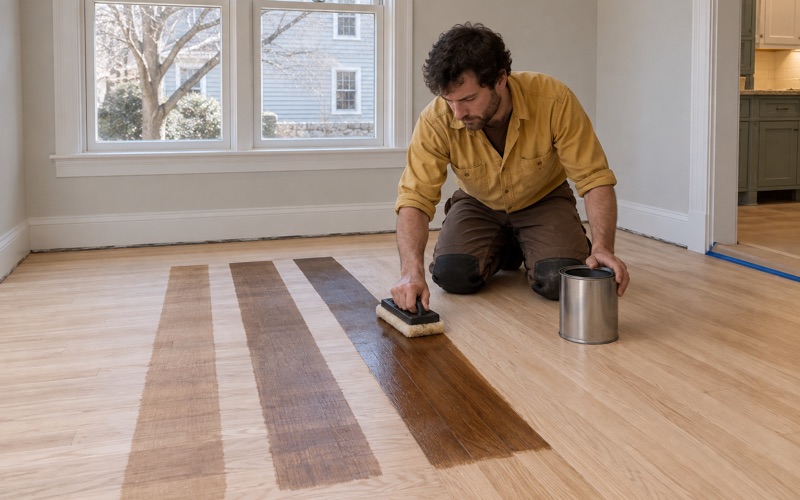
We give owners an itemized written estimate — each room, each repair and each stair flight on its own line — because floor damage that has to be justified later needs to have been written down before the work, not reconstructed from memory after it. Stain samples get laid on the actual floor, in the unit’s own light, before a color is chosen.
Where a property has been designated a Problem Property and owes the town an annual management plan that identifies deficiencies, a timeline for completing the work and the contractors hired to do it, that itemized estimate is the document that answers the flooring part of it. It is the same paper either way; we would rather write it early.
Starting before the clock does
Twenty years in older Massachusetts housing has taught us the unglamorous part of this trade: the floor is usually better than the owner fears, and the schedule is the real constraint. A floor sanded in an empty unit in February is a different job from the same floor sanded under an order.
We are glad to walk a Winthrop unit, read what is left in the boards, and say plainly whether it is a screen and recoat, a resand, a handful of weave-in repairs, or a floor that has given what it has to give. Most of them come back, and the ones that will not usually say so within the first few feet of the first cut.
- 20+ Years On Wood Floors
- Written Itemized Estimates
- Stain Samples On Your Own Floor