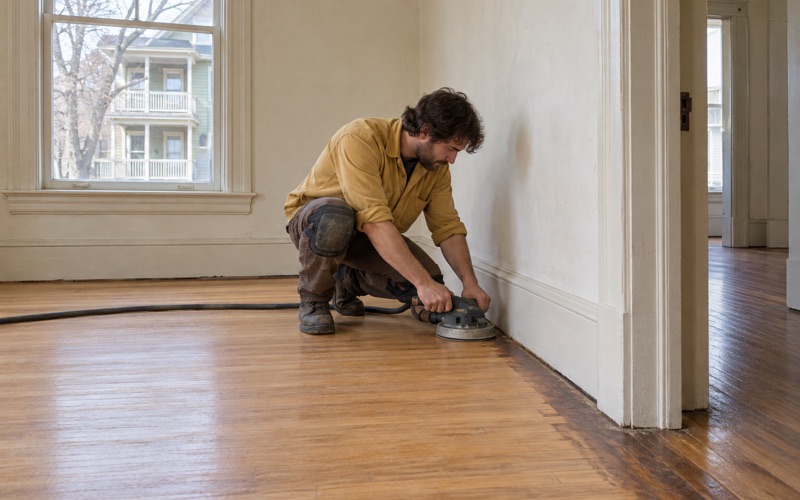
Waltham Wood Flooring has been doing wood flooring in Woburn and the towns around it for more than twenty years, and in this city the job usually starts below the surface. In the one- to four-unit houses closest to the square, a floor that dips, springs or opens at the seams is reporting on something underneath it. We work out which of those it is before anyone chooses a finish.
That makes sanding and refinishing the last step of a job here more often than it is the whole of it. We measure moisture, look at how the movement is distributed across a room, and pull a board where the picture from above is not clear enough to act on. A floor refinished over a problem in the framing looks right for a season and then tells on itself.
What follows is how we handle that sequence in Woburn in particular. It covers the buildings themselves, the way the city’s own repair program treats floor work, and what changes when the unit with the bad floor is rented rather than lived in by the owner.
Wood floors in Woburn’s one- to four-unit houses near the square
Woburn is a Middlesex County city of 40,876 people at the 2020 census, sitting about nine miles north of Boston, and its housing stock is old enough that most of our work here is repair before it is refinishing. Census figures for the city count 2,212 two-unit structures and another 1,077 with three or four units. Those buildings are where a floor problem is most likely to be shared between two households.
The same figures put 3,181 of Woburn’s 17,045 housing units at 1939 or earlier, 18.7 percent of them, with 62.5 percent built before 1980. Age on its own is not a defect. It does mean the floor you are standing on has already been repaired, covered, uncovered and refastened by somebody, and that history is the first thing we read.
What is usually under the finish here
In houses of that era we expect red oak strip flooring over a board subfloor, often with rosin paper between the two and cut nails or early flooring cleats holding the strips down. In the oldest of them the finished floor may be eastern white pine laid wide, which sands to a much softer surface and takes a stain differently than oak does.
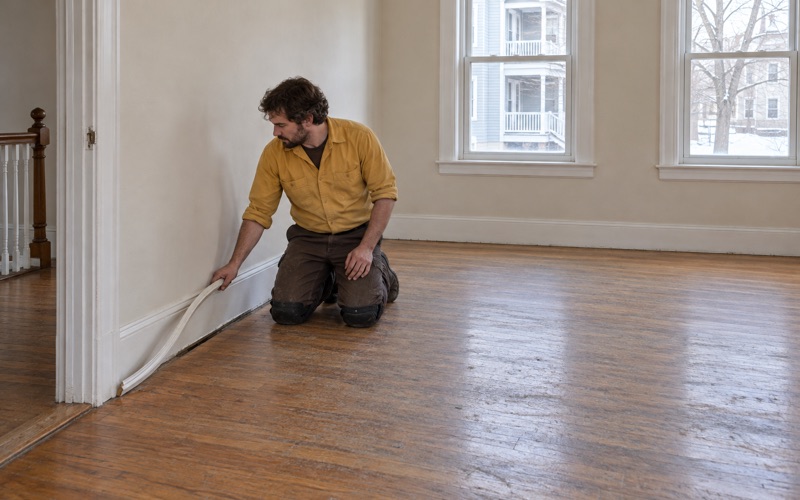
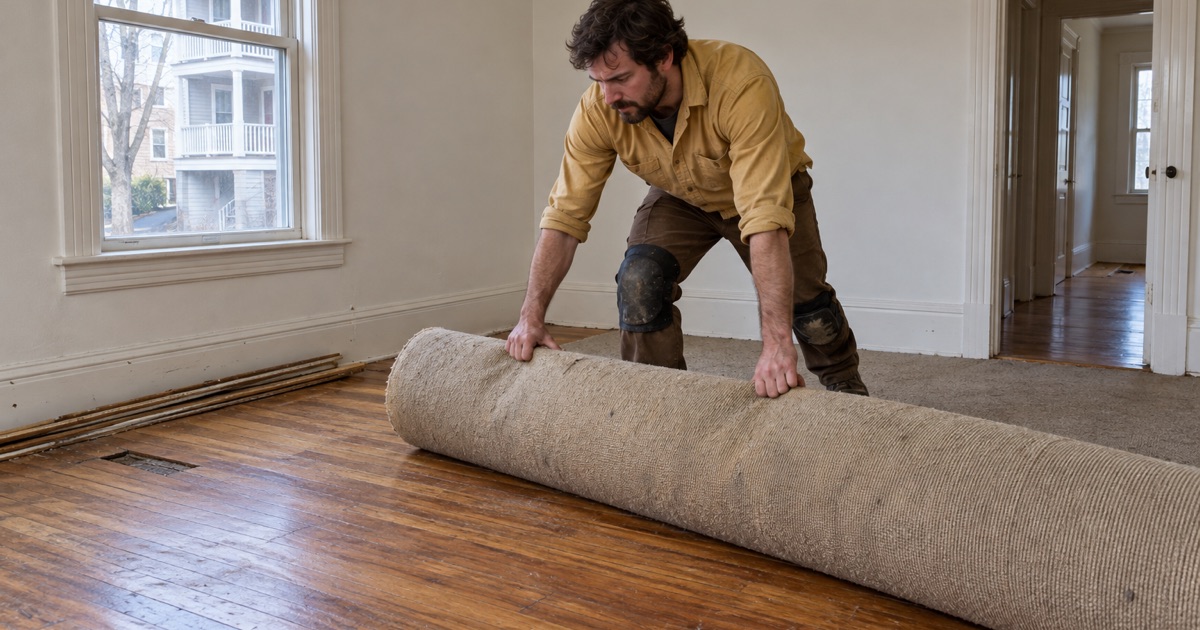
Above the wood there is usually a history of coatings. Wax residue and an old shellac finish both stop a modern coating from bonding, so we test for them and remove them rather than sanding through and hoping. Where a carpet has come up, the tack strip holes and the rug shadow tell us where the traffic lanes ran and how much of the wear is only surface deep.
The city’s own repair list puts floors on it
The Woburn Redevelopment Authority administers the Woburn Housing Rehabilitation Program, whose stated primary purpose is “to correct code violations and substandard living conditions, including the abatement of the health hazards of lead paint and asbestos.” Its repair chart names “Interior Walls, Ceilings, or Floors” as one of the categories an owner can ask for help with, beside foundation or structural repairs, plumbing, roof repairs and accessibility. Floors sit on that list next to structure rather than next to painting, and in these buildings that ordering is usually the honest one.
Eligibility is written narrowly. The program covers one- to four-unit owner-occupied and investor-owned residential properties located in a mapped Community Development Target Area running out of Woburn Square along Main Street, and properties elsewhere in the city are eligible for emergency assistance only. We are describing someone else’s program here, not administering it or speaking for it.
One caution belongs with all of that. The documents describing the program are the FY2008 grant round, with a lottery held in City Council Chambers on September 10, 2009, and we could not establish whether a current round exists. Anyone interested in that side of the work should ask the Redevelopment Authority directly rather than take a date from us.
Looking for wood-flooring closer to Roxbury? See Wood-Flooring Services in Roxbury.
When the floor problem is the structure under it
A springy patch of floor, a door that has started to catch, and a run of boards gone hollow underfoot are all floor symptoms with causes below the floor. In a two- or three-family that has carried a century of loading, the cause is often a joist notched for a pipe or a bearing point that has moved. Refinishing over that buys a smooth surface with the same defect still under it.
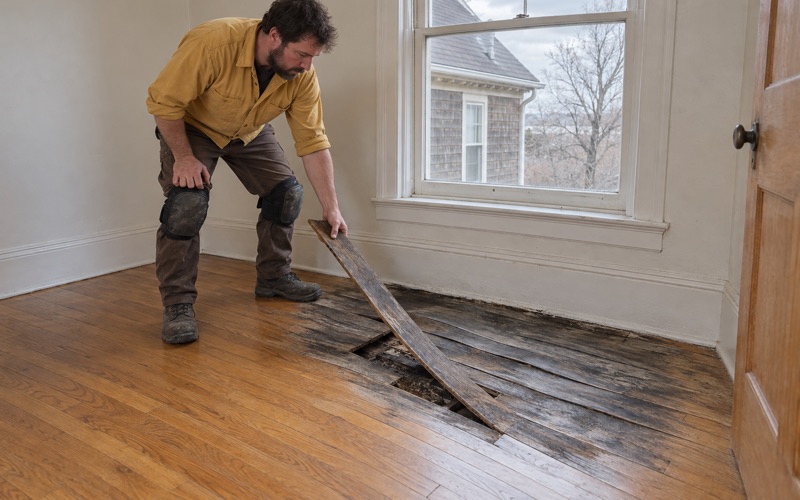
So the first visit is diagnostic. We put a moisture meter on the boards and on the framing wherever we can reach it, read how the movement is distributed, and take up a board in the worst area when the view from above is not enough to act on.
Reading the movement before choosing the repair
Cupping, where each board sits higher at its edges than at its center, points at moisture arriving from below. Crowning is the same story caught later, usually after a cupped floor was sanded flat while it was still wet. Board gapping that opens every heating season and closes again in summer is ordinary winter gaps behavior and is not a repair at all.
What is not seasonal is a gap that keeps widening, a section that has dropped relative to its neighbors, or buckling where boards have lifted off the subfloor entirely. Those get traced to a source before any material is ordered. We also look for exit holes and frass along the sills and the underside of the boards, because powderpost beetle and old house borer damage changes what the framing below can carry.
Boards, subfloor and joists, in that order
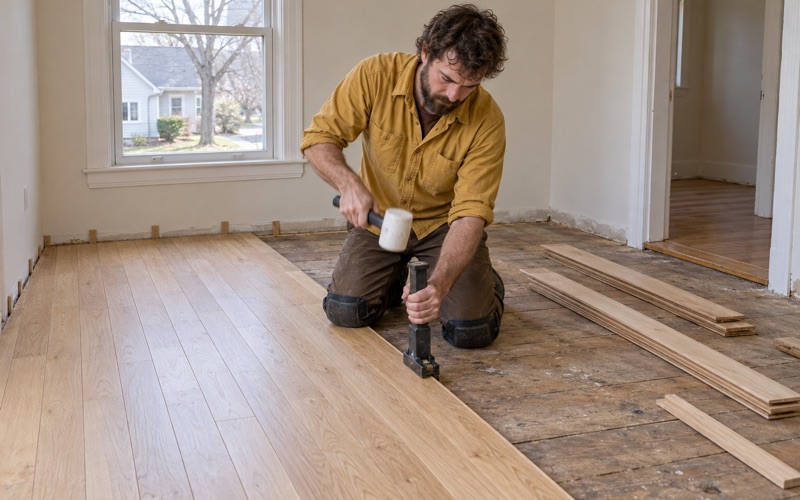
When there is real structural work to do, the sequence runs the opposite way from the order the problem was noticed in. The joists are addressed first, then the subfloor that spans them, then the finished boards everybody actually looks at. Working visible-first means paying for the same flooring twice.
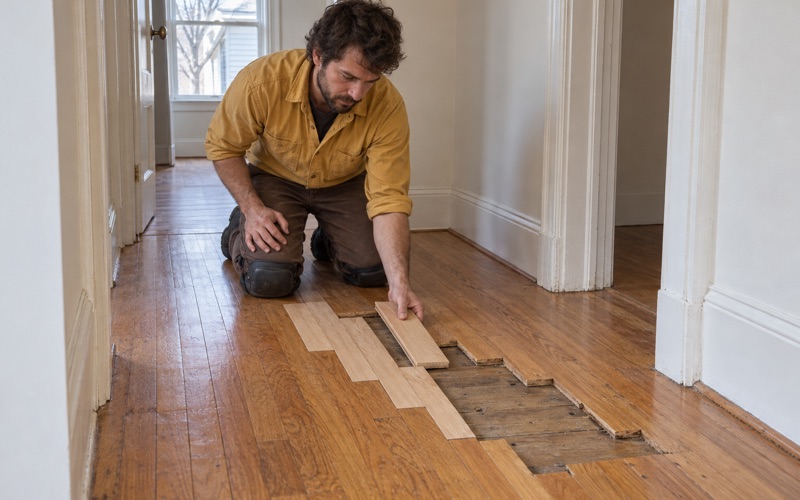
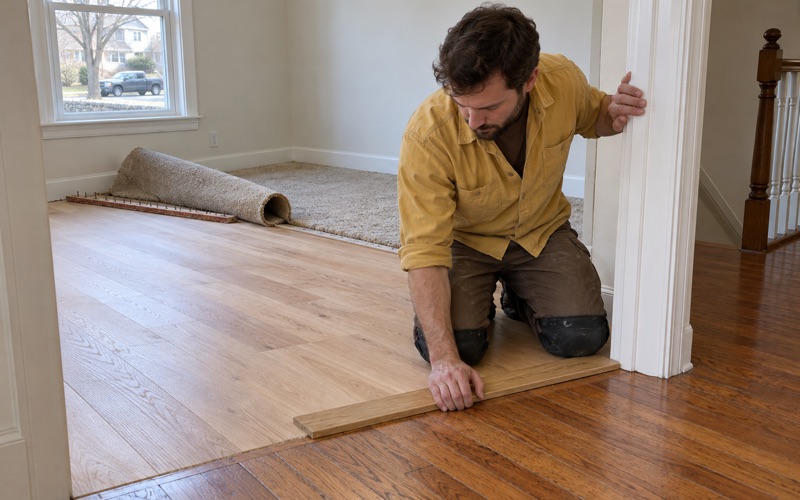
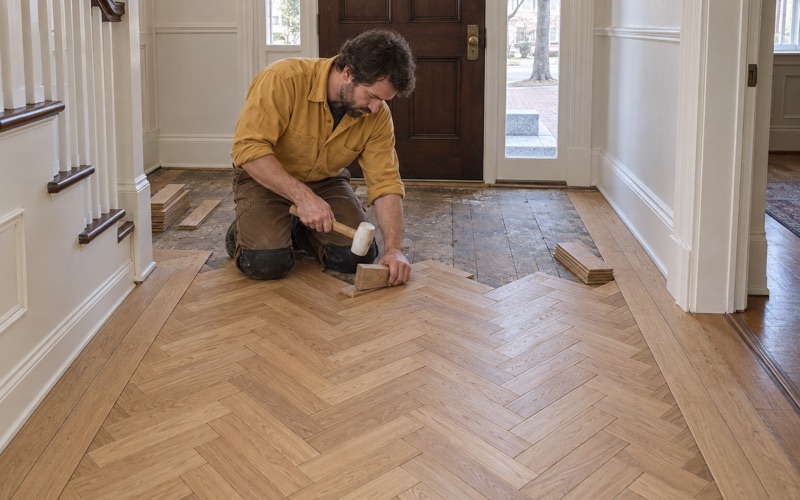
Once the deck underneath is right, the repairs above it are woven in rather than patched as a rectangle. Holes left where a steam radiator and its pipes came out get matching boards laced into the surrounding rows, and a floor opened up where a wall came down or an outlet was moved gets the same treatment, so the finished surface reads as floor instead of as a scar.
What a written floor specification has to say to be biddable
Under the rehabilitation program, work specifications are approved by the property owner and then put out to bid, and the contract goes to the lowest responsible bidder. That only produces a fair comparison when the scope is specific enough that two bidders are pricing the same job. Floor scopes are where that breaks down most often, because “refinish the floors” hides every decision that carries a cost.
We write estimates to that standard whether or not a job ever goes out to bid. The point of it is that the number on the page is attached to a described piece of work, which makes a second opinion on that number possible.
A scope two estimators can price the same way
A usable floor specification names the room, the species and the direction of the run, the count of boards coming out and whether each area is woven in or taken up wholesale, and the sanding plan down to the grit sequence and whether it is a full sand or a screen and recoat. It names the finish by type, because waterborne polyurethane, oil-modified polyurethane and hardwax oil differ in cure time, odor and sheen level, and it states the sheen rather than leaving it to the day of the job.
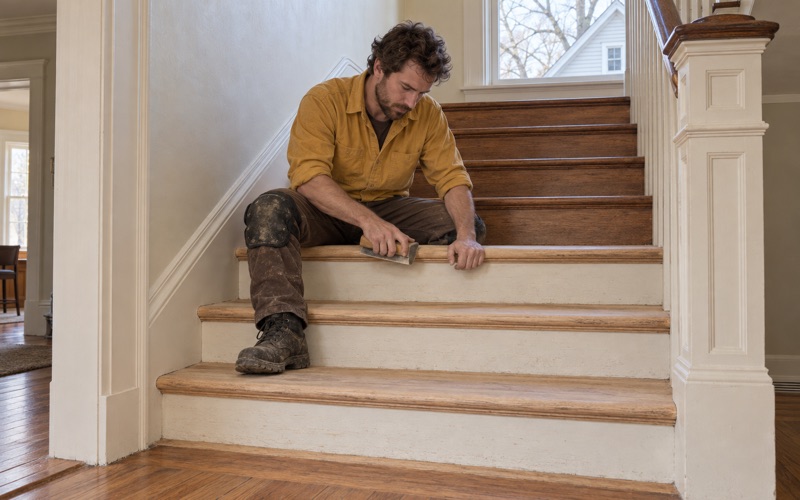
Stairs come out of the square-foot math entirely. We quote a staircase tread by tread, with risers and nosings counted separately, because a stair is a series of small joinery problems and pricing it by area makes the figure meaningless to everyone involved.
What the age of the building adds to the scope
Two rules in the program summary are worth knowing before a scope is written. A project costing more than $35,000 per unit needs both a local and a state waiver, and “if the property is older than 50 years, historic approval of the proposed work is required.” In a city where most of the housing predates 1980, that second line reaches a great many buildings.
Age changes our own sequence as well. We check the build year and any painted surfaces before a sander is switched on, because Massachusetts runs its own lead-safe renovation rules for housing built before 1978, and the rehabilitation program relocates residents for any lead hazard work. Where old resilient floor tile and the black mastic under it turn up beneath a carpet, we identify it, leave it undisturbed and stop until the right trade has handled it.
The finish side carries its own constraint. Massachusetts holds wood coatings to tighter limits on volatile organic compounds than the federal rules do, so the products written into a scope here are chosen against the state numbers.
Floor work in a rented unit and in the owner’s own unit
The program’s rules draw a hard line between those two situations, and the job itself draws the same one. An owner living in one unit of a three-family is scheduling around a single household, while an owner with tenants above and below is scheduling around leases, notice and the days a unit cannot be walked on.
What an investor owner signs up to
Under the rehabilitation program, an investor owner receiving a deferred payment loan must execute an Affordable Housing Restriction, filed with the South Middlesex Registry of Deeds, that runs with the land for fifteen years. Repaying the loan does not extinguish it, and neither does selling the building to somebody else.
That is a long obligation to attach to a floor job, and it reads better before the work is scoped than after. It is also an argument for settling the structural question first: a restriction that outlives the loan should be sitting over a floor that was actually fixed, not over a refinish that has to be opened up again in four years.
Estimates, tenants and living in the house
For landlords we itemize the written estimate room by room. Massachusetts requires an itemized written estimate before a tenant can be charged for damage to a floor, and an itemization reconstructed afterward from memory is worth very little to anybody.
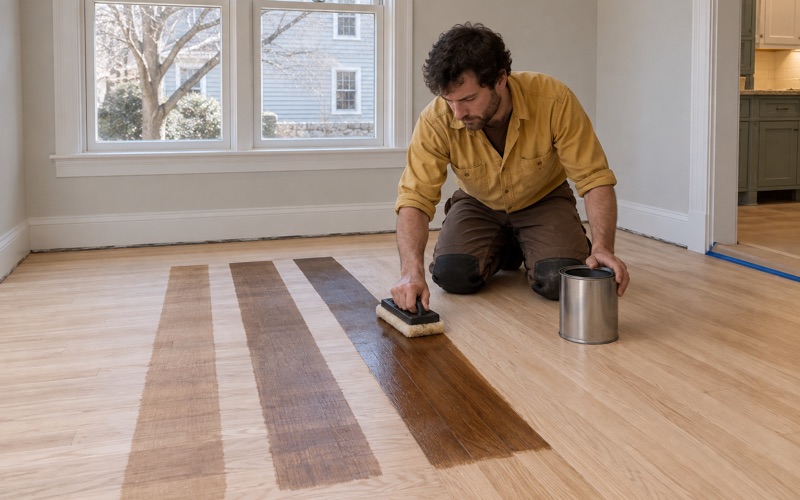
In an owner-occupied two- or three-family we work one floor at a time wherever the layout allows it, so the household on the other level keeps living in the house while the job runs. When the owner’s own unit is getting a new color, we lay stain samples on that floor in that room’s own light before anything is committed, because orange oak under a north window is not the color it was on the sample board.
- 20+ Years On Wood Floors
- Written Itemized Estimates
- Stain Samples On Your Own Floor